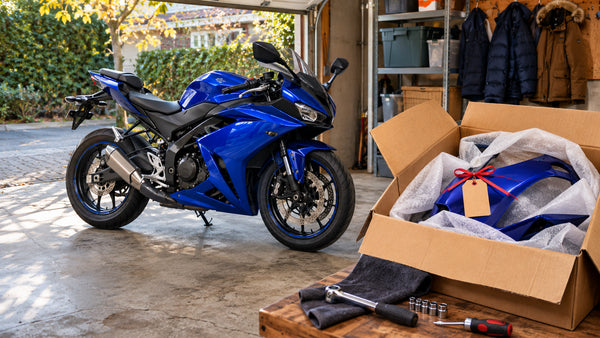

Cover: user-supplied illustration comparing a naked-style motorcycle and a fully faired sportbike. It is a design reference, not an official BMW M 1000 RS photograph or a NiceFairings installation.
If a naked motorcycle can have superbike power and winglets, why choose a fully faired sportbike? For some riders, the answer is practical: a particular riding position, weather exposure, intended use or simply the motorcycle they already own. For others, it is the shape. A full nose, connected side panels and a finished tail form a visual canvas that remains compelling even when aerodynamic appendages appear on other types of bike.
The BMW M 1000 RS makes that question interesting. BMW calls it a limited hyper-naked motorcycle based on the M 1000 R with the M Competition Package. The company describes an engine from the M 1000 RR, matte carbon M winglets and the rear end of the M 1000 RR. It plans 1,000 units worldwide and says dealer availability begins in March 2027. These are BMW's stated details, not an independent comparison or an aftermarket fitment guide.
The M 1000 RS is the starting point for a broader design discussion. It does not follow that a full-fairing kit for an S 1000 RR or any other motorcycle fits the M 1000 RS.
A naked bike can still use aerodynamic parts
Naked, partially faired and fully faired are useful descriptions of how much bodywork surrounds a motorcycle. They are not universal performance classes. A naked motorcycle can have carefully shaped panels, a small screen and functional winglets; a fully faired bike may use its bodywork for packaging, styling, wind management and other design goals together.
BMW says its M 1000 RS winglets combine a racing look with aerodynamic function. That is a claim about this engineered motorcycle and its specified components. It does not tell us the downforce of a decorative wing on another machine, nor establish that a rider will feel a particular effect on a public road. Wind speed, geometry, mounting and the complete motorcycle matter. A photograph is not an aerodynamic test.
This distinction protects a useful discussion: we can admire a race-inspired silhouette without pretending that an untested bodywork change produces a measured racing benefit.

What a full fairing gives the eye
A defined front face
A sportbike's nose brings the headlight openings, windscreen and upper bodywork into one shape. From the front, a small change to the width of a graphic or the contrast around a headlight can alter the motorcycle's expression. A pale nose with a dark center can emphasize a different feature from the same nose in one solid color.
A naked motorcycle may deliberately emphasize its headlight, handlebar and exposed mechanical components. Neither approach is inherently better. The point is that the same palette has a different amount of painted surface to work with.
A continuous side view
On a fully faired bike, the nose can flow into the side panel, lower fairing and tail. That continuity creates space for a long graphic, a broad color block or a mostly clean finish. It also creates responsibility: a stripe placed on the left side must interact with real seams, vents and neighboring parts.
A loose kit arranged on the floor is useful for counting visible pieces and inspecting the artwork, but it is not the same as seeing the panels in their fitted positions. Ask for a side reference appropriate to your motorcycle and discuss where the graphic is supposed to stop. Our seam and viewing-angle guide covers the detailed layout.
A tail that completes the story
The tail can be a quiet extension of the tank and seat, or the place where a graphic changes direction. BMW's use of the M 1000 RR rear end on the M 1000 RS illustrates how a design can draw from superbike imagery while belonging to a different motorcycle concept. It does not prove interchangeability beyond BMW's description of that model.
On your own sportbike, look at the tail, seat and retained tank before choosing a side-panel design. A large bright side graphic paired with an unrelated dark tail can be intentional, but an unplanned mismatch may make the bike feel unfinished.

Performance, appearance and comfort are separate questions
A fairing may influence the rider's exposure to wind, but the actual effect depends on the motorcycle, screen, rider and riding position. A fully faired shape is not a guarantee of comfort for every person. Equally, an upright naked bike is not automatically the best choice for every urban ride. Sit on a motorcycle and assess its ergonomics for your own use; do not infer comfort from a design image.
Winglets also deserve precise language. A manufacturer can describe a function for a tested component in a particular configuration. A supplier's painted replacement panel may be a visual bodywork product, and its image alone cannot verify downforce, race eligibility or road legality. If a part has a safety or structural role, consult the manufacturer and a qualified installer. Avoid changing or removing mounts based on an aesthetic assumption.
An owner choosing a replacement kit should begin with the correct motorcycle and the state of its existing supports. Bodywork does not repair a bent stay, replace a missing lamp or make an incompatible model fit. For an existing winglet design question, our ZX-10R color guide focuses on how colors interact with that motorcycle's projecting shapes, not on converting a different motorcycle.
Three ways to treat the full-fairing silhouette
Let the shape lead
A restrained solid or two-tone design lets the nose, side vents and tail establish the identity. Use a dominant color with a contrasting lower section, or keep the finish consistent and limit graphics. This can make an older motorcycle look coherent without pretending it is a current factory race bike.
The challenge is color continuity. If the original tank remains, identify its color and finish early. A black frame, exposed engine and exhaust will still be part of the final composition. Include those retained pieces in the reference, rather than approving only a set of detached panels.
Build a line from front to rear
A single line can link the nose, side panel and tail. It need not cross every part. Sometimes a clean stop at a seam is more successful than forcing a graphic across a tight curve. On an asymmetric body, the two sides might require different line lengths to achieve a related visual balance.
Mark the beginning, angle and endpoint on both side views, then ask how the graphic meets the actual panel edges. If the supplier provides a visualization, treat it as a design reference. Confirm the exact pieces and installation questions independently.
Use a wing or vent as an accent
Where the motorcycle already has a model-specific wing or pronounced vent, a contrasting color can emphasize it or make it blend with the surrounding cowl. The decision is visual. Do not assume that an accessory sold for a different model or year will attach to your bike, or that a carbon-look finish is structural carbon fiber.
Ask the seller which component is actually supplied, whether a pictured piece is a separate item and which original parts must be retained. If your motorcycle has accident damage around that area, have the underlying assembly assessed before ordering painted bodywork.
What to send before requesting a design
First verify the model designation, year, market and known modifications. Provide a front photo, left and right side photos, and a view of the tail and tank. If the original bodywork has been changed, say so. A seller needs to understand the motorcycle in the garage, not just the model printed in an old advertisement.
Then choose the visual question. Do you want a cleaner silhouette, a color that makes the nose stand out, or a race-inspired graphic? Mark which surfaces should stay unchanged. Provide the actual listing you are considering and ask which panels are included, which hardware or trim is reused, and what remains uncertain.
A useful brief could say: “I want a mostly dark fairing set, a light accent around the nose and a restrained line ending at the tail. The tank and wheels stay as they are. Please confirm this exact model and year, the panel list and the design options before a quote.” That is an example, not a promise of a particular finish or service.
Browse the NiceFairings motorcycle collections by the bike you own, then discuss the visual direction through custom fairings. Do not use a picture of the M 1000 RS as evidence that a kit for a different BMW model will fit it.
Questions worth asking another rider
The M 1000 RS raises a question with no single correct answer: when you picture your ideal motorcycle, what needs to be visible? For one rider it may be the frame and engine; for another, a clean full-fairing side profile; for someone else, the way the front face and tail work together.
If you already own a faired sportbike, decide what you would change before deciding how much to change. A coherent front-to-tail palette can refresh the motorcycle's personality without promising extra power or borrowing a factory racing identity. The best design is the one that works on your actual panels, with the parts and riding priorities you already have.
Frequently asked questions
Does a naked bike with winglets perform like a fully faired race bike?
The presence of winglets alone does not establish equivalent aerodynamic or track performance. Compare manufacturer information for the specific motorcycles and configurations.
Do the BMW M 1000 RS winglets fit an S 1000 RR?
The cited BMW announcement describes the M 1000 RS and its components; it is not evidence of cross-model interchangeability. Confirm parts through the correct manufacturer catalog and supplier.
Can a fairing kit add the performance of the M 1000 RS?
A bodywork kit does not add the engine, chassis, electronics or tested aerodynamics of another motorcycle. Choose it for the stated product and confirmed application.
How should I choose a race-inspired design?
Start with the exact bike and panel scope. Choose a palette, the main graphic and retained parts, then review front, left, right and tail views before approving the work.