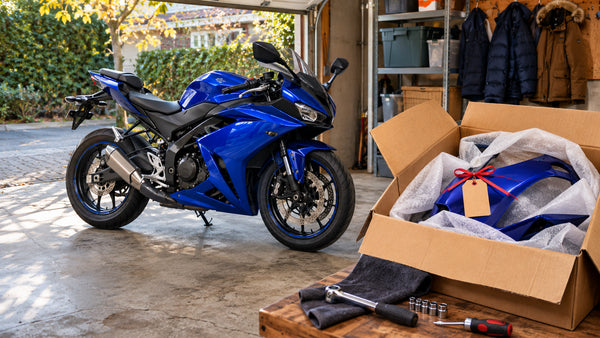

Cover: a user-supplied yellow-and-black fairing design illustration, used to discuss color planning. It is not a Yamaha factory image, a verified R7 part or a photograph of a finished NiceFairings order.
Yellow can make a motorcycle impossible to ignore. The difficult part is deciding what to do with everything around it: the tank you are keeping, the dark frame, the wheels, the tail and the bright accent that looked small on your phone but suddenly dominates a full-size panel.
Yamaha's latest R7 color announcement offers a useful starting point. In its November 2026 U.S. announcement, Yamaha listed Adrenaline Yellow/Fluo Red among the 2027 YZF-R7 colors. Yamaha Japan describes its yellow and vermilion combination as drawing on the company's US Inter Color racing heritage, with a yellow rear spring. The Japanese announcement gives a March 16, 2027 release date for its market; the U.S. announcement gave a different availability schedule. Markets and specifications can differ.
That is factory color news, not evidence that a matching replacement kit exists. Our interest here is the design problem behind it: how can an existing R7 owner build a coherent yellow-and-red look without pretending that paint changes the motorcycle's model year or guarantees fitment?
Start with the parts that are staying
Before choosing a yellow, photograph your motorcycle from both sides, straight ahead and from the rear. Include the tank, wheels and seat. Write down which original parts will remain visible and which pieces you intend to replace. A design that looks balanced as a flat set of panels can look very different next to a blue tank or gold wheels.
Consider three starting points:
- Dark tank and black wheels: yellow side panels can provide the main color. Keep the lower panels dark and use red as a narrow accent to give the eye a clear place to rest.
- Blue tank: a full yellow side may create an abrupt boundary at the tank. Either repeat a modest amount of blue in the side graphic or choose a smaller yellow area that deliberately frames the tank. Ask for an assembled-bike preview before committing.
- Bright wheels or metallic hardware: these already compete for attention. A restrained red line and a simpler tail may work better than adding another large red block.
These are design options, not factory recipes. If a kit includes a tank cover, confirm exactly what it covers and whether the listed part fits your bike. A cover is not a replacement fuel tank.

Give each color a job
Think of the motorcycle as three visual layers. Yellow is the main statement; dark surfaces define the outline and separate panels; red creates a short point of emphasis. The proportions are a design choice, not a rule. The test is whether you can identify the motorcycle's shape before you notice every individual stripe.
One approach is a yellow upper fairing, a dark lower fairing and a red accent near the leading edge. Another is to keep most panels dark and use yellow only on the upper sides and nose, with a small red detail repeated at the tail. A more adventurous version uses a wide yellow field and a single red diagonal that starts on the front panel and finishes before the seat.
What matters is continuity. A stripe that crosses two separate panels needs an agreed endpoint and a little tolerance for panel gaps. Do not design a razor-thin line that depends on two panels touching perfectly. Ask to see the proposed graphic with the actual gaps visible.
Choose the yellow in daylight, not just on a screen
Yellow covers a wide range, from pale lemon to warm amber. Fluorescent red, vermilion and a conventional deep red also read differently. Phone brightness, camera exposure and lighting can change all of them.
Instead of sending only a screenshot, tell the painter what matters: warmer or cooler yellow, solid or pearl, glossy or satin, and whether the red should be vivid or subdued. A physical sample, if available, is more useful than a color name alone. View samples outdoors in shade and sunlight, then indoors under ordinary light. Ask whether the sample represents the same base, color and clear finish that will be used on the panels.
A sample is a reference, not a guarantee that every screen and curved surface will look identical. Check the seller's process, available finishes and how any color difference is handled before approving the job. Do not assume an aftermarket finish is an exact factory color match.
Design the nose, sides and tail as one motorcycle
Nose: decide whether yellow surrounds the headlight opening or stays on the upper surface. Leave lighting, reflectors and required markings visible. A bright red shape on only one edge can look intentional, but it should have a relationship to the side graphic.
Sides: large fairings make yellow feel brighter than a small swatch. Place the dominant color where it follows the bike's real panel shapes, then use dark areas to keep vents and openings visually distinct. Confirm both sides independently: exhaust and panel shapes do not always mirror each other.
Tail: repeat one small element rather than copying the entire side design. A short red accent or a yellow edge can connect the rear to the nose without overwhelming it. Make sure the seat and original tail pieces that remain fitted are included in the preview.
Front fender: ask whether it is included in the kit. If not, decide whether the original fender color supports the design. The same question applies to the tank cover, rear seat cowl and small inner panels: confirm each item rather than assuming that “full kit” means every visible part.
Three briefs a designer can actually use
The following are fictional design directions, not products currently offered by Yamaha or promises of a NiceFairings color match.
- Quiet contrast: dark nose and lower panels, warm yellow side fields, one thin red accent, gloss finish. Best for a rider keeping dark wheels and a dark tank who wants the yellow to do most of the work.
- Race-inspired: yellow upper panels, dark lower panels, a wider red graphic across the side and a small repeat on the tail. Keep the marks original rather than assuming a racing team's logos are available for reproduction.
- Yellow as an accent: mostly dark panels with yellow on the nose and the leading portion of each side; a tiny red detail ties in the tail. Useful when a bright tank or wheels already occupy much of the visual space.
For any of these, ask for left, right, front and rear views that reflect your actual model and the components you are keeping. Mark the exact boundaries of each color. A side-only drawing cannot show how graphics meet at the nose.
Fitment comes before artwork
A beautiful scheme on the wrong shell is still the wrong shell. Identify the model year and market, not only the registration date. Compare the listing with your motorcycle and ask the seller to confirm the exact application before payment. Avoid assuming a newer R7's bodywork fits an earlier generation just because the name is the same.
Our 2025 versus 2026 R7 bodywork guide explains why changes in bodywork and lighting deserve separate attention. Photos can help a conversation, but they do not prove that mounting points or individual panels interchange. If your front support is damaged or bent, inspect and repair that issue before assessing fit.
Ask for a written list of included panels and hardware, how original grommets or heat shields are handled, and what to do if an item arrives damaged. Do a careful trial fit before final tightening; do not force panels or alter mounting holes without confirming the appropriate procedure with the supplier or an experienced installer.
A practical message to send before ordering
Give the seller your motorcycle's exact year, model and market; clear photos of both sides and the front; a list of the panels you want; and a note describing the tank, wheel and seat colors that will remain. Attach your chosen color references and mark where the red accent should begin and end. Ask for an itemized quote and availability, and agree on the design views and finish before production.
You can start with the Yamaha fairing collection, explore the custom fairings page, or contact NiceFairings with your bike details and reference images. Availability, exact colors and customization options need to be confirmed for your specific motorcycle; this article does not establish a 2027 R7 kit or an official Yamaha replica.
The best result is not necessarily the loudest one. It is the one where your chosen color, the parts you keep and the panels you order all look like they belong to the same motorcycle.