For a while, talk about the liter-class GSX-R sounded like a farewell. Then Suzuki announced an updated GSX-R1000 and GSX-R1000R, and many long-time owners had the same reaction: the name still has a future. That matters even if you will never buy the latest bike. The appeal of a Gixxer was never only one specification sheet. It was the particular relationship between a compact-looking race-derived motorcycle, the rider who kept it through changing fashions, and the color scheme that made it instantly recognizable from across a paddock.
Suzuki's July 2025 global announcement says sales of the updated GSX-R1000 and GSX-R1000R will begin worldwide from 2026, including Europe and North America. That is a launch-time statement, not a promise that every market calls the motorcycle a 2026 model. At the time of writing, Suzuki's U.S. GSX-R1000R product page presents a 2027 40th Anniversary Edition. Check the local Suzuki site and dealer for availability rather than using a global launch year as an American model-year label.
Forty years is more than one machine
The first GSX-R750 arrived in 1985. The GSX-R series celebrated its fortieth anniversary in 2025; Suzuki reports more than 1.2 million units of cumulative production across the GSX-R1100, 1000, 750, 600, 150 and 125 families. Suzuki also cites significant endurance-racing success. Those are official series-wide figures, not a sales count for the GSX-R1000R alone and not proof that every road bike was a race replica.

The 750 is central to why the badge feels distinctive. It offered a serious sportbike identity outside the neat categories people now use when shopping 600s and 1000s. A 600 can be loved for precision, a 750 for its unusual middle ground, and a 1000 for its flagship presence without declaring one the only “real” GSX-R. Owners attach memories to their particular generation: a first track day, a long road trip, a scratched panel from a clumsy garage move, a blue-and-white fairing seen in a showroom years ago. That story is stronger than a slogan about the “king” being back.
The series' racing history is also easy to misuse in cosmetic marketing. A race-inspired paint scheme can honor a visual tradition; it does not turn a street motorcycle into a homologated race machine or a licensed team replica. If a design references a historic bike, identify the era and keep it clear that the result is an interpretation unless you can substantiate every logo and permission.
What Suzuki says changed—and what we should not claim
Suzuki says the updated GSX-R1000/GSX-R1000R includes revisions to internal engine components and electronic controls while meeting current emissions and noise requirements. The announcement also mentions a new lithium-ion battery and market-dependent equipment. Those are manufacturer descriptions. They are not an independent road test, and we have not ridden the new model.
Suzuki specifies more than a new badge. Its announcement names revised injectors, cylinder heads, camshafts, valves, pistons and crankshafts, a reworked exhaust and catalytic-converter layout, and an increased-width cam chain. It says the twin-spar aluminum frame continues. New anti-lift and roll-torque controls join the electronics package; Suzuki describes the latter as using an inertial measurement unit and wheel-speed data. The announcement also describes carbon-fiber front-cowl winglets as accessories, with standard equipment in some regions. It does not make a winglet or a new front cowl a bolt-on upgrade for an older GSX-R.
Some riders will welcome the continuity; others may want a more conspicuous cockpit or a bigger technological leap. Those are judgments, not things a launch announcement can settle. We have not ridden the updated bike, and an official feature list is not an independent handling review. Performance specifications, accessories and homologation differ by market and model. Consult the current official listing for the version actually sold where you live.
For owners of older machines, the important point is not that a 2027 U.S. model renders their bike obsolete. It is that the manufacturer is still investing in the name. A carefully maintained 2006, 2011 or 2018 motorcycle has its own mechanical and visual identity. A new launch is a reason to appreciate that identity—not to paste a new bike's features onto an old one in a product description.
Buy the new one, keep the old one, or do both?
Launch news tends to turn an emotional decision into a false contest. The updated GSX-R1000R and an older GSX-R600, 750 or 1000 do not serve the same owner in exactly the same way. The new machine may offer a warranty, current emissions compliance and rider-assistance features an older model lacks. An existing motorcycle may be paid for, familiar to maintain and attached to memories no new showroom bike can inherit. Neither set of advantages establishes a universal winner.
If you are tempted to trade up, list what you actually want to change. Is it power delivery, electronics, parts support, riding position, condition, or simply the appearance? A fairing refresh addresses only the last category and some damaged bodywork. It will not install the updated engine internals, braking controls or warranty of a new model. Conversely, a new motorcycle does not automatically solve your desire for a particular old-school silhouette or a 750-class character. Test the decision against your riding and budget rather than the excitement of an anniversary announcement.
If keeping the bike wins, fund the unglamorous work first: tires, brakes, fluids, suspension service and any known mechanical concerns according to the motorcycle's service information. Then treat paint and panels as the visible chapter of a well-maintained machine. That ordering protects the meaning of the refresh. A striking fairing set on a bike with deferred safety work is not an upgrade.
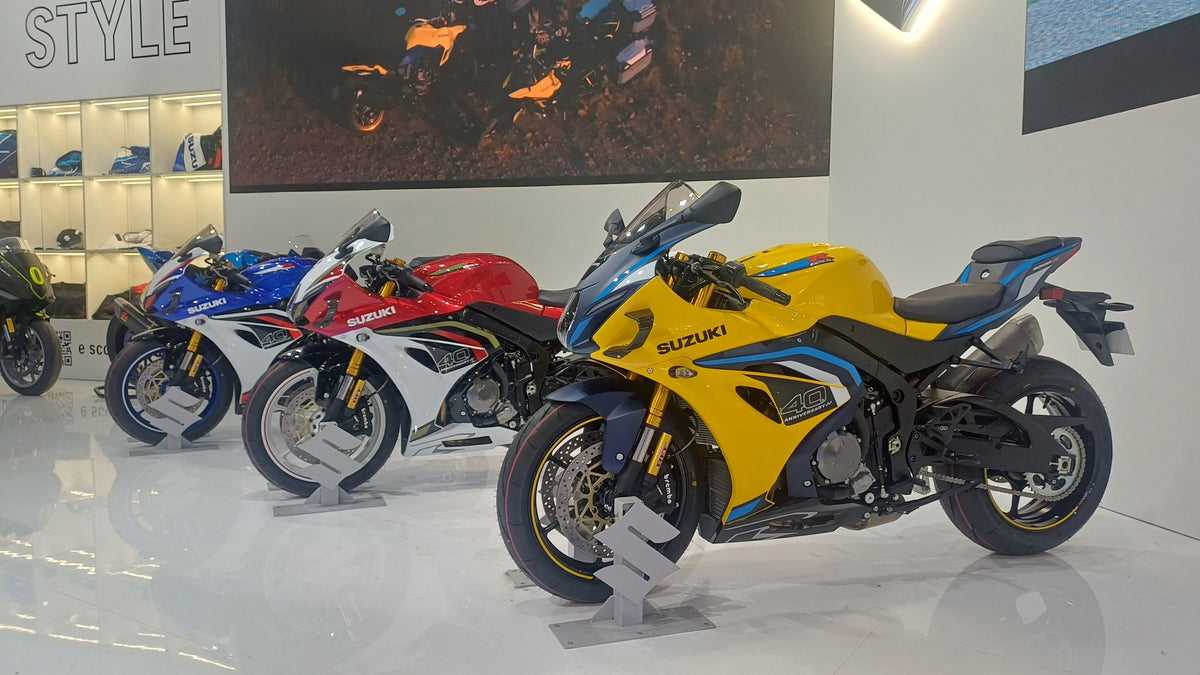
If you plan to own both, be especially careful with language in photos and listings. Identify each motorcycle and year. A photo of a 40th-anniversary display beside a link to older replacement fairings can otherwise suggest an unsupported product connection. The new GSX-R is context for this story; the product links below are starting points for older, specifically verified motorcycles, not accessories for the 2027 U.S. model.
An older Gixxer does not need to impersonate the new one
When the paint on an older GSX-R gets tired, the best refresh starts with a choice: restore the look that belonged to that generation, interpret a classic racing palette, or deliberately create a contemporary personal design. Each path can look excellent. Trouble starts when an owner buys a graphic because it looks right on a later bike, then discovers the lines cross their older fairing seams awkwardly or clash with the tank they kept.
Take a side-on photograph of your actual motorcycle before choosing colors. Note the shape of its nose, tank, tail and lower side panels. A blue-and-white scheme may read as classic Suzuki even when the stripe geometry is original. Black and red can emphasize the silhouette without pretending to be a historical factory option. A Yoshimura-inspired look can nod to Suzuki's racing associations, but logos and team marks need careful rights and authenticity checks; do not call an independent design an official collaboration.
Our older GSX-R race-livery design brief goes deeper on visual references and approvals. This article makes a different point: the best way to celebrate the series may be to preserve the character of the bike you already own, rather than forcing a forty-year story into one colorway.
Separate the restoration plan from the purchase page
Before ordering, identify the exact model, model year, market and any variant using the motorcycle's documentation and physical features. “GSX-R600,” “GSX-R750” and “GSX-R1000” are families, not one interchangeable set of panels. Nor does one broad collection title prove that every year in its range uses the same kit. Compare the current listing's included-piece photographs and openings with your motorcycle; ask about ambiguities before payment. Retain any OEM pieces in labeled storage if you might later restore or sell the machine.
The condition survey should include mounting tabs, hardware, brackets, heat shields and nearby mechanical issues. New paint will not correct a bent stay or an exhaust that has been overheating the lower panel. If the existing bodywork has a repair history, document it before removing anything. Our older GSX-R fairing audit covers that physical baseline; use it as a pre-order checklist, not proof of cross-year compatibility.
| Your motorcycle | Useful starting collection | Question to settle before ordering |
|---|---|---|
| GSX-R600 | GSX-R600 fairings | Is the listing for your exact year and body style? |
| GSX-R750 | GSX-R750 fairings | Which panels differ from a similar-looking 600? |
| GSX-R1000 | GSX-R1000 fairings | Does the nose/tail generation match your bike? |

Those are browsing entrances, not blanket fitment endorsements. Product availability and exact included pieces can change. A collection labeled through 2026 does not mean it has been verified for Suzuki's newly announced U.S. 2027 GSX-R1000R; that model requires its own product and fitment confirmation. Avoid presenting an older generation kit beside launch news as if it were already suitable for the new motorcycle.
What makes a refresh worth keeping?
If you want to enjoy the result for more than the first photo, think beyond the hero angle. How do the left and right sides relate? Does the graphic continue across a seam cleanly? Is the tank paint close enough under daylight, not just under workshop LEDs? Can you access regular service points? Are the lights, signals and reflectors where your road-going bike needs them? What will you tell a future buyer about the change?
Photograph the original bike and the new panels before installation. Check each piece, then dry-fit patiently. Do not force a panel to erase a gap or drill because a stock photograph suggested a fit. Keep the order specification and installation record. A well-documented refresh respects the motorcycle and gives the next owner an honest account, whether the design is traditional blue-and-white or something entirely your own.
A heritage project in three possible directions
Preserve the period. Keep the original parts if they are serviceable, repair only what needs attention, and use the year-specific silhouette as the star. If you must replace panels, choose graphics that respect that generation's shapes. This route is for a rider who wants the bike to remain recognizable as the machine that first caught their eye. It does not require every bolt to be a museum piece; it does require transparency about what is original and what is new.
Reference an era. A familiar Suzuki palette can evoke racing history without copying a specific team's arrangement. Pick one photographed reference, then deliberately adapt its broad color balance to the fairing you own. Let the tank and wheels constrain the design. A graphic that looks persuasive on a late-model 1000 may need an entirely different break line on an early 750. Plan the transition at each seam rather than asking a painter to “make it work” after the panels arrive.
Make it personal. A black-and-red scheme, an understated single-color look or a modern graphic can still belong on an older GSX-R. The value here is not historical accuracy but coherence. Decide which original details should remain visible and which modifications you will record for a future owner. Personal does not mean careless: lighting, reflectors, service access and heat-clearance still matter on a road bike.
Whichever route you choose, keep a small visual brief: one full-bike side photo, one front three-quarter photo, close-ups of the tank and existing panel seams, and two or three color or finish references. Label the motorcycle's exact year and model. This gives a supplier a much more useful conversation than a collage of unrelated GSX-R generations. It also lets you reject a design before paint is applied if the lower panel, tail and nose fail to read as one bike.
The new GSX-R1000R may bring a fresh generation of riders to the badge. It should also remind us why the older bikes are still worth seeing clearly. They are not placeholders until the next launch. They are the machines that carried the story here. Explore the NiceFairings Suzuki range as one source of design ideas, then choose for your exact motorcycle and verify the actual listing. The best tribute to forty years of GSX-R is not a claim that every old bike is new again. It is a bike whose history, condition and new appearance all make sense together.
Image credits: The 2025 EICMA photograph of Suzuki's 40th-anniversary GSX-R display is by MotorideSA, licensed CC BY-SA 4.0. The 1985 GSX-R750 in the Suzuki History Museum was photographed by Rainmaker47, licensed CC BY-SA 3.0. Images are editorial references, not NiceFairings products or fitment evidence.