A convincing race-inspired GSX-R starts with a specific reference and a clear list of what stays on your motorcycle. Before choosing a blue, collecting sponsor names or approving a painted kit, decide which machine and season you mean, which features matter most, and how the design will work around your existing tank. Those decisions make a much more useful order brief than “make it like the race bike.”
This guide is for owners of older Suzuki GSX-R road bikes planning a new look. It separates historical references from personal interpretations, then turns that distinction into a practical design and approval process. It does not establish fitment, promise a particular color match or suggest that an aftermarket kit becomes an official team product through its graphics.
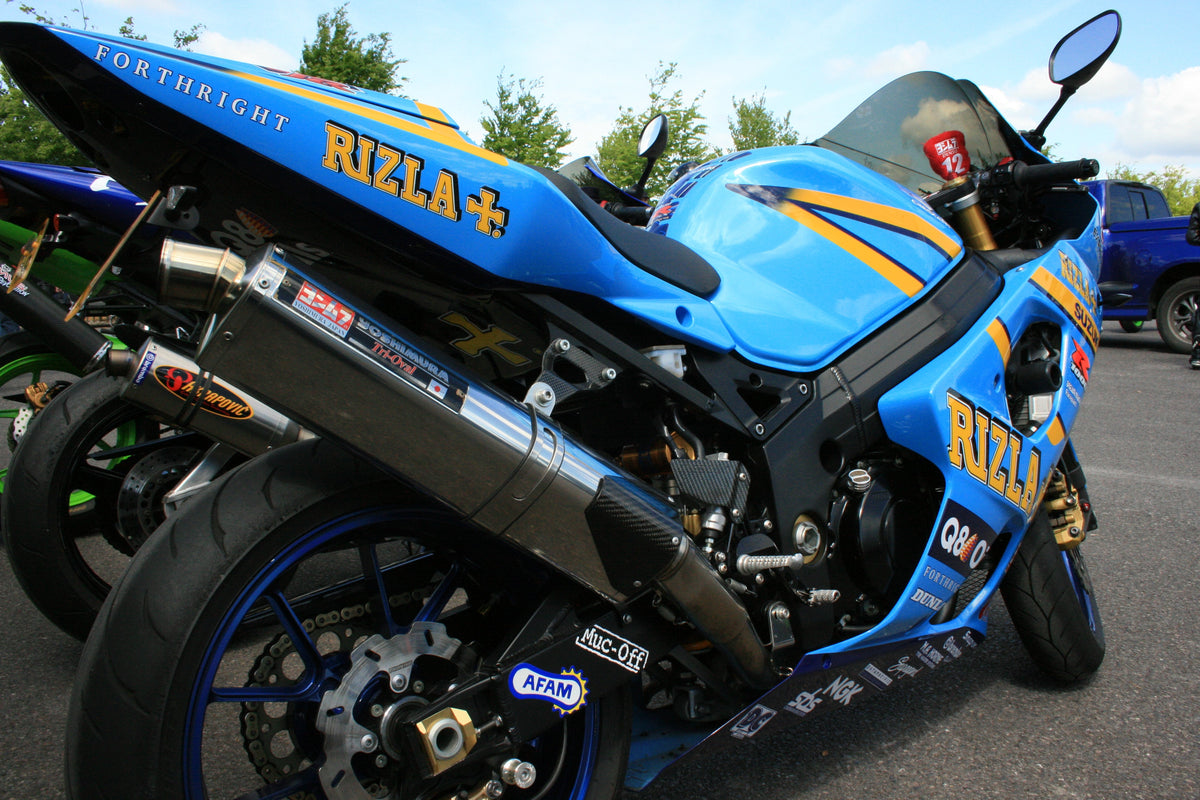
Cover: a Rizla-themed Suzuki GSX-R1000 photographed by Supermac1961, CC BY 2.0. This independently photographed motorcycle is a styling reference, not a NiceFairings customer build.
1. Pick one racing reference before combining ideas
“Rizla Suzuki” can describe an association in your memory rather than one exact layout. Start by saving a dated photograph with a reliable caption. Record the team, year, racing series and machine where those details are available. Keep unknown information marked as unknown. A striking photograph without a date can still inspire a palette, but it is a weak source for claiming a faithful period replica.
Suzuki's March 2006 MotoGP announcement, for example, identifies the Rizla Suzuki MotoGP team and the GSV-R racing machine. That is a useful historical anchor. It does not mean every Rizla-themed Suzuki was a MotoGP prototype, or that the panels of your GSX-R road bike share that prototype's shapes. The reference establishes what you are interpreting; the actual road bike establishes the canvas.
Ecstar needs the same care. Suzuki's 2020 team presentation describes a blue and slate-silver GSX-RR celebrating Suzuki's racing history. Asking for “Ecstar blue with neon-yellow panels” would therefore describe a different interpretation, not that particular 2020 scheme. Neither preference is wrong, but your brief should not call two different targets the same thing.
With a Yoshimura reference, identify the actual photographed machine and occasion instead of assuming one timeless red-and-black pattern. Lettering, number panels and color proportions contribute as much as the main colors. Save both sides when possible. If only one side is documented, ask the designer to flag the opposite side as an interpretation rather than silently inventing historical certainty.

2. Choose faithful, inspired or personal—and name the compromises
A faithful interpretation makes the historical reference the priority. You may want the dominant color blocks, lettering hierarchy and number-board treatment to remain close to the selected source. Even then, different road-bike bodywork can prevent a literal transfer. Ask which elements must move or change size before discussing a final price. A confident answer acknowledges those limits instead of promising a photograph-perfect result on unrelated panels.
A race-inspired interpretation keeps a smaller set of recognizable cues. Perhaps you want the light blue, yellow accents and large wordmark arrangement associated with your chosen Rizla reference, while leaving your own tank unchanged. Write down those three priorities. This gives the designer permission to adapt the remaining areas without turning every departure into an unexpected compromise.
A personal design borrows a racing vocabulary but deliberately changes its identity: a different base color, your number, restrained lettering or a favorite accent. Describe it as your own design. If team or sponsor names are requested, keep that request separate from claims about who manufactures, approves or sponsors the finished kit. Branding on a mockup does not establish a commercial relationship.
Rank your priorities rather than calling all of them essential. A useful order might be: keep the original tank; retain a recognizable historical color balance; keep the front number area clear; simplify smaller lettering if space is tight. If an exact tank match is actually more important than historical color, move that requirement to the top. The designer cannot resolve a conflict that the brief leaves hidden.
3. Document the motorcycle that will receive the design
Write the model, model year and market where known, and identify any changed bodywork. Registration year alone may not settle model-year questions. Include the kit listing or supplier reference under consideration. A livery brief cannot confirm whether a GSX-R600, GSX-R750 or GSX-R1000 panel set is compatible with your motorcycle; that remains a separate model-specific check before production.
Photograph both sides, the front and the tank in ordinary daylight. Include enough surrounding bodywork to show where retained and replacement pieces meet. Avoid color filters and dramatic night lighting. Keep the original files if possible. These images help a designer understand relationships and proportions, but they are not calibrated paint samples and cannot guarantee an exact match across screens.
List the retained parts individually: fuel tank, tank cover if present, seat, inner panels, wheels and any other visually significant pieces. A black tank can be a deliberate part of a blue scheme; it does not automatically need hiding. Nor should an older tank be assumed faded merely because of its age. Describe what you can see—scratches, existing graphics, visible color variation—without guessing the cause.
If a proposed kit includes a tank-related part, clarify exactly what it is and whether it is offered for your model. A trim piece, external cover and fuel tank are different items. Our tank-cover and kit-contents guide explains the terminology. Do not assume a full cover exists, fits or is included simply because a concept drawing shows a continuous colored surface.

4. Compare three briefs, not three vague color names
The following are hypothetical planning examples, not completed customer builds or tested fitment combinations. Their purpose is to show how a clear priority changes the design conversation. Each still requires a confirmed kit, a supplier discussion and an agreed final specification.
Brief A: Rizla-inspired bodywork with a retained black tank
The owner likes a particular blue-and-yellow reference but wants to keep the existing black tank. The brief identifies that reference and asks for its broad color balance on the replacement panels. It also asks the designer to show the black tank in every whole-bike view. This prevents an attractive isolated side-panel rendering from concealing an unresolved transition at the tank.
The decision is whether to repeat black deliberately elsewhere or allow it to remain a strong separate block. The owner can compare those approaches in a whole-bike mockup. Neither approach requires describing the retained tank as defective. If matching the reference exactly becomes the overriding goal, the tank decision must be reopened explicitly before the order is finalized.
Brief B: A 2020 Ecstar reference adapted to an older road bike
This owner selects the blue and slate-silver 2020 GSX-RR as the reference, while acknowledging that the road bike has different panel divisions. The brief ranks the two main colors and their visual balance above the exact location of every small mark. It asks the designer to identify areas where the original graphic crosses a feature absent from the road-bike kit.
The key review question becomes “Does this still read as the chosen reference at whole-bike scale?” rather than “Did every stripe stay at the original coordinate?” A dated source image stays attached to the brief throughout revisions. If the owner later adds yellow accents, the version notes call it a personal variation so nobody mistakes the revised target for an unchanged historical reproduction.
Brief C: Yoshimura-inspired red with a personal number
This owner values the red bodywork and clear front number-board character of a selected reference. The personal number takes priority over reproducing every small sponsor mark. The brief asks for a legible front view and a restrained side layout, with the existing seat and tank shown. Small details are judged at realistic display size, not only on a zoomed-in design file.
The tradeoff is intentional: personal identity replaces strict historical accuracy. The owner checks how the number reads around the headlight opening and other fixed features before approving its scale. A larger number is not automatically better if the available surface interrupts it. The final description calls the result race-inspired rather than presenting it as an original race-team motorcycle.
5. Turn the chosen direction into a one-page specification
Keep the final brief short enough to use beside the design. Supporting photographs can live in a separate folder, but the approved decisions should not be scattered through a long message history. The table below is a practical starting point. Where a detail is unresolved, write a question instead of filling the box with an assumption.
| Decision | What to record |
|---|---|
| Motorcycle and kit | Model, model year, known modifications and exact proposed kit reference; compatibility confirmation still required. |
| Historical source | Reference image, source, year and machine where verified; identify any unknowns. |
| Design intent | Faithful, inspired or personal, with three ranked visual priorities. |
| Retained surfaces | Tank, seat and other unchanged pieces, shown in current photos and the mockup. |
| Colors and finish | Agreed reference method and requested gloss or matte areas; list any match still unresolved. |
| Graphics and approval | Exact spelling, number, side-specific placement and the latest approved version. |
Use the same terms consistently. “Racing blue” and “light blue” are descriptions, not a complete shared color specification. Ask what reference method the supplier can actually work with, whether that is a documented code, a physical sample or another agreed process. Do not require a code you do not know, or treat a phone screenshot as equivalent to a physical paint sample.
For graphics crossing panel divisions, refer to the guide to fairing seams and viewing angles rather than inventing a universal acceptable offset. A planned break and an unintended mismatch are different questions. Record the intended appearance and ask how it will be checked; a single millimeter figure cannot settle every curved-panel design.
Also separate the parts budget from the design brief. Ask which panels, graphic work and finish choices are included in the quotation, and which retained parts would require separate work. A low initial figure is difficult to compare if one quote covers only replacement plastics while another includes work on the existing tank. Record the agreed scope beside the approved design so the finished appearance and the purchased items refer to the same plan.
Request views that answer a question. A front view checks the number area; a side view checks the balance around the retained tank; a view showing the opposite side catches differences hidden by exhausts or panel shapes. An atmospheric rendering can communicate mood, but it should not be the only approval image. Use a plain-background view alongside it when details need comparing.
Finally, write down what would make you reject the proposal before reviewing it. Examples include changing a retained tank without agreement, replacing a selected historical reference with another season, or omitting a requested number. This is more actionable than asking for a design that simply feels premium. It also keeps minor preferences from distracting you from the decisions that determine whether the project is right for your motorcycle.
6. Approve the concept, specification and finished work separately
First approve the direction: reference, retained components and main color blocks. Then review the detailed specification: wording, numbers, finish and individual panel coverage. Finally, ask what finished-part photographs or other checks are available for your order. Agree these stages with the supplier; do not assume a physical sample, assembled-bike photograph or unlimited revisions is included.
Review finished photos against the latest approved specification, not against an earlier favorite rendering. Ask for an unclear area to be shown more clearly. Photographs can help reveal missing graphics or an obvious layout discrepancy, but lighting and screens limit color judgments, and loose-panel photos do not prove installation fit. Keep color approval, visual completeness and compatibility as separate questions.
Name the approved file clearly and keep a simple change log. “Version 3: retained black tank; reduced side lettering; front number unchanged” is more useful than “looks good except the last changes.” If you change a priority after approval, ask how it affects the work already agreed. There is no need to invent a universal revision limit; make the actual arrangement explicit.
When you are ready, explore the Suzuki fairings collection and send NiceFairings your design brief with the model details and reference photos. Ask the team to confirm the available kit and customization scope before treating a concept as an order. A clear brief keeps the historical inspiration, your motorcycle and the finished specification connected all the way through the decision.


