A new YZF-R9 presents a deceptively small decision: install a pair of frame sliders now, or keep its painted side fairings intact. With Yamaha's genuine US accessory, those choices cannot be separated. The US R9 frame-slider listing identifies part BKN-F11D0-T0-00 and explicitly says drilling and cutting are required. A photograph of a finished motorcycle does not tell you which panel was altered or whether a replacement panel will work with the same hardware.
This is a guide to decisions before irreversible work, not a drilling tutorial or a claim that any slider prevents crash damage. You will leave with a way to document your exact accessory, decide which bodywork to preserve, ask a fairing seller the right component-level questions, and give an installer a coherent brief. If you only remember one rule, make it this: confirm the actual accessory instructions and affected panel before cutting an OEM or replacement fairing.
Read Yamaha's warning precisely—then stop generalizing
The US Yamaha listing calls its genuine R9 slider easy to install, but in the same description states that drilling and cutting are required. “Easy” therefore cannot be read as “no bodywork alteration.” The page also says the design matches integrated cut and drill marks in OEM bodywork. That is evidence about that US-listed accessory, not permission to guess an opening from a product photograph or apply it to another brand's slider. Yamaha lists replacement slider pieces separately; that does not establish that a modified fairing is replaceable through the same accessory SKU.
Market and part number matter. Yamaha's European R9 frame-slider page identifies BKN-F11D0-V0-00 and says the fairing must be properly drilled. Yamaha Canada also identifies the V0 variant and notes drilling and cutting. These listings corroborate that Yamaha offers a cutting-required design in more than one market. They do not establish that the T0 and V0 kits, their included hardware, instructions or vehicle applications are interchangeable. Use the current instruction set for the exact kit supplied to your motorcycle.
Nor does this warning apply to every aftermarket R9 slider. Some makers may describe a no-cut layout, but the phrase alone says nothing conclusive about the mounting point, clearance with a particular fairing, or what will happen in a fall. Our broader cut-versus-no-cut slider guide explains the general layout question. The R9-specific issue here is that the genuine Yamaha listing gives you a clear reason to pause before treating the original panel as a disposable template.
Choose which property you are trying to preserve
There are three distinct assets: the uncut original painted panels, the ability to fit a particular slider, and the option to change the bike's appearance later. They may not all survive the same installation plan. State your priority before you ask a seller for a fairing kit.
- Keep original panels uncut. If the chosen slider requires altering the panel it passes through, set the original aside and ask whether a suitable replacement of that exact piece exists. Alternatively, investigate a different documented slider layout or defer the accessory. Do not buy a “no-cut” kit solely because it sounds safer; have its actual design reviewed.
- Use the original panels with Yamaha's listed accessory. You are accepting an irreversible bodywork change. Make that an informed choice, with the exact current instructions and a qualified installer. A carefully executed opening is still an opening; it does not become factory-original by being neat.
- Use a second set for the modification. This can preserve the removable OEM panels, but only if the proposed set includes the affected piece, provides the necessary interfaces and can be safely prepared for the exact slider. Replacement fairings are not automatically pre-cut, accessory-certified or complete with every inner part.
Do not equate any of these paths with guaranteed crash protection or higher resale value. A slider may help in some circumstances and create other loads at its mounting point. The outcome depends on the event and the complete motorcycle, not the marketing label. The purpose of a reversible bodywork plan is narrower: avoid sacrificing a panel unnecessarily and make later service or ownership history intelligible.
Consider two owners with the same model year. One plans to keep the factory finish and has space to store original panels; a verified second set may be worth the added cost and fitting work. The other plans to ride the motorcycle in its present color for years and does not want to store parts; modifying the factory panel may be an acceptable choice after an informed installation review. Neither owner is more “correct” merely because one kept the original plastic. The useful comparison is whether each understands exactly what will be changed, which parts are replaceable, and what remains uncertain before paying for labor or making the first cut.

Make the order of decisions work in your favor
The first useful decision is not a cut location. It is whether the motorcycle already has non-stock parts. Photograph both side fairings, the area around the candidate slider location, any current openings, and the visible mounting region where it can be seen without disturbing uncertain hardware. Write down the model year, market, VIN for your own records, and any previous repair that changes the panel or its supports. A used R9 with an existing hole is a different starting point from an untouched bike.
Second, identify the slider by maker, complete part number and instruction revision. Do not order the fairing around a stock image of a slider puck. The installer needs the supplied brackets, fasteners and applicable instructions in hand. If the parts came with a used bike and their origin is unknown, investigate their identity before treating a pre-existing opening as evidence of compatibility. A former owner's cut may be slightly off-center, made for another kit or surrounded by damaged tabs.
Third, identify the panel, not just the color. Ask the installer which exact side or inner piece the instructions require altering and which other parts must be removed, transferred or checked for clearance. The seller can answer what a product includes; the installer determines whether the actual combination can be fitted safely. Neither party should have to pretend to answer the other's question. A general “R9 2025–2026” application is useful but does not describe the modifications on your particular motorcycle.
Only then compare the cost and disruption of an OEM replacement piece, a separate painted set, leaving the accessory uninstalled, or using an alternative design that has been specifically checked. Include labor, missing brackets or trim, storage of the factory parts and the inconvenience of switching configurations. Our two-set bodywork guide covers the broader street-and-track tradeoff; here the decision is tied to one potentially cut R9 panel.
Treat a product image as a question starter, not an answer
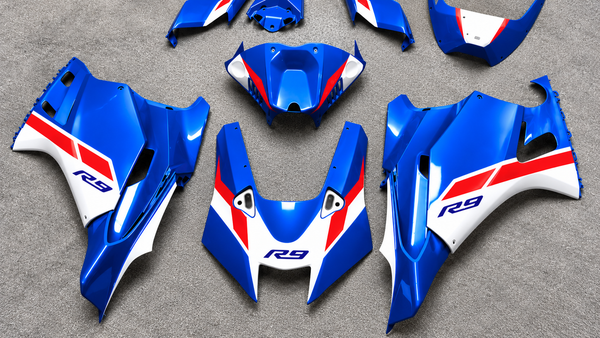
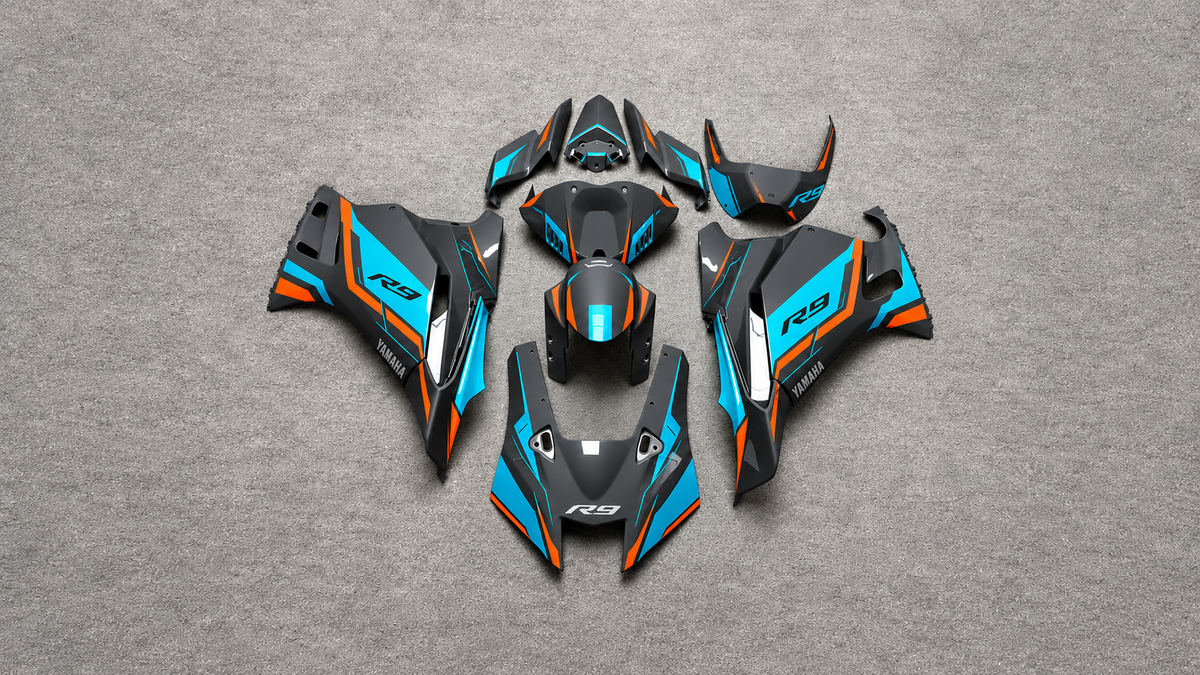
NiceFairings offers YZF-R9 2025–2026 body-panel options, including a purple-and-blue R9 panel listing and a white-painted option. The photographs can help you choose a finish and identify visible shapes. They do not document the delivered piece count, hidden mounting surfaces or a tested opening for Yamaha's slider. The owner-supplied flat-lays in this article are visual references, not before-and-after installation records or promises that a depicted livery is currently available. The cover's gray floor has been AI-extended sideways to show the full panel layout in a wide card; that presentation change is not product evidence.
When you contact NiceFairings, include the exact product URL, selected finish, year and market, and the slider maker and complete reference. Request a written, order-specific response to five questions:
- Is the particular left or right panel affected by this slider supplied with this option? Please identify it in the photo and the current component list rather than saying only “full kit.”
- Is that panel supplied uncut, marked, or with an opening? If an opening exists, for which exact accessory reference was it made? A visible gap elsewhere on a panel does not answer this.
- Which inner pieces, shields, brackets, clips and fasteners are included, expected to transfer from the bike, or separately required? Which photographed pieces are illustrative rather than shipped?
- Can you provide clear reverse-side and tab-area photographs of the affected panel? These are more informative for an installer than a three-quarter beauty shot.
- What are the current order, return and modification terms for this option? Get them before any trimming or drilling, not after a trial fit has gone wrong.
Do not interpret silence as a yes. A seller may be able to verify the panel's presence while leaving slider compatibility unresolved; that is still a useful answer. Put “not confirmed” in the plan and let the installer resolve the physical interface. Our supplied-versus-retained parts guide explains why a polished kit photograph is not a packing manifest. This R9 purchase needs the additional slider-reference question because the planned alteration is irreversible.

Give the installer a stop/go brief—not a guessed hole position
Before work begins, hand the installer a short packet: current motorcycle details, the exact slider kit and its current instructions, the fairing product link and seller's component answer, photographs of both sides, and a list of any prior repairs or accessories. Ask the installer to identify any conflict between the accessory procedure and the replacement panel before drilling. A loose physical pre-fit should establish the natural panel position and whether the parts meet without forced tabs, pinched wiring or unexpected contact. The installer should compare the actual components, not a screenshot from another R9.
Agree on a stop point. If the part number on the box differs from the instructions, a bracket is missing, an old opening does not match, or the proposed change would affect a tab, duct, shield or adjacent component unexpectedly, pause and get a product-specific answer. Do not enlarge an opening simply to make incompatible parts appear to line up. Do not loosen a structural mount, substitute hardware or invent a torque figure from a blog post. The motorcycle and accessory instructions, plus a qualified installer's judgment, govern those operations.
The handoff should also answer what happens to the OEM panels if a second set is used. Photograph and label them before removal; store each piece supported and protected from loads on mounting tabs. Keep hardware identified by location, and record any pieces moved between sets. That prevents the next service visit from becoming a mystery about which screws, spacers or inner trim belong where. For a bike with prior damage or altered fittings, the modified-sportbike ordering checklist offers a wider record-keeping framework.
Separate a street-bodywork decision from track-day rules
An R9 owner planning a first track day may want to protect the original paint with a second set. That is a bodywork-preservation strategy, not a claim that an ordinary street-style fairing qualifies as race bodywork. Ask the actual organizer for current requirements on secure bodywork, mirrors, lights, taped lenses or fluid containment as applicable to the event. Do not import race-series rules into a beginner track day, and do not assume a street set will pass a race inspection. The track-day bodywork plan treats that as a separate decision.
The slider question also remains separate from event eligibility. A track organizer may permit a motorcycle with a particular slider, but that does not validate its installation or a new fairing opening. Conversely, a correctly installed accessory does not certify the rest of the bike for track use. Resolve the mechanical, bodywork and organizer questions with their respective sources. If the bike will return to road use, include the condition and function of all road-required equipment in the return-to-road inspection rather than assuming the painted panels are the entire conversion.
Keep evidence after the work—and know when to walk away
When the parts arrive, compare the received pieces with the seller's written list before modification. Photograph the finish, reverse side and tabs as delivered. After the qualified installer completes the work, retain the accessory instructions used, the part and revision numbers, the invoice and clear photographs of the finished left and right sides. Record which set is installed and where the other panels and associated hardware are stored. This is not busywork: it allows a future service technician to distinguish an intentional accessory opening from accident damage or a mysterious previous repair.
Have the installer confirm that the panels sit without stress and that required clearances, steering movement, wiring and nearby hot or moving parts have been addressed under the applicable instructions. A neat-looking opening alone is not evidence of a sound installation. If a fall or tip-over later occurs, inspect more than the puck and the visible outer fairing. The mount, adjacent components and motorcycle may need qualified assessment even if the bodywork is cosmetically repairable. A slider's presence is never proof that the chassis is unharmed.
The decision can still be “not yet.” If the accessory identity is uncertain, the seller cannot identify the affected panel, or the installer cannot reconcile the actual pieces without improvisation, delay the alteration. You can still enjoy the R9 while gathering the missing information. The useful first-season achievement is not a hole cut quickly; it is a setup whose parts, limitations and history you can explain clearly a year from now.