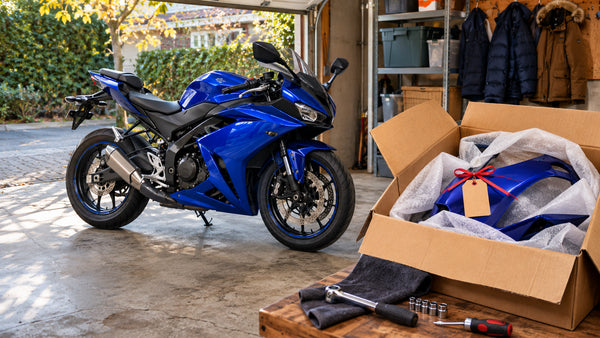

Cover: user-supplied comparison illustration. The motorcycles are visual examples, not evidence of exact model-year specifications, trim, dimensions or fitment.
“I’m trying to compare the Ninja 500 and CBR500R as a beginner.”
It is a sensible question. Both look like sportbikes, both have twin-cylinder engines, and both can make a first showroom visit feel exciting. The harder decision comes afterward: which one feels manageable when you have to back out of a parking space, stop on an uneven road, or practice another slow turn after a long day?
There is no honest winner for every new rider. The Ninja has a lower published curb weight in the U.S. specifications compared here; the Honda includes ABS as standard for this model. Neither number tells you how a particular rider will balance the bike, reach the controls or feel after an hour in the saddle. Use those facts to narrow the choice, then sit on—and, where legally and practically possible, try—the actual motorcycles.
This is an ownership guide based on published specifications, not a head-to-head road test. We have not measured the motorcycles or tested them back-to-back. Your size, experience, equipment, route and local dealer support all affect the right answer.
First, make sure you are comparing the same year and market
For a consistent starting point, the table uses new 2026 U.S.-market models: the standard Ninja 500 ABS and the CBR500R with ABS. It does not compare the Ninja 500 SE ABS, a used motorcycle, or the similarly named four-cylinder CBR500R FOUR. Those are separate configurations and should not be mixed into the figures below.
| Specification | 2026 Kawasaki Ninja 500 ABS, U.S. | 2026 Honda CBR500R, U.S. |
|---|---|---|
| Engine | 451 cc liquid-cooled parallel twin | 471 cc liquid-cooled parallel twin |
| Seat height | 30.9 in | 31.1 in |
| Published curb weight | 374.9 lb, 49-state; 377.1 lb, 50-state | 421 lb |
| ABS | Optional on standard Ninja 500; this comparison uses the ABS version | Standard on the listed U.S. model |
| Starting base MSRP | $5,799 for the standard ABS model; certain colors cost more | $6,399 |
| Published destination charge | $650 | $600 |
Sources checked November 16, 2026: Kawasaki 2026 Ninja 500 specifications and pricing and Honda 2026 CBR500R specifications and pricing. Manufacturers may change specifications or pricing. Kawasaki defines its curb weight with the fluids needed to operate, a tank more than 90% full and a tool kit if supplied; Honda states its figure includes standard equipment, fluids and a full fuel tank. The figures are useful for context, not a same-scale measurement of two particular bikes.
These are manufacturer prices, not quotes for an actual motorcycle. On the listed base configurations, MSRP plus destination starts at $6,449 for the Ninja 500 ABS and $6,999 for the Honda. Tax, registration, dealer charges, accessories, promotions and dealer pricing can change the amount you pay. Ask each dealer for a written, itemized out-the-door quote on the exact bike and color. For another country or a used bike, restart the comparison using that market's documents and the individual motorcycle's condition.

What matters more than top speed: low-speed control
The first weeks on a motorcycle involve plenty of things that happen almost at walking pace. You may need to hold the bike upright at a stoplight, turn into a narrow parking space or walk it backward on a slight slope. This is where a purchase that looked straightforward on paper becomes personal.
Pushing, parking and turning around
The Kawasaki's lower published curb weight is a meaningful reason to put it on your shortlist if moving a bike around by hand is a concern. For the figures in the table, the difference is roughly 44–46 lb, depending on the Kawasaki emissions version. It is still not a laboratory comparison, and weight distribution, handlebar position, surface slope and your experience affect the effort you feel.
At the dealership, ask a staff member to support the motorcycle while you first bring it upright from its side stand. With permission and assistance, see how it feels to walk it forward and backward on a level surface. Do not attempt a difficult maneuver alone to prove a point. Think about your real parking space: a garage with a step, a sloped driveway or loose gravel can matter more than the last half-inch on a spec sheet.
The published seat heights differ by only 0.2 inch, but that does not prove they feel the same. Seat width and shape, the position of the footpegs, your inseam, boots and confidence all affect your reach. You do not need to force a flat-footed position on both sides to make a bike acceptable; you do need a stable, repeatable stopping strategy that you can practice with an instructor. If you cannot hold either motorcycle comfortably with assistance on level ground, ask about suitable alternatives or professional adjustment options.
Steering space matters too. A tight turn depends on the motorcycle's steering range and geometry as well as the rider's technique. Look at how the handlebars and controls sit at full lock, but do not treat a showroom glance as a measured turning-radius test. A training course can help you practice slow control on an appropriate motorcycle before taking your own bike into traffic.
Clutch and throttle: compare the feel, not just displacement
The 451 cc and 471 cc figures identify engine size, not an objective ranking of which throttle is more forgiving. Clutch engagement, throttle response, gearing, idle behavior and the condition of the specific bike all matter. Both have manual transmissions; learning a smooth start and stop is part of the process.
While parked, ask the dealer to show you the controls and explain the clutch's reach and adjustability. If a legal, insured test ride or supervised training opportunity is available, pay attention to the first few starts, a gentle stop and a low-speed turn. Do the controls feel understandable, or are you working hard just to find the engagement point? On a used motorcycle, stiff or unusual controls deserve inspection rather than being assumed to represent every bike of that model.
ABS can help prevent wheel lock during braking, but it does not replace good braking technique, appropriate following distance or training. Compare the exact ABS configuration you will buy, and practice under qualified instruction.
Which one fits your actual route?
Commuting and parking-lot practice
Imagine your usual ride instead of the best road in a promotional video. Where will you park? Will you make repeated stops, filter through busy traffic where legal, or push the bike through a narrow gate? If the Ninja's lower listed weight makes the stationary handling exercises feel easier to you, that is a real buying consideration. If the Honda's controls and seating make you feel more settled, that matters too. We cannot determine either rider's personal result from the specifications.
Repeated stopping also makes the clutch lever and seat-to-ground relationship important. A bike that feels comfortable for a minute can feel different after fifteen minutes of simulated stop-and-go riding. Ask whether you can sit on each bike long enough to notice pressure points, and compare them with the same boots and riding gear.
Weekend rides and longer trips
Longer rides add different questions. Can you support your upper body without excessive pressure on your wrists? Do your knees feel cramped? Can you look over your shoulder easily? Does the seat offer you enough room to change position at a stop? A windscreen changes airflow, but its usefulness depends on height, posture and local conditions. Neither factory windscreen should be assumed to fit every rider.
Bring your normal helmet and jacket if the dealer permits them. Sit with your feet on the pegs and hands naturally on the grips for ten to fifteen minutes, with the motorcycle securely supported. A short stationary check cannot replace a ride, but it can reveal discomfort that an impressive walkaround photo cannot. Consider how often you will stop and whether your route includes highways, traffic or long exposed stretches.
Purchase price and ownership cost are different decisions
Begin with the out-the-door quotes, then add the items you will need before the first ride. A reasonable comparison uses the same assumptions for each motorcycle:
- Insurance: request individual quotes using the actual model, year, location, your riding history and the coverage you want. Do not assume the cheaper motorcycle automatically has cheaper insurance.
- Equipment and training: budget for a properly fitted helmet, protective jacket, gloves, pants and boots, as well as a recognized rider-training course and applicable licensing costs.
- Maintenance: ask the local dealer about scheduled service intervals, labor rates and parts availability. Add consumables such as tires and chain care based on your expected mileage, rather than assuming a universal annual figure.
- Storage and transport: consider where the motorcycle will live, whether you need a cover or lock, and whether delivery or an approved transport service is necessary.
- Bodywork: fully faired motorcycles have painted panels that may need repair or replacement after damage. Obtain a local estimate if that possibility would strain your budget; a drop is not an inevitable part of learning.
If you are shopping used, condition and service records can outweigh a new-bike MSRP difference. A cheaper listing with overdue tires, missing keys or unknown maintenance can cost more to make ready. Arrange an independent inspection when appropriate and check whether the advertised motorcycle actually has ABS.
It is reasonable to care about how your first bike looks
You will see the motorcycle every time you open the garage, so attraction is part of ownership. The Ninja's family styling and the CBR's fully faired profile create different impressions. Compare the actual colors and panels in person rather than assuming screen images reproduce paint perfectly.
Keep that preference alongside—not above—the practical checks. Ask yourself two separate questions: “Do I like looking at it?” and “Do I feel comfortable controlling it?” If one bike looks perfect but leaves you tense when you hold it upright, that is useful information. If both pass your comfort and budget checks, choosing the one that makes you want to ride is entirely reasonable.
For existing owners who later want a different color or need to replace a panel, make and model alone are not enough to order bodywork. Confirm the exact model year, market and kit contents. The Ninja 500 and CBR500R are different motorcycles; do not assume their fairing parts interchange. Check your own bike and the supplier's application before buying.

Take this checklist to both dealerships
Use the same questions on each visit and write the answers down immediately afterward:
- Version and price: What is the model year, trim, ABS specification and color? What is the complete written out-the-door price, including dealer fees and taxes?
- Getting upright: With a staff member supporting it, can you bring the bike off its side stand and find a comfortable, stable position?
- Moving by hand: On a level surface and with help, can you walk it forward and backward without feeling rushed or overextended?
- Controls: Can you reach and operate the clutch and brake levers naturally? Can the dealer explain adjustment and any unfamiliar controls?
- Seat time: After ten to fifteen minutes in your usual riding position, are your wrists, knees and back still comfortable?
- Low-speed practice: If a legal and insured test ride is available, how do starting, turning and stopping feel to you? If not, ask a training provider what comparable motorcycles you can practice on.
- Ownership: What are insurance quotes, service arrangements, expected maintenance costs, parts availability and dealer support like in your area?
Bring a friend or instructor if that helps you evaluate calmly. You do not need to decide on the day of your first visit. Taking photos of your notes and comparing written quotes later can make the decision clearer.
So, Ninja 500 or CBR500R for your first bike?
If one motorcycle makes you noticeably more relaxed during low-speed handling and lets you operate the controls confidently, give that experience serious weight. The Ninja's lower published weight makes it worth trying if moving a bike around is your main concern. The CBR's standard U.S. ABS and the way its seating and controls feel to you may matter more in your own comparison. Neither point is a substitute for a proper fit check.
If both feel manageable, choose between the complete costs, appearance and local dealer support. If neither feels right, you are allowed to keep looking; a first motorcycle does not have to be a sportbike, and choosing a different size or style is a practical decision, not a failure.
Already own one? Browse Kawasaki fairings or Honda fairings, and confirm your exact model and year before selecting a replacement panel or custom finish.
What’s making your decision harder: the weight, the price, or simply which bike you like looking at more?