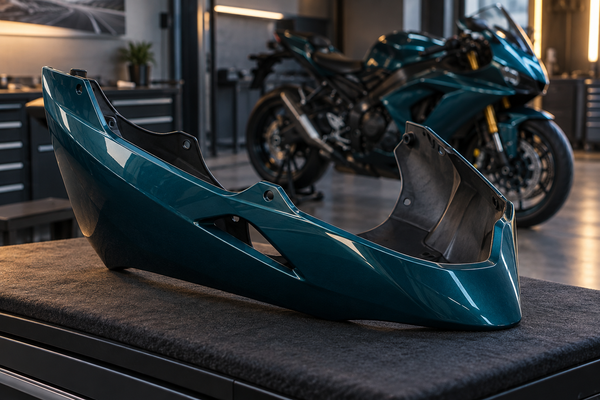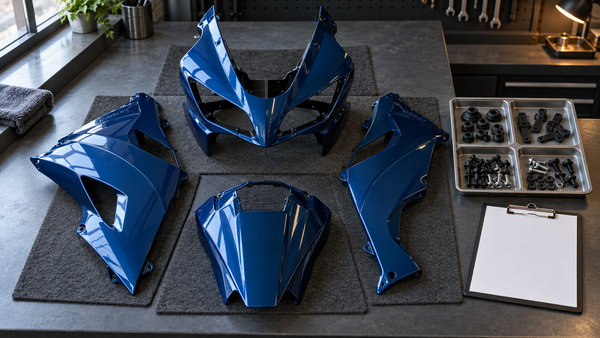

Painted and unpainted motorcycle fairings place the finishing work in different parts of your project. A supplier-painted kit can be convenient when its confirmed design and application meet your needs. Unpainted panels may suit a project you want a separate professional finisher to handle. Neither route is automatically cheaper, quicker or better for customization. Compare the delivered surface state, finish scope, approval evidence, transport responsibilities and total quoted work before ordering.
This guide is for street-bike buyers who compare ways to buy. It is not a spray-paint tutorial. Before you choose, figure out your project type. A repair, a refresh, a restoration, and a custom build each need different levels of control, coordination, and paperwork from your supplier.
Key Takeaways
-
Supplier-painted fairings include the agreed finishing work; confirm the actual finish, application and delivery condition.
-
Unpainted fairings need an agreed finishing plan, usually with a qualified painter; the buyer does not need to perform that work personally.
-
Record the agreed finish scope and exact application separately before committing to the order.
-
Unpainted fairings might cost less at first, but the total cost also includes painting and shipping.
-
Both routes can serve a custom design. Choose according to the confirmed offer and who will perform the finishing work.
Painted vs Unpainted Motorcycle Fairings at a Glance
This section gives you a clear snapshot of the differences between painted and unpainted fairings. You see a structured comparison of five factors: delivered condition, finish scope, customization level, installation workflow, and approval evidence. Each factor defines what you receive and what responsibility you take on during your project.
Delivered Condition and Finish Scope
A supplier-painted kit should arrive with the finish specified in the order. Confirm the chosen colors, graphics and sheen, and ask what approval materials are available. A digital proof, a physical color sample and photographs of finished panels communicate different things; none should be treated as an unconditional guarantee of exact appearance in every light. Receiving painted panels does not remove the need for delivery inspection, supported pre-fit checks and appropriate installation.
“Unpainted” does not describe one universal delivered condition. A panel might have an unfinished surface, a preparatory coating or other supplier-specific treatment. Ask for the actual condition and have your chosen finisher assess the required work before quoting. Preparation, color and protective finishing depend on the substrate and compatible coating system. This guide does not prescribe a sanding, filling or primer sequence. Your responsibility is to agree who will assess and complete that work, not to assume it must all be done personally.
The delivered surface state helps determine the finishing quote. Ask whether any coating, release residue or previous preparation is present, and pass the supplier’s information to the painter. A description such as gel coat or primed does not establish a universal next step or prove the surface is ready for the chosen system. Let the finisher specify compatible preparation and any inspection needed. Resolve uncertain surface history before irreversible work rather than assuming one cleaning or sanding method suits every panel.

Key Decision Factors Compared
|
Factor |
Painted Fairings |
Unpainted Fairings |
|---|---|---|
|
Delivered Condition |
Agreed supplied finish; confirm what is included |
Exact unfinished or preparatory surface condition to confirm |
|
Finish Scope |
Supplier handles agreed finish; inspection and fitting checks remain |
Finisher assesses and quotes the compatible finishing process |
|
Customization |
Catalog or custom design, if offered and confirmed |
Design subject to chosen finisher capability and material suitability |
|
Installation Workflow |
Follow an agreed inspection, pre-fit and installation process |
Agree suitable supported pre-fit before irreversible finishing |
|
Approval Evidence |
Confirm available proof/sample and its limitations |
Record application review and finisher surface assessment |
The table is a set of questions to resolve, not a promise that every supplier uses the same workflow. A painted order puts the agreed finishing work with the supplier or its finisher. An unpainted order usually leaves a separate finishing stage to coordinate. Either route still needs exact application confirmation and a suitable inspection and installation plan. Record which party checks surface readiness, which party handles the visual approval and which party verifies the motorcycle installation.
The practical trade-off is where finishing responsibility sits. A supplier-painted order may reduce the number of parties you coordinate, while an unpainted order may let you work directly with a selected painter. Both can support custom artwork when the service is available. Neither gives unlimited control: the substrate, coating system, design feasibility and provider’s capabilities impose limits. Compare those limits against your project rather than choosing from the words painted or unpainted alone.
When Painted Fairings Make Sense
Painted fairings can suit a design that the supplier already offers or agrees to create for your order. You do not have to commission a separate painter for the same agreed work. Check how the supplier confirms the design and what finished-photo review is available. A coordinated kit may help you plan a consistent look, but paint supply, application, lighting and retained panels still affect appearance. Do not assume the result exactly matches aged original bodywork.
Painted Panel Refresh Planning
A prepainted kit still needs a supported pre-fit and an exact application check. A good-looking finish does not establish that the mounting interfaces match the actual motorcycle. Confirm the model, year, market and relevant modifications before production. Ask the supplier and qualified installer what verification process is appropriate. If a hole or panel does not align, stop and seek guidance; do not trim, drill, heat or force it merely to make the painted kit fit.
Supplier-painted does not mean restricted to a fixed catalog color. Where the service is offered, the supplier can paint a new kit to an agreed custom design before delivery. That is different from repainting a kit afterward. Later refinishing is a separate project whose feasibility and preparation need a professional assessment of the existing surface; it is not a guaranteed backup if an original color choice disappoints. Clarify the intended design before production wherever possible.
Color-Match and Turnaround Trade-Offs
If the kit must coordinate with retained panels, agree how the color will be referenced. A named color, digital photo, paint code and physical sample have different limitations. Ask whether a relevant physical sample or test panel can be supplied when a close match is important, without assuming the service is always available. Discuss lighting, sheen and aging of existing parts. These issues apply to both supplier-painted and locally finished panels.
Turnaround depends on the actual provider’s workload, design approval, finishing process and delivery arrangements. Ask for the current estimate and the conditions that could change it. Do not assume a painted kit is ready to dispatch or that unfinished panels can reach a finished-bike stage sooner. Compare two complete project plans, including any separate painter booking and necessary coating-process requirements. The current production and shipping information is the appropriate place to check NiceFairings estimates rather than relying on a generic timetable.
When Unpainted Fairings Make Sense
Unpainted panels may suit a project when you want a particular professional painter to control the finishing work, or when a supplier cannot offer the agreed design. A design missing from a catalog does not automatically rule out a supplier-painted order: ask about custom work first. Compare the capabilities and scope of both offers. The unpainted route is one way to organize a custom project, not the only route to an original color or graphic scheme.
Custom Paint and Graphics Projects
For either route, provide a clear reference and discuss what it represents. A design file describes layout; a paint code identifies a reference; a physical sample helps discuss appearance under actual lighting. Ask the selected provider what can be achieved on the confirmed panels and how approval works. No reference alone guarantees an exact visual result. Decide who will prepare the artwork, confirm the coating approach and resolve questions before finishing starts.
Unpainted does not always mean ready-to-paint. Ask the supplier for the exact delivered surface state before you order. Some panels ship with mold release residue. Some carry a gel coat. Others arrive sanded but unfilled. Each condition changes the prep work your painter must quote. Get that answer in writing.

Budget and Control Considerations
An unpainted offer may have a lower initial panel price, but do not assume that relationship without comparing actual quotes. The two offers may differ in supplied parts, substrate, preparation or other scope. A separate painter can add labor, materials, facility time and transport costs. Compare the total agreed work and any exclusions, rather than treating the absence of paint as a guaranteed saving.
Working directly with a chosen painter can give you a different approval relationship. You can discuss available coating systems, sheen and graphic placement with that provider, subject to feasibility and material compatibility. You also need to coordinate the panel condition, transport and approval stages. Supplier-painted custom work can offer similar design discussions through a different provider. Choose the arrangement you can manage and whose confirmed scope meets your needs.
Dry-Fitting and Workflow for Unpainted Fairings
Trial Fit Before Irreversible Finishing
Agree an appropriate supported pre-fit process with the supplier and qualified installer before irreversible finishing. This can identify discrepancies while questions can still be referred back to the supplier. It does not mean the buyer should modify the panels or assume every apparent mismatch is a panel defect. Review the seller’s applicable terms before installation or finishing work. Do not infer a universal return rule, or assume a trial fit guarantees the final result.
Have the qualified installer review the correct application, mounting interfaces and retained components using the applicable instructions. Record any concerns with the supplier before proceeding. Do not force a panel, enlarge a hole or apply heat to resolve an unexplained mismatch. Photographs can communicate a question, but they do not establish exact geometry or clearance. Share the agreed findings with the painter so the finishing stage is based on the actual project, not an assumed installation sequence. This article does not replace a model-specific fitting procedure.
Transport Between Supplier, Painter, and Installer
A separate finishing provider may add transport steps. Map the actual route: the panels might go to you first, directly to an installer for inspection or to another agreed receiving party. Each handoff needs clear receiving, inspection and packaging responsibilities. Do not assume every order must follow the same supplier-to-buyer-to-painter sequence. Discuss the sequence with the parties before booking the work.
At each agreed handoff, record the received condition and pass on relevant supplier surface information. Ask the receiving party how the components should be supported and protected, especially after finishing. The painter should advise when the chosen coating system is ready for the intended handling and packaging conditions; this is not necessarily the same as reaching its final cure state. Do not invent a universal waiting period or pack against fresh paint without guidance. Agree who arranges transport and who to contact if something appears damaged or missing.

Comparing Total Project Cost
A lower advertised panel price is only one part of a purchase comparison. Get the actual supplied-parts scope first, then add any separately quoted finishing, inspection, installation and transport work needed for your project. Some costs may already be included in one offer and excluded from another. Mark uncertain items as awaiting a quote rather than entering a guessed saving. That produces a useful comparison without assuming which route must be cheaper.
Itemized Written Quotation Checklist
Ask every vendor for a written quote. The document should list each cost on its own line. Use this checklist to compare quotes side by side:
-
Substrate assessment and compatible preparation: what is included and what needs inspection
-
Color finish: agreed system and reference or matching approach
-
Graphics: design work, masking, decal application, or custom artwork
-
Final finish: specified sheen, system and care guidance
-
Transport: shipping to the painter, return shipping, and packaging materials
-
Additional work: exclusions and the approval process for any change or remedial work
A written quote makes the agreed scope and exclusions easier to compare. It does not guarantee that no unexpected work will be discovered. Ask how additional work is approved and charged, and whether the finisher needs to inspect the panels before confirming a price. Record any assumptions about surface condition or preparation. Resolve differences between two quotes before treating their totals as equivalent.
Costs Beyond the Panel Price
Depending on the offer, additional costs can include preparation, design work, samples, finishing, transport and installation. Ask which of these are included and which require a separate quotation. Do not count a cost twice simply because both the supplier and painter mention it. Also distinguish an optional visual upgrade from work necessary to deliver the agreed finish. A short included/excluded/awaiting-confirmation column is often more useful than a speculative total.
Do not assume the unpainted route always saves money. A complex custom graphic job can cost more than a pre-painted kit. A simple solid color may cost less. The total depends on your design, your painter's rates, and how many panels need work. Get every quote in writing. Compare the full scope, not just the panel price.
What a Vendor Documents Before You Approve
Finish Approval vs Fitment Confirmation
Keep finish approval and application confirmation distinct in your records. They can appear in the same order document and may be discussed at different stages; there is no universal paperwork sequence. The important point is that an answer about visual appearance is not mistaken for a physical fit check, and a listed application is not mistaken for approval of a color or graphic.
Finish approval records the agreed visual direction, references, sheen and graphic placement. Ask what the approval material demonstrates and what uncertainty remains, especially with digital color references. Confirm the production-release and later-change process with the provider. Approval does not by itself guarantee every finished panel looks identical to a screen image, nor does this guide determine when contractual obligations have been fulfilled.
Fitment confirmation covers the physical fit. You verify that the panels mount to your exact bike model, year, and sub-model. This step checks mounting holes, tab locations, and clearance around the frame, exhaust, and controls. A panel can have a perfect finish and still not fit your bike. A panel can fit perfectly and still show a color you did not approve. Treat these as two separate checkpoints. Get both in writing before you commit.
Example: NiceFairings R6 Application
Consider the NiceFairings Yamaha R6 custom-painted kit listing as an example of a seller describing a painted ABS application. The page states a listed 2008–2016 R6 application and a made-to-order design-confirmation process. Confirm the actual motorcycle and selected order details rather than treating a broad model-year label as independent evidence of interchangeability. This example illustrates an offer and its confirmation process, not a tested fit claim.
This example shows how a vendor documents a painted application. It does not prove that parts interchange across every year in that range. Model-year listings reflect the seller's stated application. You still confirm your exact bike before you order. For a finish enquiry on a custom-painted kit, you can review the options at NiceFairings custom fairings. Current production and shipping terms appear at production and shipping. No price is quoted here because terms change.
Note what this example does not cover. It does not confirm that NiceFairings sells unpainted panels. No unpainted offering from this seller has been verified. If you want a raw panel for a custom paint project, ask the supplier directly about the delivered surface state. Do not assume a painted listing has an unpainted counterpart.
Keep the agreed finish references, confirmed application, selected variant and written scope in the approval file. Separate superseded design versions from the current one. When the panels arrive, the file helps you compare what was ordered with what was delivered and describe concerns clearly. It is useful evidence for an enquiry, not a guarantee of a particular dispute outcome.

Decision Guide by Project Type
Two Hypothetical Choice Scenarios
Think about two made-up examples. These are not real customer stories. They just show how your project type shapes the painted vs unpainted motorcycle fairings decision.
In the first hypothetical example, a rider wants a coordinated refresh and a supplier offers a custom-painted kit with an agreed color direction. The rider confirms the exact application, understands the limits of the color reference and chooses the supplier-painted route to keep finishing with that provider. Delivery inspection and supported fitting checks still follow. The choice reduces the number of providers in this example; it is not a universal time-saving promise.
In the second hypothetical example, a rider wants an existing trusted painter to develop a distinctive two-tone design. That painter agrees to assess a specific unfinished panel set and quotes the complete finishing work. The rider chooses this arrangement after comparing it with a supplier-painted custom offer, and agrees the inspection and transport plan. The reason is the preferred working relationship and confirmed scope, not a claim that catalog suppliers cannot create custom designs.
Matching the Option to Your Constraints
Start with the result and constraints of your project. For a repair or refresh, ask whether either route can deliver an acceptable coordinated finish within your actual schedule. A supplier-painted offer may reduce separate finishing coordination, but a made-to-order kit still takes production time. An unpainted set is not a finished solution until the appropriate inspection, finishing and installation work is arranged.
For a restoration, discuss the reference and limits of matching retained or aged surfaces with both providers. A paint code alone does not guarantee an exact match. For a custom build, compare the confirmed design service from the kit supplier with the service from a separate painter. Both are possible approaches. Choose the provider and process that can address the specific brief rather than assuming every custom build requires unpainted bodywork.
Consider your budget, the complete estimated schedule and your willingness to coordinate several parties. Compare what is confirmed, what is excluded and what remains uncertain in each offer. Do not substitute “painted costs more” or “unpainted gives full control” for that comparison. The more suitable choice is the one whose actual scope fits your project and whose remaining questions you can resolve before committing.
Final Installation Checklist
Pre-Installation Verification
Before final installation, have the appropriate installer confirm the required fasteners, retained fittings and application-specific instructions. Do not assume the kit contains every necessary item. Missing or questionable components should be resolved with the supplier or appropriate parts source. This final check concerns the actual motorcycle and the supplied parts, not just the paint finish.
If mounting interfaces show a mismatch, unexpected coating buildup or another concern, stop and contact the supplier and installer. Do not drill or grind a finished panel to overcome an unexplained issue. Use the actual service and component instructions for fitting sequence and torque; there is no universal cross-pattern tightening procedure for motorcycle fairing panels. Finish approval does not replace these installation requirements.
Post-Installation Review
Ask the qualified installer to complete the relevant post-installation checks for the motorcycle and components. Panel seams need not all be flush or identical because some designs intentionally overlap. Unexpected contact or misalignment needs investigation rather than a diagnosis from appearance alone. Keep records of any issue and its resolution before the motorcycle is returned to use.
Do not use an improvised bounce test or a first ride to establish that a questionable installation is safe. Clearance, control operation and fastening checks should follow the applicable service and component guidance and be completed by an appropriate person. Follow any specified reinspection interval rather than inventing a universal after-first-ride torque routine. If a concern remains unresolved, do not ride the motorcycle to test it.
The useful comparison is who will supply and approve the finishing work, in what delivered condition and at what confirmed scope. Both supplier-painted and separately finished panels can support a custom design. Neither is automatically cheaper or faster. Record the references, application, responsibilities and exclusions before ordering, and keep the later fitting checks separate from the visual approval. Treat the purchase as part of a complete finish project.
FAQ
Which route should you pick for a simple repair?
A supplier-painted option can suit a repair when the confirmed application and finish meet the project requirements. It may reduce separate finishing coordination, but still needs inspection and fitting checks. Compare the actual offer with a separately finished alternative instead of assuming painted panels always cost more or arrive sooner.
What does "unpainted" actually mean when the box arrives?
It depends on the supplier. Some panels come with a gel coat. Some have mold release residue on them. Others show up sanded but not filled. Ask for the exact delivered surface state in writing before you order. That answer shapes your painter's quote and prep work.
How does finish approval differ from fitment confirmation?
Finish approval covers how it looks: color, gloss, and graphic placement. Fitment confirmation covers the physical mount: holes, tabs, and clearance on your exact bike. They are separate sign-offs. A panel can pass one and fail the other. Get both in writing before production starts.
Who owns the panel between the supplier, the painter, and you?
Ownership, responsibility for damage and transport arrangements depend on the applicable order terms and agreements. Do not assume one universal rule. Before each handoff, agree who receives, inspects and packages the panels and how concerns are reported. Ask the finisher when handling and packaging are appropriate for the specific coating system.
Does a lower panel price mean a lower total project cost?
No. Compare actual quotes for the complete agreed scope. Separately commissioned finishing and transport may change the total, and an unpainted panel is not necessarily cheaper than every painted alternative. Mark missing prices or exclusions clearly rather than assuming a saving.