
A race bike can make three colors feel inseparable from its shape. Then you look at your own sportbike and discover that the fuel tank, headlight, indicators, mirrors and panel seams are all in different places. The useful question is not “Can I copy the 2026 MotoGP bike?” It is which part of its visual idea can work on the motorcycle I actually own?
This guide uses three documented 2026 MotoGP presentations as design references, then turns them into a street-fairing brief. It is not a claim that a NiceFairings kit is an official team product, that racing bodywork fits a road bike, or that new paint changes handling. Begin with a verified model and year; approve the layout on that bike's real panels; decide deliberately what remains original.
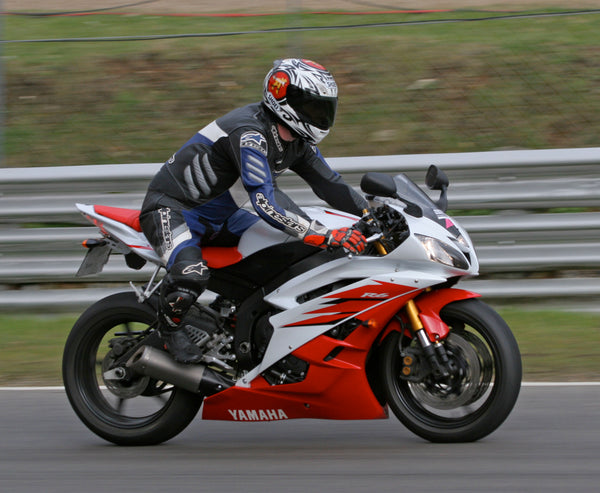
Cover: a real Honda CBR600RR photographed by Aethonatic on Wikimedia Commons, CC0. This road bike illustrates an existing red-white-blue HRC-style color language. It is not a 2026 MotoGP race bike, a NiceFairings product, or an installation result from this article.
What the 2026 paddock actually showed
The official MotoGP Trackhouse 2026 launch presented two schemes for its Aprilia race bikes: a darker updated Trackhouse identity and a Gulf-partner color scheme. The latter's light blue and orange are recognizable even before a viewer reads any sponsor mark. Its scheduled appearances were part of the team's racing plan, not a promise that every street kit called “Gulf-style” is licensed or historically exact.
The official Honda HRC Castrol 2026 presentation describes a red, blue and white factory color language in Honda's sixtieth year in the premier class. Separately, LCR's 2026 reveal gave its two sides of the garage different identities: a revised Castrol scheme for Johann Zarco and a new Pro Honda look for Diogo Moreira. These are three visual systems, not three interchangeable templates.
| Race reference | Visual idea worth studying | Street-bike question it raises |
|---|---|---|
| Trackhouse Gulf-partner scheme | Light main field with strong orange contrast | Where can the orange continue across your bike's actual nose, side and tail without a broken stripe? |
| Honda HRC factory colors | Red, blue and white arranged as large, legible blocks | Which color carries onto the retained tank, wheel and seat, and which stays on replacement panels? |
| LCR Castrol identity | Sponsor-led contrast and a separate team character | Do you want a color relationship, or are you asking for specific protected marks and team identity? |
The evidence here is that these 2026 designs were presented, not that one palette is “trending everywhere,” sells better, or makes a street bike safer. A fan may love one photograph without wanting to live with every logo, color boundary or high-contrast patch on their own motorcycle for years. Treat the race presentation as a source of design questions rather than an order form.
Translate a livery into layers before choosing a product
Start by describing the scheme without brand names. Name the base field, the secondary block, the accent, and the graphic rhythm. “Warm white main fairing, deep blue lower area, narrow red line that climbs toward the tank” is a usable brief. “Make it the 2026 factory bike” leaves the supplier guessing where to put a color when the street-bike headlight occupies the race bike's number-panel area.
Next, list the surfaces that will not be replaced. The metal fuel tank may stay red. The wheels may be black. The front fender may be original. A fairing flatlay can look perfectly balanced while the assembled bike looks divided at the tank-to-side-panel junction. Take clear daylight photographs of both sides, front three-quarter and rear three-quarter views. Include the wheels, seat, windscreen and any belly pan or tank cover that will remain. Ask for a proposal that shows the whole motorcycle, not an isolated side cowl.
Then reduce the first concept to two or three dominant colors. Race bikes are viewed at speed and in crowded imagery, so teams can use large areas and layered marks with purpose. On a road bike, every added border creates an alignment job across a seam. More colors also increase the chance that the existing tank and wheels feel like unplanned leftovers. A clean interpretation may retain the color hierarchy while deleting most sponsor marks. The result can feel race-inspired without implying it is a team machine.
If exact lettering or logos matter to you, specify them separately and ask the supplier what it can actually provide. A colorway, a brand mark and an official endorsement are different things. Do not assume a fan-made rendering grants permission to use a trademark, or that a listing called “race replica” is a licensed team edition. If the brand identity is essential, check the particular offering and your intended use before approving the design. If the color story is what you love, a mark-free scheme may be the more personal choice.
Shape and seams decide whether the idea survives the swap
MotoGP prototypes and road-legal sportbikes are different products. Race fairings may have different ducts, screens, winglets, lower sections and service openings. A graphic that reads as one long band on a prototype can be interrupted by a CBR street bike's headlight, mirror mount, intake, side vent or removable lower panel. No paint scheme changes those structures.
Make a seam map from photos of the exact model and generation. Mark nose-to-side, upper-to-lower, side-to-tail and any tank-cover boundaries. Show where a stripe begins and ends on both sides. A line that is beautiful in a single side view can appear abruptly broken from the front three-quarter angle, the angle most people actually see when the bike is parked. Our existing guide to graphics across seams and viewing angles goes deeper on that visual test; this article applies it to specific 2026 race-color references rather than re-teaching the general rule.
Ask for left, right, front three-quarter and rear three-quarter previews. Compare each preview with photographs of the real panels, not just a smooth AI silhouette. The preview can check color placement and scale; it cannot prove physical fit, exact paint color under daylight, or the appearance of hardware not shown. Look especially at the leading edge of each panel and the area where the tank meets the side fairing. If the preview hides a junction with a dark shadow, request a clearer view before approving it.

Choose the route by what you are changing
There are three common routes to a racing-inspired appearance. A surface graphic or wrap can test a direction while retaining the existing panels, but edges, complex curves and older paint condition affect the result. A repaint of sound existing panels preserves the original shapes, yet preparation and repair of cracks or damaged tabs are separate work; painting over a bad mounting point will not solve it. A replacement fairing kit is a different scope: you select new exterior pieces and a paint design while planning the original components that must be reused. None of the three routes substitutes for mechanical inspection or repairs.
The right choice depends on the condition of the current bodywork and how much of the livery must change. If only a small accent is wanted and the original fairings are sound, replacing an entire kit may be unnecessary. If the old panels are cracked or the rider wants a coordinated new color over multiple sections, a painted replacement set may make sense, provided the included pieces match the intended design. Our color-choice guide covers the general choice among replica, OEM-inspired and original schemes; here the practical task is to take a named 2026 reference and remove every assumption that does not transfer to a specific street bike.
For a concrete catalog example, NiceFairings has an active CBR1000RR-R 2020–2023 HRC-style kit listing. Its product photo lets you assess a red-white-blue direction on the photographed panel set. It does not establish that a 2026 MotoGP graphic is supplied, that a 2024-or-later CBR uses the same panels, that every inner piece is included, or that your tank will match the listing photograph. Read the exact option, model/year language and included-parts description; ask about any pictured piece whose status is unclear. The kit-contents checklist helps turn that question into a written scope.
Even within a single brand, design inspiration should not become a fitment claim. A 2005–2006 CBR600RR product and a 2020–2023 CBR1000RR-R product can share a red-white-blue idea while having entirely different shapes. Identify the motorcycle from its VIN, year, market and existing parts; tell the seller about modifications such as sliders, aftermarket lights or exhausts that alter openings. Do not buy a kit by matching a color thumbnail or a race-bike photograph.
Proof the look as a street motorcycle, not a poster
Approval needs more than “the mockup looks fast.” First, request a plain list of the panels to be supplied and the original pieces to retain. Second, mark every proposed color boundary on the actual panel layout. Third, agree on gloss or matte treatment and on which graphics are painted, under clear, or applied as surface decals, if the listing gives those options. These are different finish decisions; a screenshot does not resolve them. Fourth, ask what finished-product photographs will be provided for review and what they can show. They can confirm visible layout and apparent finish, not fit on your motorcycle.

Review the design in daylight and under ordinary indoor light, where possible. Racing launch photos have controlled lighting; a deep blue can look nearly black on one screen and saturated outdoors. Compare any proposed match with the fuel tank and wheels you are keeping. Our paint-color comparison guide explains how to document a discrepancy. If a precise tank match is critical, discuss the limits before ordering; do not assume an online color name is a paint code.
Do not hide the road-legal parts of the motorcycle just to preserve a racing composition. The headlight, turn signals, mirrors, reflectors and license-plate provisions of your actual bike and location remain relevant. Applicable rules vary by place and use; check them for your motorcycle rather than treating a race paddock image as a road-use template. Likewise, an aerodynamic winglet in a factory race photo is a design feature of that machine, not a performance promise that can be inferred from decorative street graphics. If you want to understand that boundary, read our separate race-inspired aero article.
At installation, fit the panels without forcing a hole or pulling a seam into line with a screw. Protect the paint, map the fasteners, check clearances and functions, and stop if a support or retained part is missing. That is not a glamorous final step, but it is what makes the design believable on a real motorcycle. A colorway that only works when a panel is under stress has not been successfully translated from racing to street use.
A short design brief you can send
“My motorcycle is a [verified make, model, year and market]. I like the [specific 2026 team launch] mainly for its [base color], [secondary block] and [accent], not as a request for official team sponsorship. My tank, wheels, seat and [other retained parts] will remain as photographed. Please show the proposed design on the actual panel shapes from both sides and front/rear three-quarter views. Mark where the major stripe crosses each seam. Confirm which panels and accessories this exact listing supplies, which original parts must be reused, the finish and graphic method available, and any marks you can or cannot provide. I will review the finished-product photos for visible design and finish; I understand they cannot certify fit on my bike.”
Attach daylight photographs and link the exact NiceFairings product you are considering, rather than just the MotoGP announcement. If the seller cannot identify the year range or the kit contents, pause the design discussion. A precise brief will not make two generations interchangeable, but it lets the supplier answer the questions that are answerable before production.
The enduring lesson of the 2026 paddock is not that every street bike needs the newest sponsor pattern. Trackhouse shows how strongly two colors can signal an identity; Honda HRC shows the power of large tricolor blocks; LCR shows that team identity and individual rider scheme can diverge. Keep the part that genuinely appeals to you, adapt it to the panels and retained parts of your own bike, and leave any unsupported claims of official status, fitment or performance at the garage door.
Editorial note: Motorsport launch links document the race-team presentations at the time cited. Product listings are separate commercial offerings and must be checked for current availability and exact configuration. No rider, team or manufacturer is represented as endorsing this article or NiceFairings.