A used Honda advertised as “CBR 600” could be a CBR600 F4, an F4i or a different member of the CBR family. If you are shopping for bodywork, the missing letter matters. Start with the motorcycle's documented model and year, then compare the front cowl, headlights and current parts with the specific listing. Do not choose a kit by paint or by a seller's shorthand alone.
NiceFairings groups CBR600 F4 fairings for 1999–2000 separately from its CBR600 F4i collection, which lists 2001–2003 and 2004–2007 options. Those are store categories, not a guarantee that every original part in a year range is interchangeable or that a modified motorcycle retains its original front end.
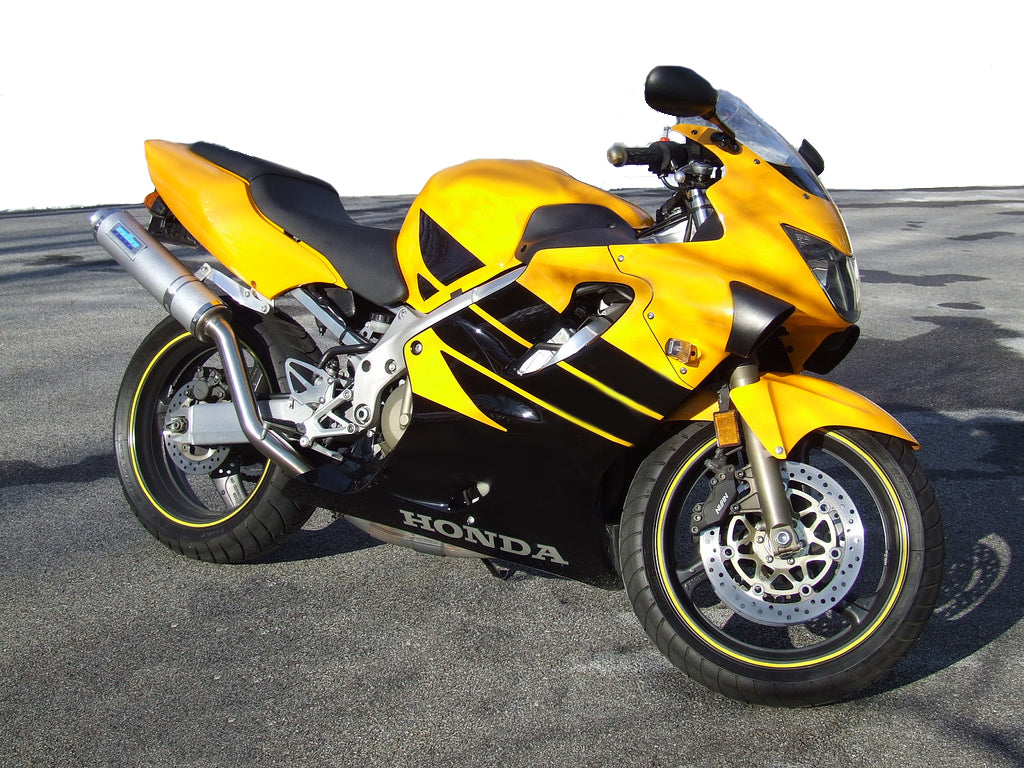
Cover: a real Honda CBR600F4 identified by its photographer as a 2000 model, with visible aftermarket exhaust. Photo: Maxquijano / Wikimedia Commons, released into the public domain. This motorcycle is not presented as a NiceFairings installation or a fitment test.
What changed when the F4i arrived?
Honda's 2001 Japanese F4i announcement describes a redesigned front upper cowl and dual headlights, alongside PGM-FI fuel injection and a separate-seat arrangement for that Japanese specification. Honda's CBR history also records the F4i's European announcement and Japanese launch. These sources explain why the designation and front assembly deserve attention; they do not prove that any individual aftermarket panel fits every regional variant.
Fuel injection helps distinguish the model's history, but it is not a fitment measurement. A decal may be missing or changed, and a new headlight can be fitted during a repair. Treat the front shape as a visual clue, then ask Honda or a qualified dealer to help identify the model and market using appropriate vehicle records. A VIN identifies the motorcycle as built; it does not tell you which panels or mounts a previous owner later installed.

A real 1999 F4 photographed outdoors. The painted bodywork and exhaust may have been modified; use it to understand the type of motorcycle, not to certify another bike's configuration. Photo: Sunni1L / Wikimedia Commons, CC BY-SA 4.0.
Compare the nose as an assembly
Stand back far enough to photograph the entire front, screen and both mirrors. Then take left and right front-quarter photographs showing where the nose meets the side panels. A tight crop of a lamp is less helpful than a view that shows the lamp opening and surrounding cowl together.
| Check | Photograph or record | Ask before ordering |
|---|---|---|
| Headlights | Both lamps, their outer edges and the surrounding nose | Does the exact cowl listing expect the lamps currently fitted? |
| Screen and mirrors | Screen outline, mirror bases and adjoining trim | Which original parts must be retained? |
| Side-to-front joint | Both seams and any visible fasteners | Does the seller have a matching view of the offered kit? |
| Damaged mounts | Tabs, brackets and the undamaged opposite side | Does the bike need a support or lamp repair first? |
| Previous changes | Aftermarket lights, race stay, signals or repaired panels | Can the seller assess this configuration, or is it unresolved? |
The table is a way to document the motorcycle, not a conversion chart. If the upper stay or a headlight support was bent in a fall, a new painted nose cannot make it straight. A technician should assess uncertain damage before the panel order or any road use.
Check the F4i tail separately
Even after you identify an F4i, do not assume that one seat photograph answers the rest of the order. Honda's US information identifies a one-piece seat as new for the 2004 F4i; the store also separates early and later F4i offers. Markets and previous modifications matter. Our F4i seat and tail guide examines that separate 2004 question.

A real 2005 F4i with its one-piece seat, shown as an example of a later F4i—not an early F4i or a NiceFairings installation. Photo: Silver Kalve / Wikimedia Commons, CC BY-SA 2.5.
If the seat or subframe has been changed, photograph what is actually on the motorcycle and explain the conversion. An F4i label on an engine or an attractive tail in a product photo cannot establish which latch, seat and support arrangement the kit expects.
Two common buying situations
The documents say F4, but the nose looks unfamiliar
Start with the recorded model and market, then look for evidence of a repair or conversion. Ask the previous owner or workshop whether the headlights, upper stay and side panels were replaced together. If there is a receipt, note the part descriptions and dates; if not, write down what is unknown. A used motorcycle can have a mixture of parts, so a confident answer about the original model is not automatically an answer about every part now attached to it.
Send the supplier a front view, both front-quarter views and the exact product link. Explain that the existing nose may not be original. Ask what photographs or part information would allow the supplier to assess its kit, and whether the listed panels are meant to work with the lights and supports currently on the motorcycle. If that remains uncertain, resolve the configuration with a qualified shop before ordering painted parts.
The bike is an F4i, but the front panel is missing
A missing piece removes the easiest visual reference. Do not fill that gap by assuming that a picture from a different year or market is the correct assembly. Photograph the fitted lamps, screen, mirrors, exposed supports and the edges of the remaining side fairings. If the bike has a repair history, retain photographs of damaged pieces and any identifiable labels or part numbers. Ask the seller which mating parts are required and compare the specific listing with those records.
When the bike also needs a tail, treat that as a second question. Seat style and rear support must be assessed in their own right; a front-end match does not establish the seat or tail configuration. List both questions in the same message, but do not accept one answer as proof of the other.
Make the quote useful before committing to paint
Ask for a written breakdown of the exact kit, selected design and any optional or separately sourced items. A photo showing many panels is helpful for recognizing a design, but it is not a carton-by-carton inventory. Request clarification about the front upper cowl, side panels, tail pieces and small trim specific to the listing, as well as the fasteners, rubber mounts and heat protection you may need to retain or source. What is included varies by product and should be confirmed on the order.
If the seller asks for more photographs, keep the original images and the resulting answer together with the product link and your chosen options. This record helps if the bike arrives at an installer weeks later: the installer can see what was discussed and identify unresolved questions before painted surfaces are placed under stress. Neither the store's year category nor this guide guarantees fit on a motorcycle with unknown alterations.
Write down the pieces you need
“Full fairings” can describe a set of painted panels without including lamps, inner trim, screen, mirrors, rubber grommets or brackets. For the exact product and selected paint option, ask the seller which parts are in the order and which parts are reused. If your old bike is missing a panel or its fixing hardware, identify that before you budget for the project.
Keep undamaged originals until the replacement has been checked. They can help a technician compare visible outlines and mounting locations. Do not force screws to pull a painted panel into position, or cut a lamp opening to solve an unexplained mismatch. Start by checking the model, the selected product, the existing supports and the condition of reused parts.
Send a question the seller can answer
Give NiceFairings the model designation, year and market, photographs of the front and both sides, any known repairs or modifications, and the exact product link you are considering. Ask whether the offer is intended for that documented motorcycle, what is included and what is still uncertain. A precise answer may require more photographs or an in-person inspection; a picture alone is not proof of fit.
Begin with the 1999–2000 F4 collection or the F4i collection, then discuss your chosen color through custom fairings. Confirm the model and front assembly first; the right paint scheme is more enjoyable when it belongs to the bike in your garage.