
Ducati's October 15, 2026 Panigale V4 announcement includes a detail beyond power and lap times: the 2027 Panigale V4 S joins Ducati Factory Made. Ducati says buyers can configure colors, liveries and certain homologated accessories at the factory. It is an appealing idea. Your motorcycle arrives with a deliberate identity rather than an aftermarket plan still in your phone's photo folder.
The important comparison for a Japanese sportbike owner is not that a painted replacement kit becomes a factory-built Ducati. It does not. The useful question is how to plan a coherent, documented, reversible custom appearance on the bike you already own.
Factory choice and aftermarket choice are different contracts
Ducati Factory Made concerns a specific new model and the options Ducati offers during production. A custom-painted fairing set for a Honda, Yamaha, Kawasaki or Suzuki is a separate product made to fit an already-built motorcycle. It may let you keep the original panels in storage and explore a design that the factory never sold, but it does not inherit factory paint specifications, homologation or warranty coverage by association. Keep those distinctions clear when comparing prices or finish claims.
For a current owner, the aftermarket route has one strong advantage: you can begin with the actual bike, not a configurator. Take front, both-side and rear photographs in consistent daylight. Mark what stays original: tank, wheels, frame, screen, inner plastic and seat. That inventory determines whether a new fairing color will look unified or like one unrelated section of a motorcycle.
Make the brief specific enough to paint
“Make it like a factory race bike” is a mood, not an order specification. Choose a base color, secondary color and accent; describe whether the finish should be gloss, satin or matte; and say where graphics must stop at panel seams. Identify any number, name or logo and confirm that you have the rights to use it. Send references for the layout, then ask the seller to confirm what can actually be reproduced on your model's panel shapes. A reference photograph from a different model may need redesign rather than direct copying.
Ask for a written rendering or design confirmation if offered, followed by finished photographs before shipping where available. Inspect both sides, nose and tail, not just the most flattering side view. Different panels can catch light differently; an online image cannot promise a perfect match to aged original paint. If exact color matching is important, discuss a physical sample or a reference part and ask what tolerance the painter can realistically commit to.

Fitment is still the first filter
Before debating stripes, confirm the exact model and year. A 2024 CBR500R kit is not a CBR500R FOUR kit merely because the names share “500R.” The same principle applies to R6 generations and to GSX-R 600/750 variants. Inspect the specific listing, not just a broad brand collection, and provide photographs if the bike has aftermarket lights, screens or repaired brackets.
NiceFairings lists year-specific choices such as Honda CBR500R 2024–2026, Aprilia RS660 2020–2024 and Yamaha R6 painted bodywork. These are examples of current catalog offers, not universal promises about every trim or modified motorcycle. Use the product page that matches your bike, then confirm the supplied pieces and design before production.
Keep the original set and document the change
If your stock bodywork is sound, store it clean, dry and labeled with its original fasteners. Photograph the bike before removal and each mounting point as you work. That protects your ability to return to the factory appearance and gives a future buyer a clearer history. It is also useful if a painted replacement arrives with a question about a tab, rubber mount or gap: you can compare against the old part rather than relying on memory.
What the buyer is actually purchasing
The Ducati news is about a production program for the 2027 Panigale V4 S. It should not be used as a shorthand for every painted fairing offer. With a factory program, options are selected as part of the specified new vehicle. With an aftermarket kit, you purchase panels and a paint or graphic specification for a motorcycle you already own. The installed result depends on the exact kit, the existing bike, and the quality of the fitment and finishing process. Neither model is inherently the right answer for every rider; they solve different ownership problems.
| Decision | Factory-configured new motorcycle | Painted replacement bodywork |
|---|---|---|
| Starting point | A new model offered by its manufacturer | Your existing, year-specific motorcycle |
| Design menu | The manufacturer's approved colors and options | A seller's available designs or confirmed custom brief |
| Original bodywork | The delivered motorcycle's own specification | Often removable and storable if still sound |
| Fitment proof | Manufacturer configuration for that vehicle | Exact seller listing plus verification of your bike |
| Warranty and approval | Terms of the vehicle and option program | Terms of the kit; no automatic factory approval |
| Reversibility | Depends on the original purchase specification | Possible when original parts and hardware are preserved |
This table is a comparison of purchasing paths, not a claim that every aftermarket kit includes all necessary pieces or that every factory color is unique to a single motorcycle. Ducati says Factory Made offers 11 colors and two liveries for the Panigale V4 S, plus selected homologated accessories. “Unique” in the announcement describes a configurable combination; it should not be turned into a promise that no other buyer can choose the same livery. Avoid repeating marketing language beyond what the manufacturer actually offers.
An order packet beats a vague inspiration board
If you are considering painted replacement fairings, make a one-page packet before requesting a quote. Put the exact motorcycle model, model year and market at the top. Add full front, left, right and rear photographs. List any changes to the screen, lights, brackets, tank, tail or exhaust. Attach one or two visual references for the color direction, then write the specific paint and graphic decisions you want confirmed. The packet should say which stock pieces remain visible, because a beautiful side-panel design can look disconnected when the tank or inner trim stays original.
Below that, list the exact pieces you expect in the box. The order should distinguish a front nose, upper sides, lowers, fender, tail panels, seat cowl, windscreen, tank cover and small trim where relevant. Do not assume these are all included. A gallery may show a dramatic layout but use a different option or omit a hidden attachment part. Ask for an itemized reply from the seller. If you want the same color across several pieces, note which surfaces must match and how the seller handles the final photo approval.
For graphics, distinguish an inspiration reference from a licensed logo. A racing photograph can be a useful palette example without granting rights to reproduce team trademarks. If you want a brand mark, number or personal name, ask the seller about its policy and provide suitable artwork where you have permission to use it. This step also avoids poor-quality raster logos that look crisp on a phone screen but print badly at panel size.
Three owners, three different choices
The first owner has an undamaged 2024 CBR500R and wants a deep green scheme. They can keep the OEM red set in labeled storage, discuss the exact 2024–2026 CBR500R product and confirm the finish and included parts. They should not describe the result as a Honda factory option or assume that a photograph proves a color match to their original tank. The value is a reversible new appearance on a known motorcycle.
The second owner has a Yamaha R6 with previously repaired brackets. Before paint, they should verify the exact R6 generation and inspect the mounting points. A custom kit for the advertised R6 range cannot correct a bent front stay by itself. They may need a mechanical repair before a painted set will sit evenly. The right order of work is fitment, then finish.
The third owner wants a Ducati-like custom livery but rides another model for which no verified NiceFairings listing is visible. They should not select the nearest-looking panel set and hope. A local painter working with sound original pieces, a reversible vinyl design or waiting for a model-specific kit are more defensible options. A trend story can inspire a color brief; it cannot create inventory that does not exist.
Judge the final result with the bike assembled
When finished photos are offered, ask for front, both sides and tail in reasonably consistent light. Verify the requested color boundaries and graphic placement, and compare them with the written order. Once the parts arrive, inspect them before installation and dry-fit all major pieces without forcing fasteners. Review the gap around the screen, lights, tank and tail, plus steering and heat clearances after assembly. A close-up of smooth clear coat is useful, but it says nothing about whether the full set fits your modified motorcycle.
After installation, photograph the finished bike from the same angles used in the brief. This gives you a fair before-and-after comparison and a record of what was fitted. Keep the paint confirmation, product URL and photographs with the original panels. If you sell the bike later, you can show the transformation honestly rather than asking the next owner to guess why the bodywork changed.
The 2027 Panigale V4 S shows that individualized liveries matter even at the factory level. The practical takeaway for an existing sportbike is a disciplined order: verify the bike, define the visible whole-bike palette, confirm kit contents and proof images, and preserve a way back. That is how a custom appearance becomes a satisfying project instead of an expensive mismatch.
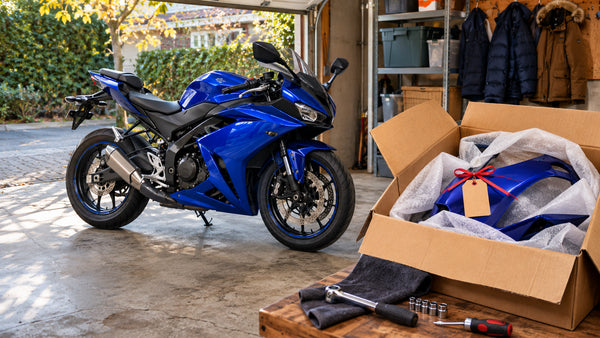
Cover: NiceFairings' own photographed green painted CBR500R 2024–2026 bodywork. It illustrates an aftermarket custom-color option, not a Panigale or factory production process.