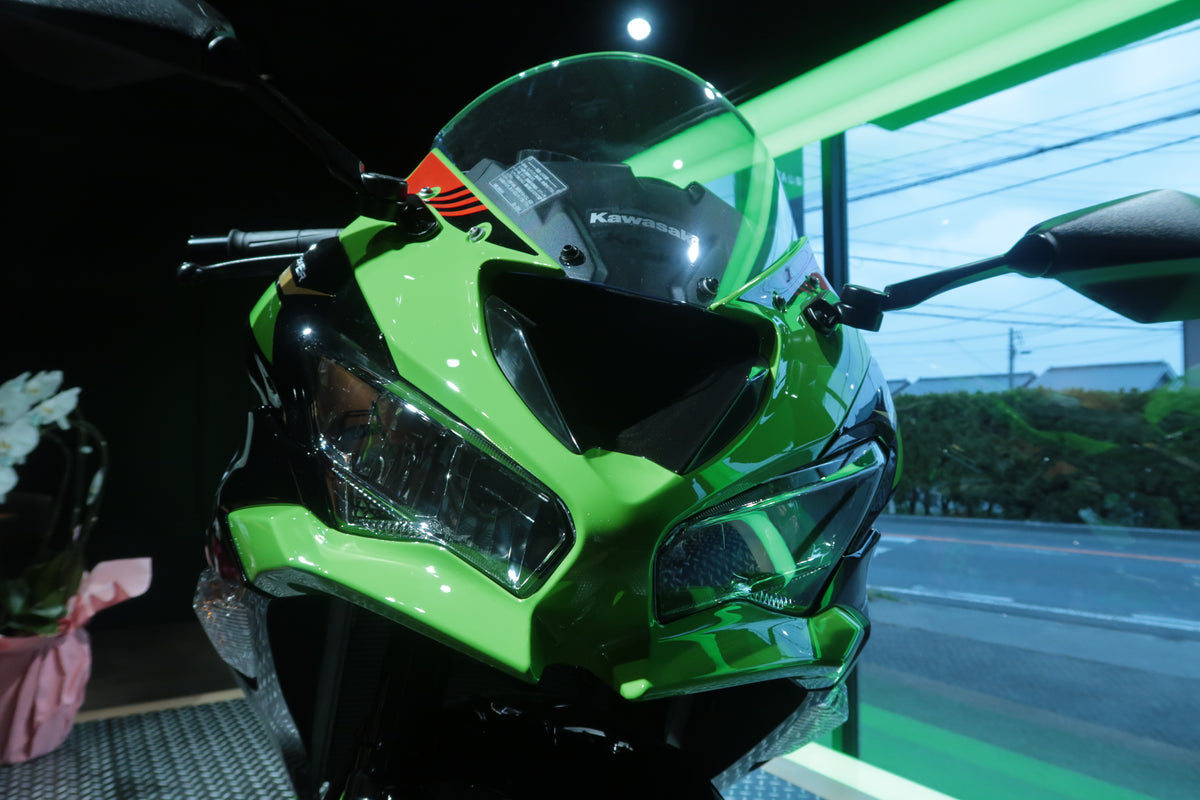
The words “ZX-6R 636” can appear on two listings that are not intended for the same front-end assembly. That is the real risk at the 2023/2024 model-year boundary. A green paint scheme, a familiar displacement badge or a seller's generic photograph does not establish which nose, headlight surround, inner pieces and supports are on your motorcycle. The practical task is to identify the machine you actually own, document any changes to its front end, and ask what the particular fairing listing supplies.
Kawasaki's 2019 launch information describes a renewed front and tail cowl for that model generation. Its 2024 US model announcement describes compact LED headlights and layered front-cowl styling. Those are sound reasons to pause at the boundary. They are not a statement that every fastener, side panel or bracket is different, nor evidence that a particular part can be interchanged. For that, use the parts information for the exact model code and inspect the motorcycle.
The cover photograph is a real 2020 ZX-6R photographed from the front. It illustrates the earlier front appearance; it does not depict a 2024 bike, a NiceFairings kit, or a fitment test. Photograph by サフィル on Wikimedia Commons, CC BY-SA 4.0; the photograph is used unaltered.
Why the year label is a starting point, not a verdict
NiceFairings places 2019–2023 ZX-6R 636 designs and 2024–2025 ZX-6R 636 designs in separate collections. That is a useful browsing boundary: it prevents a shopper from treating a single “ZX-6R” search as one continuous shape. It cannot, by itself, tell you whether an individual motorcycle still has its original upper stay, lights, inner trim, mirrors or tail assembly. Nor does the collection title prove that every photographed item is included in a particular box.
Model year is not necessarily the same as first-registration year or the year a second-hand seller typed into a listing. Start with the vehicle's documents and model identification, then check the relevant Kawasaki owner-center parts lookup for that exact market and variant. The 2023 US ZX-6R parts lookup and a 2024 ZX-6R ABS cowling lookup illustrate how specific those references are. They are examples, not a substitute for selecting your own model code. A model code from a different market or trim may lead to a wrong inference even when the year matches.
There are two separate questions here. Generation selection: which year-group listing should you investigate? Item compatibility: does the particular replacement piece work with the retained hardware on your motorcycle? The first can often be narrowed by documents and visible front-end design. The second may require part numbers, measurements, photographs and a technician's examination after damage. Do not turn a useful store filter into a universal interchange rule.
Make a five-photo packet that answers something
Ask a friend to hold the motorcycle upright safely, or photograph it on stable stands. In daylight, take one straight-on photograph showing the complete nose and both lamps; one from each front quarter showing how upper cowl and side panels meet; and one from each side with the windscreen, lower panels and tail visible. Move back enough to keep edges in frame. Avoid a fisheye lens, heavy portrait blur and a photograph taken so close that the headlight opening is cropped away. A clean image helps someone else compare shapes without pretending a photograph measures bolt holes.
Add a small second set of detail photographs where there is damage or modification. Useful views include the lamp mounts, mirror bases, screen attachment points, front stay, inner trim, upper-to-side seams, turn signals and surviving tab locations. Photograph both the left and right sides, even if only one side looks damaged. If a tab is broken, show the surrounding intact structure; a broken tab alone makes a poor template. Do not remove electrical, brake or structural parts solely to stage a picture. An existing workshop photograph or the damaged original panel may be enough to show the retained hardware.
Label the packet with the model year from the paperwork, the full model designation if known, market, and whether the bike is stock, track-converted or previously repaired. Write “unknown” where you lack evidence. That is more useful than confidently describing an unseen bracket as original. A 2024-registered machine with an earlier replacement nose or race stay poses a different ordering question from an untouched 2024 road bike, even if the seller describes both as a 2024 ZX-6R.
Read the seam as a system, not a single plastic edge
Suppose a replacement nose seems to meet the side fairing at the wrong angle. It is tempting to blame the painted panel or assume a different year kit will solve it. But the apparent seam is the outcome of several components: upper stay position, lamp and inner trim locations, windscreen mounting, rubber seats, neighboring side pieces and the panel itself. A crash-damaged stay can make a correctly identified panel appear wrong. Conversely, a wrong-year nose may be impossible to correct by adjusting a sound stay. Neither possibility can be settled from a catalog thumbnail.
The same logic applies around the chin and lower-cowl transition. Check whether the intended year group and the motorcycle's actual front assembly agree, then establish which supports will be reused. If a gap remains, compare the original panel, new panel and retained mounting points before any permanent change. Enlarging a hole, forcing a tab or tightening a screw against a visible mismatch hides the diagnosis and can damage both parts. This article is an ordering guide, not a drilling or repair instruction. Where lamps, wiring, steering clearance, cooling airflow or impact-damaged supports are implicated, a qualified mechanic should assess the bike before riding.
An owner may also discover that the damaged assembly already contains mixed-generation or aftermarket components. Record that configuration without assuming it was installed correctly. A previous owner's ability to make a piece attach is not proof that it clears the tire at full compression, leaves the controls free at full lock, or preserves the intended lighting. The safe ordering decision may be to inspect and repair the motorcycle-side hardware first.
Write down what the kit replaces—and what it does not
“Full fairing kit” is not a universal bill of materials. Before choosing a design from the wider NiceFairings ZX-6R collection, make an inventory of the parts that are damaged and the parts you intend to retain. The table below is a way to organize questions, not a promise about what any particular product contains.
| Area | Photograph or record | Ask about the exact listing |
|---|---|---|
| Upper front | Nose shape, headlight openings, screen edge and mirror bases | Is the upper cowl included, and what stock lights, screen or mirrors must be reused? |
| Sides and lowers | Both side profiles, inner trim and lower seams | Which left and right panels are supplied, and are inner pieces or ducts separate? |
| Tail and fender | Rear bodywork, seat edge, front fender and fasteners | Which painted pieces are included; which OEM supports remain necessary? |
| Mounting hardware | Intact tabs, stays, grommets, collars, screws and clips | Is any hardware supplied, or must the original parts be retained or purchased? |
| Altered equipment | Exhaust, signals, race stay, sliders and repaired brackets | Has the seller assessed this exact configuration, or is fitment still unresolved? |
Product photos are good for seeing colors and the general panel layout. They can show a windscreen, lights or fasteners for presentation even when the written package contents are narrower. Conversely, a tiny thumbnail may omit a supplied panel. Read the description, options and written response for the specific product URL. Save a dated screenshot of the selected design and its contents. A seller's broad claim of “100% fit” cannot establish that a bent motorcycle-side bracket is sound or that a race conversion follows the stock configuration.
When deciding between one replacement panel and a complete painted set, consider color matching separately from physical fit. Paint on an older machine may have faded; a newly painted panel can look different beside original pieces despite having the correct shape. A complete kit may solve a livery mismatch but create more dismantling work. A single panel may be economical when the adjacent pieces and supports are intact. Neither route should be chosen until the damaged and retained components are clear.
Use parts diagrams to narrow a question, not to declare interchangeability
The Kawasaki owner center is valuable because it presents named assemblies for a particular model code. Compare the relevant cowling, lamp, mirror and bracket diagrams for your identified bike, and write down the specific part or support you are uncertain about. If another year appears to use a similar-looking item, do not stop at the drawing: confirm the applicable part number, variant and supersession information through the manufacturer or dealer. Different callout labels can describe one part family; similar illustrations can conceal different fittings. Either way, a blog cannot establish interchangeability from appearance alone.
This is particularly important if the machine was bought after a crash. A missing rubber collar, distorted front stay or substituted lamp mount can make a prospective fairing purchase look like a year-group problem when it is a repair problem. If the shop identifies a motorcycle-side fault, address it before evaluating painted bodywork. If the question is simply whether a selected NiceFairings kit includes a pictured component, ask NiceFairings directly; the OEM diagram cannot tell you the contents of an aftermarket carton.
Kawasaki's styling announcements and the owner-center diagrams answer different questions. The announcement explains why a rider should notice the revised 2024 face. The diagrams help identify the actual parts and supports in a specified model. The collection page tells you what the store markets for a year group. Your photographs show what is currently on the bike. A responsible purchase uses all four kinds of evidence without letting any one of them do a job it cannot do.
Send a supplier a bounded, answerable request
Choose one or two product URLs from the appropriate 2019–2023 or 2024–2025 collection. Then send the five photos, model details and a short list of modifications through the NiceFairings contact page. Ask whether that exact listing is intended for the identified model and configuration; which pictured components are supplied; which stock lights, screen, trim, brackets and hardware must be transferred; and which details the team cannot confirm remotely. If the bike is damaged, say so up front instead of presenting it as a standard motorcycle.
If you want a colorway or graphics different from the listing, discuss that as a separate request through custom fairings. A paint mockup can confirm visual intent; it should not be treated as a mechanical fitment approval. Likewise, check the store's production and shipping information for the current process instead of assuming the order ships immediately after a design is chosen. Keep the final written product URL, inclusions, customization agreement and unresolved fitment questions together.
A useful supplier reply may be limited: “This kit is listed for the 2024–2025 year group; the product includes these painted panels, but please verify your non-stock stay and lighting locally.” That is more credible than a blanket assurance about a motorcycle no one has inspected. If an essential answer remains unknown—especially what will hold the nose, whether the lamps fit, or whether a damaged support is straight—pause the order until a technician or the appropriate parts source resolves it.
A decision example: two similar ads, different bikes
Imagine two riders both search “ZX-6R 636 fairings.” Rider A has a documented 2023 road bike with stock lamps, intact supports and cosmetic damage to one side. The 2019–2023 collection is a sensible starting point. Their main work is to identify the exact damaged panel, compare its seams and fasteners, and ask whether one panel or a full color-matched set best suits the repair. The 2019–2023 ZX-6R installation guide can help frame the later fitting stage, but it is not proof that a product image supplies the required hardware.
Rider B has paperwork for a 2024 bike but the front was repaired with an aftermarket stay, different lights and track-oriented bodywork. The 2024–2025 collection is the correct place to begin researching the stock-year offering, yet it is not enough to approve an order. Rider B needs photographs and a parts-side inspection to identify the installed assembly. Depending on that inspection, the answer may be a stock restoration, a different compatible race-bodywork system, or a refusal to promise fit until the front support is corrected. The key distinction is not how attractive the design looks. It is whether the stated product and the actual motorcycle have a documented relationship.
Neither example is a claim that a 2023 panel can never be used on a later machine, or that all 2024 stock components are unique. A conversion could exist, but the burden then shifts to documenting the complete assembly, not borrowing a broad fitment label. This boundary guide exists to prevent a costly assumption—not to replace exact model-specific evidence.
The final pre-order check
Before payment, you should be able to answer five questions in writing: What model year, variant and market does the motorcycle actually have? Which front-end and side-body components are currently installed? Which exact product URL and year group is being ordered? What is included in that package versus retained from the motorcycle? Which fitment or repair questions remain for a technician? If one answer is unknown, label it unknown and assign it to the person able to verify it. Do not bury it beneath a promised paint color.
The value of this small evidence packet is not bureaucratic thoroughness. It lets the seller answer a specific bodywork question, lets the mechanic separate a panel problem from a motorcycle-side problem, and lets the rider understand what the order will actually change. That is a stronger basis for a ZX-6R refresh than choosing the most compelling photograph under a generic “636” search result.