A fairing quote can look complete while still leaving part of the bill unpriced. The useful number is not simply the biggest figure on the page: it is the total for your agreed work, with unknown charges and optional choices clearly separated.
This worksheet shows how to add up two offers without counting included work twice or treating a blank shipping line as free delivery. All figures below are fictional examples in the same currency. They are not NiceFairings prices, market averages, or evidence that one type of fairing always costs less.
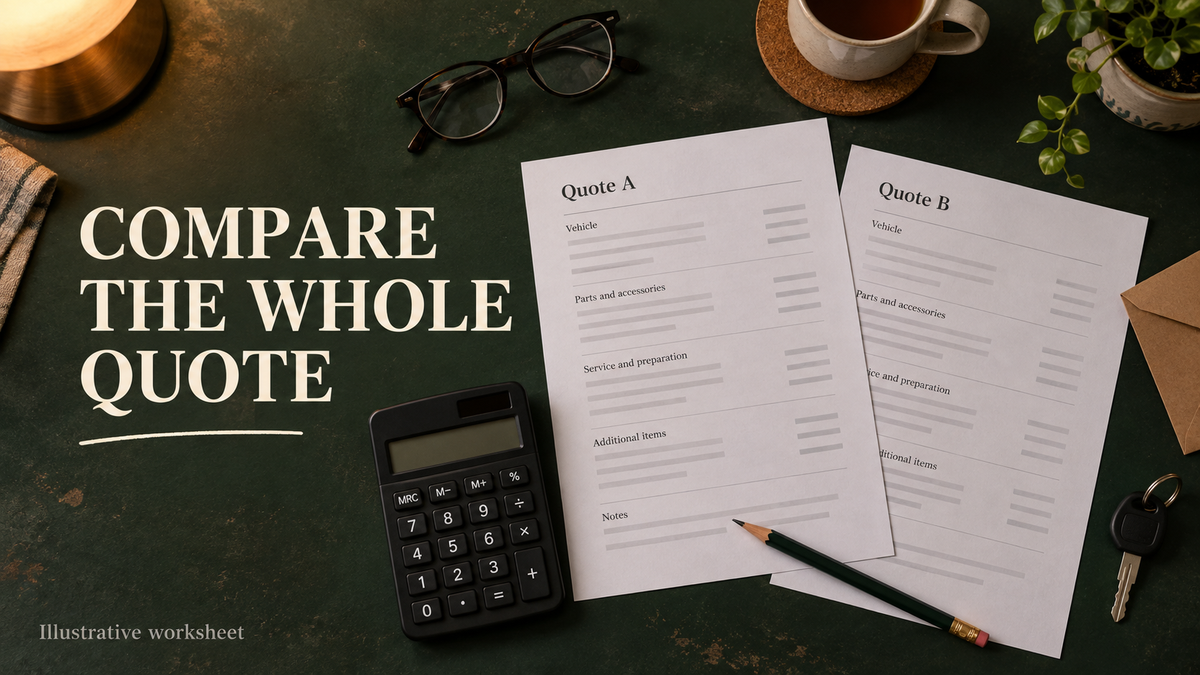
The cover is an AI-generated illustration of quotation paperwork, not a customer invoice.
Start with a matched scope, then do the arithmetic
Before calculating, establish that both offers address the same motorcycle application, replacement panels and agreed finish. A single painted side panel and a complete unfinished kit are different jobs. An installed price and a parts-only price are different jobs too.
Use our fairing quote scope checklist to resolve those differences first. This article focuses on what to do with the amounts once the scope is recorded.
Give every line an amount and a status
Use two columns for each quote: the amount and its status. A blank cell is not a zero. If paint is included in a kit price, record that fact instead of adding an imaginary separate paint charge.
| Status | How to record it | How it affects the total |
|---|---|---|
| Known, required charge | Written amount for agreed work | Add once to the known subtotal |
| Included in another line | Included in kit / paint / labor, with reference | No additional amount; do not count twice |
| Unknown | Not quoted or awaiting assessment | Keep explicitly unresolved |
| Optional | Separate price for work you may choose | Add only to the version where selected |
| Required but excluded | Needed for your job but outside this supplier's scope | Obtain a separate amount; the job total is incomplete until resolved |
For example, installation might be excluded from a parts seller's offer. That does not make the offer inaccurate, but you still need an installation amount if your comparison is for a finished, installed job. Mark who supplies each missing figure and when it will be confirmed.
Worked example: the lower headline number is not a finished total
Suppose both offers cover three specified panels. Quote A lists three panels at 200 each, paint at 300, and delivery at 50. Quote B lists three panels at 150 each but leaves paint and delivery unquoted.
| Line | Quote A | Quote B |
|---|---|---|
| Three panels | 3 × 200 = 600 | 3 × 150 = 450 |
| Agreed paint | 300 | Unknown |
| Delivery | 50 | Unknown |
| Known subtotal | 950 | 450 |
The difference between the known subtotals is 500. That is not a proven saving: Quote B still needs two amounts. These figures also exclude any other charges that apply to the real job, such as installation or applicable tax. Until those are addressed consistently, neither number is a complete installed total.
If B later confirms paint at 350 and delivery at 80, its subtotal for these three lines becomes 880. The difference on that matched scope is now 70. Keep the revised written quote rather than comparing a current offer with an old incomplete figure.
Build a larger job subtotal without hiding the unknowns
The same method works for a more extensive replacement. The next example assumes six specifically agreed panels with separate paint, hardware and labor charges. A panel count alone does not prove equivalent coverage or quality.
| Agreed line | Quote A | Quote B |
|---|---|---|
| Six specified panels | 6 × 500 = 3,000 | 6 × 180 = 1,080 |
| Paint | 400 | 400 |
| Required hardware | 100 | 60 |
| Defined installation work | 240 | 420 |
| Known subtotal | 3,740 | 1,960 |
| Shipping and applicable tax | Not yet quoted | Not yet quoted |
These are deliberately fictional offers A and B, not representative OEM and aftermarket prices. The arithmetic difference is 1,780 on the listed lines; it is not a claim about typical savings, equal fitment or equal finish. Shipping, tax and any excluded required work must still be resolved before comparing the complete jobs.
Keep upgrades and contingencies separate
Suppose an optional graphic treatment costs 120. Show two versions: the agreed base job, and the same job with the selected graphic treatment. Do not add the option to one offer while leaving the other at its base specification.
A contingency for possible hidden damage is also different from an agreed charge. Label a personal planning allowance as an allowance. If a workshop cannot price additional work before inspection, ask what inspection costs, what the initial authorization covers, and how it will obtain approval for extra work. Do not turn an estimate into a promised final bill.
For shipping arrangements, review production and shipping information and request the amount and scope that apply to your order. Do not assume an unfilled delivery line includes shipping, import charges or a guaranteed arrival date.
Send a short request to close the gaps
Please confirm the total for the attached agreed panel list and finish. My worksheet shows [amount] in known required charges, [items] included in those charges, and [items] still unpriced. Please quote the unresolved items or state the exclusions. List optional work separately and confirm whether shipping and applicable taxes are included. If inspection could change the amount, please explain the approval process before extra work starts.
Keep the reply with the quote date, version and currency. When a price changes, update the affected line and the subtotal together. If you are comparing different currencies, note the conversion date and account for any actual payment conversion charges separately; an exchange estimate is not a fixed supplier price.
The final worksheet should answer three questions: What is definitely included? What remains unknown? What have you chosen to add? Once those are clear, the total becomes useful for a purchase decision. For help confirming a NiceFairings order's contents and pricing, send your model details and itemized questions.