To compare motorcycle fairing quotes the right way, check four details first. Look at what comes in the kit, what gets painted, shipping terms, and what is left out. Two quotes that look almost the same often are not. One seller may paint the inner panels, but another may not. Shipping timelines may count production time or transit time. One quote may include hardware, while another leaves parts out. Hidden charges like customs fees also change the real price. This guide gives you a worksheet to match the scope when you compare motorcycle fairing quotes. It also has questions you can send to every seller. Use these tools to get written answers before you order. Then compare quotes on the same details, not just the lowest number.
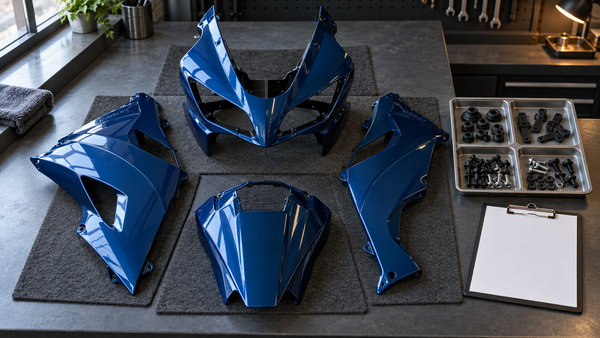
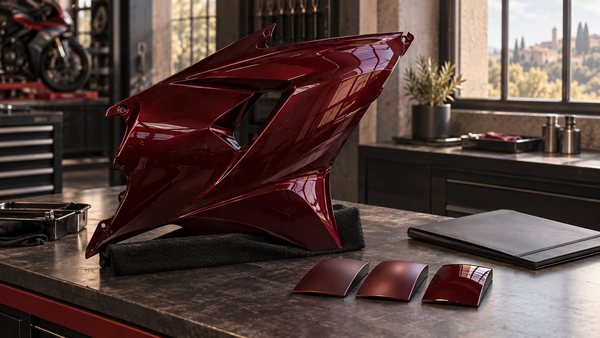
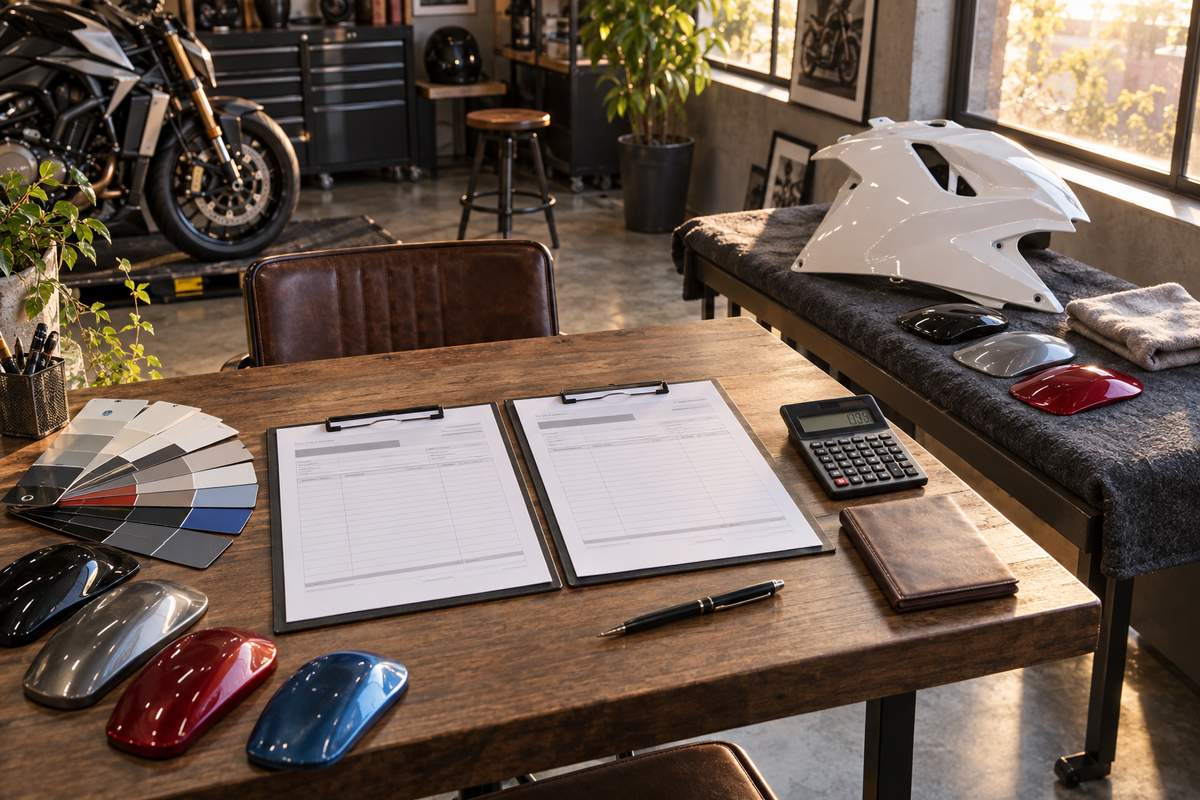
Images are AI-generated editorial illustrations, not photographs of a supplied kit or evidence of model-year fitment. Use real product information and your own motorcycle records for ordering decisions.
Key Takeaways
Check four important details: what comes in the kit, what gets painted, shipping terms, and what is not included.
Check your bike's exact model, year, generation, and market spec.
Ask for a written list of all the panels and hardware items that come with it.
Define the paint coverage and coating process, including inner panels and hidden areas; do not use coat count alone as a quality score.
Keep production time and transit time apart in shipping quotes.
Get all answers in writing before you pay.
Use a worksheet to compare quotes next to each other.
Pick the quote that fits what you need, not just the cheapest one.
Confirm Bike And Market
Match Model, Year, And Generation
A generic model name does not give a seller enough to work with. Your quote must match the exact model, year, and generation of your bike. A quote for a "CBR600RR" without a year range tells you nothing about which panels will bolt on. That name covers many model years, and the bodywork changed across them. Ask the seller to write the year range on the quote. Then check that your bike falls inside it.
Year-range fitment notes
Sellers often list a span of years for one kit. Read that span with care. A kit may fit some years in the range and not others. Ask which years share the same mounting points and panel shapes. Get the answer in writing before you pay.
Generation and trim differences
One model can have several generations with different bodywork. Trim levels can also change the side panels, the tail, or the seat area. Tell the seller your exact generation and trim. A quote that ignores these details may send you parts that do not line up.
Match Your Market Spec
Market, model year and trim can affect the parts fitted to a motorcycle. Ask the seller to verify the application against your specific bike and its original equipment rather than treating all US or European machines as identical.
Market check |
Question for the seller |
|---|---|
Original equipment |
Which lights, brackets and trim must be retained? |
Application |
Does this quote match the exact year, trim and market? |
Changes |
Do current modifications affect the quoted bodywork? |
US vs. EU lighting and plate brackets
Lighting, connectors and mounting arrangements may differ with year and market. Ask which original lights, brackets and trim the quoted bodywork is designed to retain. A fairing kit description is not proof of road-use compliance, and this comparison does not establish lighting rules for every jurisdiction.
Emissions and trim variations
Emissions rules and trim packages vary by market. These changes can affect bodywork and brackets. Tell the seller where your bike was sold.
Get Fitment Confirmation In Writing
What sellers should ask you
A careful seller will ask for your model, year, generation, trim, and market. They may ask for your VIN or a photo of your bike. Answer these questions fully. Good sellers use them to check the kit against your bike.
When a quote skips fitment questions
A quote that skips these questions is a warning sign. It may be a generic listing, not a fitment match. Send your details anyway and ask for written confirmation. If the seller will not confirm fitment, treat that quote as incomplete.

Match Motorcycle Fairing Quotes Piece By Piece
Itemize Panels And Trim
Ask for a complete written contents list. A description such as full kit does not define every component. The following are examples of items to ask about, not a promise that they are supplied:
Upper cowl
Left and right side panels
Lower fairings or belly pan
Tail section
Windscreen (some kits include it)
Inner cowl panels (some kits include them)
Mounting holes, fasteners and associated hardware: confirm each separately
Piece counts vary and can be misleading when sellers count trim differently. Match named components instead. Use the NiceFairings kit-contents checklist to record panels, trim, fasteners and any unanswered questions.
Main fairings, nose, tail, side panels
The nose, tail, and side panels make up the visible body of your bike. Make sure each one shows up on the quote. A quote that says "full fairing kit" with no breakdown leaves room for missing parts.
Windscreen, mirrors, inner trim
Windscreens and inner trim often sit outside the main kit. Mirrors and inner cowl panels may or may not come with the set. Ask the seller directly. A kit that is not complete makes you buy more parts later.
Check Materials And Construction
ABS describes a material; injection molding describes a manufacturing process. Ask for the actual material and construction information for the quoted kit. Do not infer a universal service temperature, impact behavior or quality level from a generic material label. Heat protection, finish and installation requirements must be checked for the specific product.
Material and Process: ABS, Injection Molding, and Fiberglass
Ask the seller how the panels are made. Request written construction details. Do not guess quality from thickness, flex, price, or photos alone.
Thickness, flex, and heat resistance
Thickness and flex tell you little on their own. Ask for the material spec and the molding method in writing. Heat resistance matters near the exhaust headers. Confirm whether the kit includes heat shields.
Verify Hardware And Small Parts
Small parts add up fast. Many kits leave out fasteners, and you pay for them separately. Here is what sellers often leave out:
Component |
Quote status |
|---|---|
Fasteners, clips and grommets |
Ask seller: exact items included, retained or purchased separately |
Collars, brackets and heat protection |
Confirm requirements for the actual kit and motorcycle |
Windscreen and inner trim |
Confirm inclusion and application; do not infer from a full-kit label |
Ask which existing fasteners and supports a qualified installer expects to reuse and which require replacement. Obtain a separate current quote for missing or unsuitable items. Age alone does not prove every original fastener is unusable, and an included bag of bolts is not proof that all hardware is correct.
Choose the comparison options that match your needs. Ask each seller for the same panel and finish scope before interpreting any price difference.
Bolts, clips, grommets, heat shields
Ask the seller to confirm each fastener type on the quote. Get the answer in writing.
Decals, tank cover, seat cowl
Decals, tank covers, and seat cowls may sit outside the kit. Confirm their status before you compare motorcycle fairing quotes side by side.
NiceFairings supplies aftermarket bodywork. Confirm the exact application, finish and included items for the proposed order; this guide does not make a universal fit or accessories promise.

Compare Paint And Custom Design
Define Paint Scope
"Painted" means different things to different sellers. Some paint only the outside parts you see from three feet away. Others coat the inner panels, the undertail, and the inside of the nose. You need to ask.
A painted quote should list each surface on its own. Ask if hidden areas get primer only or a full color coat. Ask if the undertail is painted the same color as the body. Ask if the inner side panels match the outer finish. Without that breakdown, you cannot compare quotes side by side.
Please give me a detailed quote with separate line items for: base ABS fairing kit, custom paint labor, graphic application, and shipping to my address. Include any taxes or fees that apply.
This request turns a vague price into a scope you can check. One quote may look cheaper until you realize it skips the inner panels and the seat cowl.
Base coat, clear coat, primer
Ask the seller to describe the coating system and which surfaces are finished. Primer, color and clear-coat stages depend on the process; a simple layer count is not a reliable quality ranking. Record the agreed finish and care guidance instead of assuming every product uses the same coating sequence.
Single-color vs. multi-color vs. graphics
Single-color, multi-color and graphics work can involve different preparation and masking requirements. Request a current quote for each actual design rather than assuming a fixed price order. Discuss where patterns cross panel seams and how any complex details will be approved before production.
Make a panel map with unique names to plan how graphics flow across seams. This map shows where each color goes. It also shows where a graphic wraps from one panel to the next. Without a map, you risk mismatched lines at the gaps between panels.
When you describe your design to the seller, include main and accent colors, graphic sizes, placement from anchor points, and no-go zones. Put the details that affect the final look first. Agree on practical tolerances.
Check Color Match And Finish
OEM color codes vs. close match
An OEM color reference may help communicate a target, but it does not guarantee a match to aged panels or photographs. Ask how the seller uses references, what finish is proposed and how differences will be reviewed. Do not assume one matching method always costs more.
Gloss, matte, and metallic options
The finish changes the look of your bike. Use this table to compare options:
Finish description |
What to agree |
|---|---|
Gloss or matte |
Appearance reference, coating process and care guidance |
Metallic or special effects |
Color/effect reference and approval limitations |
Graphics |
Placement and how patterns continue across adjoining panels |
Describe the finish you want and ask for suitable reference images or samples where available. Confirm appearance, care requirements and approval steps in writing. Gloss, matte, metallic effects and candy-style finishes are not interchangeable descriptions or automatic quality grades.
Clarify Custom Design Approval
Custom design work follows a process. You do not just send a photo and hope for the best. You approve a design before paint starts. The NiceFairings custom fairings page at https://nicefairings.com/pages/custom-fairings explains this workflow in detail. The design brief guide at https://nicefairings.com/blogs/motorcycle-fairing-guides/how-to-write-custom-motorcycle-fairing-design-brief shows you how to write clear instructions for your builder.
What counts as a custom design
A custom design includes any change from the standard color scheme. The seller needs to know these items:
Main and secondary colors
Gloss, matte, or another finish
Logos, graphics, and where you want them
Any parts that must be kept or avoided
Clear reference images in a file format and size accepted by the seller
Approval steps before paint
Ask the seller to confirm the actual approval workflow. Do not assume a process described by another store applies to your order. Use these questions:
Pick the motorcycle by brand, model, and model year.
Send a request with contact details, a design brief, and a reference image.
Who reviews feasibility and when should a response be expected?
Which design details must be approved before production begins, and how are changes handled?
Are finished-part photos available, and is further approval required before dispatch?
Record the agreed checkpoints before paying. If photos or a design preview are promised, clarify what they show, when you receive them and what happens if you raise a concern. A photograph or screen color is not an exact physical color-match guarantee.

Compare Motorcycle Fairing Quotes On Shipping
Separate Production From Delivery
Shipping terms hide two different clocks. One clock covers production. The other covers transit. A quote that blends them tells you nothing useful.
Production queue vs. transit time
Ask what event starts the production estimate: payment, design approval, materials availability or another agreed milestone. Request a separate transit estimate and define when it begins. Standard and custom options may have different availability, so do not assume an advertised shipping figure covers the complete project timeline.
Why "ships in X days" needs a definition
"Ships in X days" sounds clear. It is not. Does the clock start at payment or at design approval? Does "ships" mean it leaves the paint booth or leaves the country? Ask the seller to define the starting point and the ending point. The NiceFairings production and shipping page at https://nicefairings.com/pages/production-shipping gives current policy context. Read it before you compare motorcycle fairing quotes side by side.
Compare Shipping Methods And Costs
Sellers use different carriers and service levels. Each one changes cost, speed, and risk. Use this table to compare the options a seller may offer.
Shipping question |
Written answer needed |
|---|---|
Service and destination |
Carrier, service level, address and tracking scope |
Price scope |
Shipping charge and any excluded destination charges |
Risk and reporting |
Packaging, any cover offered, reporting contact and applicable terms |
Timing |
Production estimate separately from transit estimate |
Carrier, tracking, and insurance
Ask which carrier handles your kit. Ask whether tracking works door to door or only at the airport. Insurance matters most for fragile painted panels. Confirm the coverage amount and who files the claim.
Packaging and damage risk
Ask how painted surfaces, edges and mounting tabs are protected during packing, and what documentation accompanies the shipment. Confirm the contact and evidence needed if damage is discovered. Do not use another company’s freight example as a promised price, saving or delivery time for your order.
Review Checkout Charges
The listed price is not always the final price. Extra charges appear at checkout or after delivery. Ask about each one before you pay.
Taxes, duties, and customs fees
Ask which charges are included in the quoted total and which may be payable separately at your destination. Confirm the seller’s current shipping terms and, where needed, check with the carrier or relevant authority. Do not assume the same tax or customs arrangement applies to every order.
Payment fees and currency conversion
Ask which payment methods and currencies the seller currently accepts. Check any conversion or processing charges with your bank or payment provider and compare the final total. A fee statement from another seller does not establish NiceFairings payment terms.
Confirm shipping cost, method, and insurance in writing before ordering. A written answer protects you later.
Review Exclusions And Approval
List Common Exclusions
Installation and labor
Ask whether installation, preparation or professional inspection is included or excluded. If these services are separate, obtain an appropriate quotation rather than assuming the kit price covers the complete job.
Watch for these warning signs that point to hidden exclusions:
No return policy for fitment issues
Stock photos only instead of real product images
Too-good-to-be-true pricing for full kits
Vague compatibility like "fits most 600cc sportbikes"
Missing hardware items on the quote
Each sign means you need to ask more questions.
Warranty terms and limits
Warranty coverage varies between sellers. Some cover paint defects. Others cover manufacturing flaws only. Many exclude damage from improper installation or normal wear. Ask the seller to write the warranty terms on the quote. Do not assume coverage exists. Point to the NiceFairings contact page at https://nicefairings.com/pages/contact for policy questions. Get the answers directly from the source.
Confirm Return And Damage Policies
Return window and condition rules
Compare the actual return terms for the exact made-to-order or standard product, not a policy copied from a different store. Record the following questions before ordering:
Return question |
Ask seller |
|---|---|
Eligibility |
Does this exact custom or standard order qualify? |
Process |
Authorization, condition, timing and documentation requirements |
Costs |
Who pays shipping and are any charges applicable? |
Ask whether prior return authorization is needed, who pays shipping, whether any charges apply and which product conditions matter. Obtain the policy that applies to your order. Do not infer a fee or deadline from another store’s rules.
Damage claims and photo evidence
Check the current seller policy for reporting damaged, incorrect or missing items. Photograph the packaging and parts promptly, retain relevant records and contact the seller without delay. Do not assume a universal claim deadline or a guaranteed free replacement.
Resolve Questions Before Ordering
Questions to ask in writing
Send these questions to every seller before you pay:
Confirm the exact model year and market for the fairing kit.
Ask whether the kit fits a stock motorcycle or a modified one.
Request the complete panel list and which hardware items are included.
Obtain the written product application details from the listing.
Ask for genuine photos of the actual bodywork and mounting interfaces.
Inquire about return, warranty, and shipping policies before you modify any panels.
Request an itemized description and a process for resolving incorrect items.
Document all unknowns before you pay.
Each answer helps you compare quotes on the same details.
Getting answers before you pay
Do not accept verbal promises. Get every answer in writing. Keep the messages in one place. Use the worksheet from this guide to track each seller's responses. When a seller refuses to answer a question in writing, treat that as a red flag. A complete response lets you compare motorcycle fairing quotes fairly. You choose the best value, not just the cheapest price.

Use A Worksheet And Template
Fill In The Worksheet
A worksheet turns scattered answers into a side-by-side view. Build one before you send any messages. Use these columns: kit contents, paint scope, shipping terms, exclusions, and open questions. Leave every cell blank at the start. Fill each cell only when a seller gives you a written answer.
Columns for contents, paint, shipping, exclusions
Your worksheet needs clear column headers. Here is a starting layout:
Seller |
Kit Contents |
Paint Scope |
Shipping Terms |
Exclusions |
Open Questions |
|---|---|---|---|---|---|
Seller A |
|||||
Seller B |
|||||
Seller C |
Each row holds one seller. Each column holds one comparison point. This layout forces you to compare motorcycle fairing quotes on the same details.
Marking "unknown" as a question to ask
When a seller does not answer a question, write "Ask seller / not confirmed" in that cell. Do not guess. Do not leave it blank. That marker reminds you to follow up. It also shows you which quotes are incomplete. A quote with many unknown cells needs more work before you can compare it fairly.
Send The Same Questions To Every Seller
Message template for sellers
Send this message to every seller you contact. Keep it short and direct.
Hello, I am comparing fairing options for my [year, make, model, generation, market spec]. Please confirm the following in writing:
The exact panels included in the kit.
Which hardware items come with the kit.
The paint scope, including inner panels and hidden areas.
Production time and transit time as separate figures.
Shipping cost, carrier, and insurance options.
Any exclusions, return rules, and warranty terms. Thank you.
This template asks the same questions every time. You get answers you can place side by side.
Keeping answers in one place
Save every reply in one folder or thread. Copy each answer into your worksheet. When a seller sends a vague reply, ask again. Written answers protect you later. They also speed up your final choice.
Check Fitment, Materials, And Warranty
Assess Fitment Quality
A listing photograph cannot prove physical fit. Ask for the exact supported application, relevant product evidence and clear answers about retained hardware and modifications. An unanswered question makes the quote incomplete; it does not by itself establish what testing a seller has done. Keep unresolved fitment points visible in the comparison worksheet.
Panel alignment and hole compatibility
Ask which original supports and hardware the kit is intended to use and whether the bike’s modifications change that application. A pre-drilled description alone is not enough. Resolve mismatched panels or damaged supports with the seller and a qualified installer instead of assuming holes should be enlarged.
Arrange any pre-fit assessment according to the product instructions and the motorcycle’s service information. A generic quote-comparison guide cannot prescribe a universal bolt sequence or tightening pattern. Stop if parts require force or show damage, and seek an appropriate assessment.
When modification may be needed
These are reasons to stop and seek an assessment, not instructions to modify a panel:
A panel needs strong force or hard bending to reach a mounting point
A tab twists or sits under clear tension
The area around a mounting hole turns white, cracks, or bends
A panel bows outward or inward and will not settle during loose assembly
Alignment stays clearly wrong after you place the surrounding pieces correctly
Stop when a tab is clearly cracked. Stop when a major hole is badly placed. Stop when a panel shape is clearly wrong. Stop if a panel only fits when forced.
A slightly bent support bracket or old crash damage can make a decent fairing kit look worse than it really is. If the bike's support structure is off, the panels may never sit right no matter how carefully you install them. If the part already looks stressed on the floor, it will not get better once hardware starts pulling on it.
Compare Material And Construction
ABS describes a material; injection molding describes a manufacturing process. Ask for the actual material and construction information for the quoted kit. Do not infer a universal service temperature, impact behavior or quality level from a generic material label. Heat protection, finish and installation requirements must be checked for the specific product.
High-grade ABS and molding thickness
High-grade ABS and molding thickness are common points to compare. Ask the seller to state the material grade and the molding method in writing. A written spec tells you more than a marketing phrase like "premium material." Ask for the construction details on the quote itself.
Durability and cracking risk
Durability depends on the material, the molding method, and how you install the panels. A panel that only fits under force carries stress from day one. That stress can lead to cracks at the tabs and holes. Ask the seller whether the kit includes heat shields for areas near the exhaust headers. Confirm the answers in writing before you compare quotes.
Check Warranty Coverage
Warranty coverage on paint and manufacturing defects is a useful point to compare. Ask the seller to write the terms on the quote. Point to store policy instead of assuming coverage exists.
Paint and manufacturing defects
Warranty question |
Ask seller |
|---|---|
Scope |
What written coverage, if any, applies to this order? |
Procedure |
Reporting time, contact and evidence requirements |
Remedy |
How will the issue be assessed and resolved? |
Exclusions |
Which conditions are excluded under the applicable terms? |
What is not covered
Ask what is and is not covered under the actual seller terms. Confirm claim procedures and proposed remedies in writing. Do not treat examples in a comparison article as a warranty promise or a statement of your legal rights.
Four checks decide a fair comparison: kit contents, paint scope, shipping terms, and exclusions. Confirm your exact bike model, year, and market before you look at any price. Use the worksheet and message template to collect written answers from every seller. Then compare motorcycle fairing quotes on the same details. A low number means little when the kit skips hardware or the paint stops at the base coat. Ask about production time, transit time, and checkout charges in writing. Negotiate with facts, not guesses. Choose the quote that covers your real needs, not just the cheapest one.
FAQ
What should you do if a seller will not confirm fitment in writing?
That is a red flag. A seller who dodges fitment questions may ship panels that do not fit your bike. Pick a seller who answers clearly and puts their fitment confirmation in writing.
How can you tell if a fairing panel needs modification?
If a panel needs force, shows stress marks or does not align, stop and ask the seller or a qualified installer to assess it. The problem may involve the wrong part, damage or existing supports; it does not automatically mean the panel should be modified.
What counts as a manufacturing defect under warranty?
A defect assessment depends on the condition, cause and applicable terms. Record the issue and ask the seller to assess it under the policy for your order rather than assuming a list of symptoms guarantees warranty coverage.
Can you return a fairing kit that does not fit your bike?
Check eligibility, authorization, timing, costs and condition requirements for the exact order before paying. Made-to-order and standard items may have different terms. Do not assume installation or a trial fit leaves return eligibility unchanged; ask the seller to clarify the applicable process.
What should you do if your fairings arrive damaged?
Photograph the packaging and affected parts, keep your records and contact the seller promptly. Follow the actual reporting process and deadline for the order; this guide does not set a universal 48-hour window.
Is new hardware necessary, or can you reuse old fasteners?
Hardware reuse or replacement depends on condition, specification and the product and motorcycle instructions. Have unsuitable items assessed and ask what is included in the kit. Obtain a current quote for anything missing rather than relying on a generic fastener budget.
How do production time and transit time differ on a quote?
Ask the seller to define the start and end milestones for both production and transit. Production may depend on payment, approval and availability; transit begins according to the stated shipping milestone. Keep both estimates and any exclusions separate instead of assuming every seller uses the same definitions.