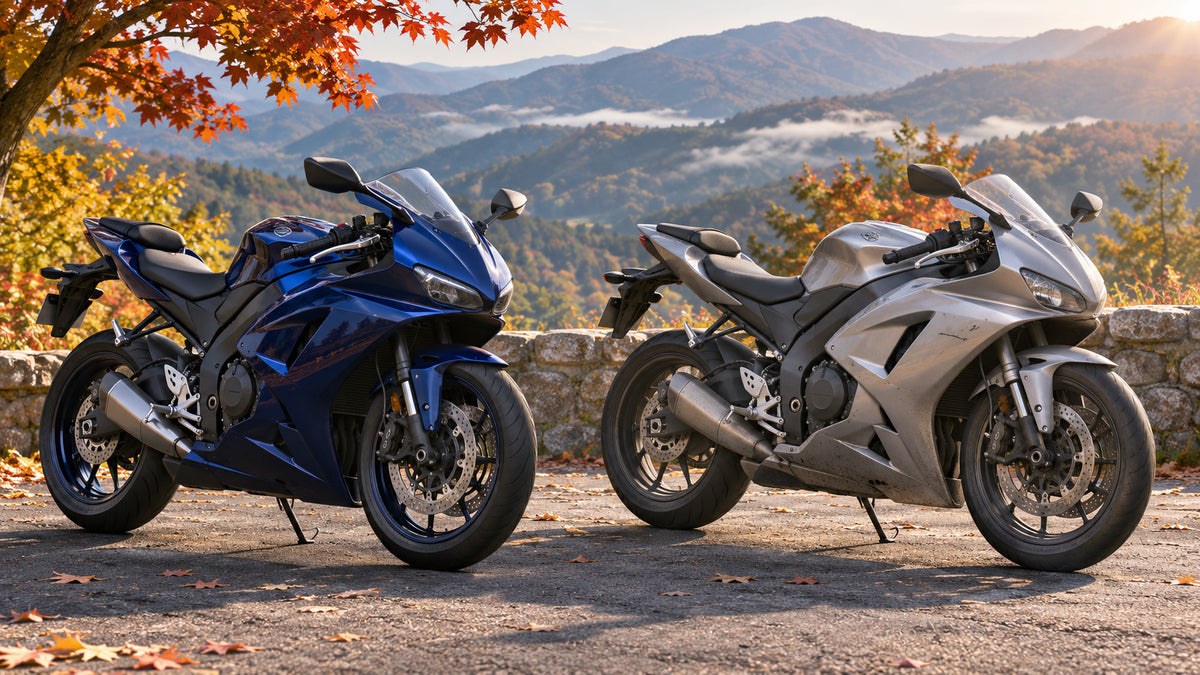
Cover: AI-generated editorial illustration of two sportbikes for a new-versus-used comparison; the motorcycles are fictional and do not establish model specifications or condition.
The new sportbike is clean, comes with the documentation you can review, and has a price the dealer can put in writing. The used one costs less upfront and leaves room for riding equipment—or it might need tires and service sooner than you expected. Which is the smarter first bike?
There is no universal winner. Buy the motorcycle you can afford to equip, insure, maintain and comfortably practice on. A new bike may suit a rider who values a clear starting point and an available manufacturer warranty. A carefully inspected used bike may make sense when its documented condition and total cost leave more room in the budget. Neither is automatically safe, cheap or right for your body and experience.
This guide compares the ownership decision, not the specifications of two particular models. Any dollar amounts below are fictional examples, not current prices, quotes or estimates for a particular motorcycle.
Start with the money you need after the purchase
Before comparing listings, set aside money for a suitable helmet, riding jacket, gloves, pants, boots, training and the paperwork required where you live. Get insurance quotes on the exact bikes you are considering. A motorcycle that uses every available dollar before you have checked those costs can be the wrong purchase even if the advertised price looks attractive.
Write down three separate figures:
- The purchase amount: an itemized out-the-door dealer quote or a negotiated private-sale price, plus applicable taxes, registration and transfer expenses.
- The first-year essentials: insurance, protective equipment, training, parking and expected maintenance based on the bike and your actual use.
- The reserve: money for a professional inspection on a used bike and for repairs or surprises without relying on a best-case guess.
For a new motorcycle, ask what the quoted price includes. Freight, dealer preparation, accessories, tax and registration can change the total. Get the quote in writing and compare the exact version and color, not just an advertisement. For a used motorcycle, ask for service records, a clear title or ownership status, and an opportunity for independent inspection before committing. Fees and requirements depend on location.
What the new-bike buyer is paying for
A new motorcycle can offer a known starting mileage, a fresh service schedule and a manufacturer warranty subject to its actual terms. You can read the manual, ask the dealer to explain service requirements and check the specific vehicle for any open recalls. Buying new does not mean ignoring tire condition, damage in transport, controls, fluid levels or the final invoice.
Ask for the warranty start date, duration, exclusions, authorized service process and any included maintenance in writing. A warranty is not the same as insurance and is not a promise to repair every crash or wear item. Optional protection plans are separate decisions; request the terms and a full price before adding one.
The other consideration is flexibility. A more expensive purchase may leave less cash for equipment, instruction and ordinary ownership costs. On the other hand, a new motorcycle can be a sensible choice when the exact configuration is affordable and the dealer's service support is valuable to you. Avoid assuming a new bike will hold its value by a fixed percentage; resale varies by model, region, condition and market.
What the used-bike buyer is accepting
A used bike's main appeal is the possibility of a lower purchase price for a motorcycle that already suits your needs. It also comes with a history that may be incomplete. Mileage alone is not a complete condition report: a bike that was stored poorly or neglected can need work even if the odometer looks appealing. Conversely, a well-documented higher-mileage motorcycle may deserve a closer look.
Ask who owns it, why it is being sold, how it was used, what service has been done, and whether it has been dropped, repaired or modified. Request invoices and photographs where available. An honest “I don't know” is better than a confident claim that cannot be supported.
Arrange a pre-purchase inspection with a qualified motorcycle shop that is independent of the seller, if available. Give the shop the model, VIN and seller's description. Ask what the inspection covers, whether any fairings will need to be removed with the owner's permission, and what remains unknown. An inspection reduces uncertainty; it cannot guarantee that a hidden problem will never appear.
Compare the total, not just the asking price
Suppose a new bike has a fictional written out-the-door quote of $8,200. A used bike is offered at $5,700. That $2,500 difference is only the beginning of the comparison.
| Cost or question | New example | Used example |
|---|---|---|
| Purchase and local fees | $8,200 written quote | $5,700 price plus applicable transfer costs |
| Inspection | Ask what the dealer's handover covers | Get a written independent inspection quote |
| Immediate maintenance | Follow actual service schedule | Price any confirmed tires, fluids or other needed work |
| Insurance | Obtain a quote for this exact bike | Obtain a separate quote for this exact bike |
| Equipment and training | Budget separately | Budget separately |
| Unknowns | Verify fees, warranty and availability | Verify service history, title and mechanical condition |
Do not subtract invented repair costs and treat the remainder as a guaranteed saving. Replace the blanks with real quotes. If the used bike needs a documented tire replacement and service, add those figures; if a possible mechanical problem has no reliable estimate, leave it unresolved until a shop can assess it. Keep the same equipment and training assumptions in both columns so the comparison remains fair.
The cheapest available used bike may not be the least expensive route to a reliable first season. Equally, a dealer's new-bike quote may be more manageable than expected once the used bike's known work and inspection are included. Choose based on the actual motorcycles in front of you.
Can you manage the motorcycle where you will actually ride?
New or used, a sportbike should feel manageable before its paint scheme wins you over. Seat height is one useful number, but seat width, your footwear, the motorcycle's balance and your experience also affect how it feels at a stop. Sit on the exact bike with the seller's permission, wearing appropriate footwear.
Can you reach the controls naturally? Can you bring the motorcycle upright from the side stand under supervision, and can you move it backward without struggling? Notice your knees, wrists and back after sitting for several minutes. If you feel uncertain, ask an experienced instructor or dealer to help you assess the fit rather than trying a maneuver beyond your ability.
If a legal, insured test ride is available and you are qualified, discuss the conditions beforehand. Do not feel pressured to ride an unfamiliar motorcycle in traffic. Low-speed control, smooth starts and comfortable braking matter more to a new rider than a high-speed demonstration. A training course is a useful place to build those skills; the Motorcycle Safety Foundation's Basic RiderCourse describes its introductory program and equipment requirements.
If both the new and used options feel too difficult to handle, widen the search. There is no rule that your first bike must be the one with the most aggressive riding position. If you are specifically comparing two entry-level models, our Ninja 500 and CBR500R beginner comparison discusses fit, slow-speed confidence and budget using a stated market and model year.
What to check before putting down money on a used bike
Begin with the identity and paperwork. Check that the VIN on the motorcycle and documents agree, and verify the seller's authority to transfer ownership. Ask about any lien, title brand, outstanding finance or required inspection, and confirm the transfer process with the relevant local authority. Do not assume that a verbal explanation resolves a discrepancy.
In the United States, NHTSA's recall lookup allows a VIN search for certain unrepaired safety recalls. Follow up with the manufacturer or dealer as needed; recall information and eligibility can vary by jurisdiction and timing. A history report is another lead, not proof that every incident or service event was recorded.
Next, look at maintenance and condition as separate questions. Request dates and records for scheduled service, tires, brakes, chain and sprockets, battery and fluids. Check for fluid leaks, damaged controls, wiring, missing fasteners and unusual movement or alignment. A competent shop can explain which issues are urgent and which can wait. The MSF T-CLOCS checklist is a useful guide to pre-ride checks; it does not replace an independent pre-purchase inspection.
Finally, inspect the bodywork without letting it make the whole decision. Ask which panels are original, repaired or replaced, why the work was done, and whether photos or receipts exist. A replacement fairing can reflect a color change or a repair; it cannot establish that the frame or other components are sound. Our used sportbike bodywork inspection guide explains how to separate visible clues from conclusions.
New-bike questions that are easy to miss
Ask for an itemized quote for the exact motorcycle, including optional accessories and delivery charges. Confirm the handover date, warranty terms and what the first service involves. Clarify whether a deposit is refundable and obtain its terms before paying. If the dealer offers financing or an add-on plan, compare the written full cost and obligations with your own budget; a monthly payment by itself does not describe the whole purchase.
At handover, check the motorcycle and the paperwork together. Confirm the VIN, model and requested options; ask the dealer to explain the owner's manual, routine checks and any visible marks or missing items. Keep the purchase documents and service schedule. If something is unclear, resolve it with the dealer before accepting an explanation based solely on a sales listing.
Also consider how long you expect to keep the motorcycle. A new bike can be a rewarding purchase if it fits your needs and your total budget. Buying a bike because it is “the last one” or because its monthly payment looks small is a different decision from choosing the right motorcycle.
A realistic approach to your first season
You do not need to plan for an accident to respect the cost of bodywork. Fully faired motorcycles use multiple painted panels, and a damaged panel may have related mounts, fasteners or inner pieces that need assessment. On a used bike, price known cosmetic work separately from any safety or mechanical work. On a new bike, read the insurance terms before assuming a cosmetic repair is covered.
If a future color change appeals to you, keep the exact model, year and variant in your records. A fairing kit is selected for a particular motorcycle; similarly named models or different generations should not be assumed to share bodywork. Check the listing's actual included pieces and ask about the parts you must retain or source separately. Original panels and photographs may also help document the motorcycle's history if you choose to change its appearance later.
Cosmetics can wait until the motorcycle is mechanically ready and you have the gear and training you need. A carefully chosen color is more enjoyable when the rest of the ownership plan is comfortable too.
Make a decision with three possible answers
Choose new when the exact bike fits you, the complete purchase and first-year costs fit your budget, and the warranty and dealer support meet your needs. Ask for the actual terms rather than treating “new” as a blanket promise.
Choose used when the specific motorcycle fits you, its identity and ownership can be verified, an independent inspection supports the purchase, and known work plus a reasonable reserve still leave it attractive. You are choosing an individual machine, not a used-bike category in the abstract.
Keep looking when either option strains the budget, makes you nervous to maneuver, or has unresolved paperwork or mechanical questions. Walking away is a useful decision; there will be other motorcycles.
Once you own the bike, explore replacement or custom fairing options by exact model and year at NiceFairings. Start with what is fitted to your motorcycle and confirm the actual kit contents before ordering.
What matters most for your first sportbike: a predictable starting point, a lower purchase price, or the way it feels when you sit on it?


