
One is a parallel twin with a quickshifter; the other is an inline four with an electronically assisted clutch. Both wear full bodywork and promise a sportbike experience without requiring a race replica. If you are choosing between a Suzuki GSX-8R and a Honda CBR650R, the decision is as much about how you want to use the motorcycle as it is about which one looks better outside the café.
The useful question is not which engine configuration wins in isolation. Think about your commute, your appetite for shifting, where the motorcycle will be serviced and which riding position works for your body. Then compare actual dealer quotes and sit on both bikes.
This guide compares manufacturer information for the 2026 U.S.-market GSX-8R and CBR650R E-Clutch. It is not a back-to-back road test: we have not measured, ridden or timed these motorcycles for this article. Prices and equipment can differ by country, model year and dealer. Verify the exact motorcycle you intend to buy.
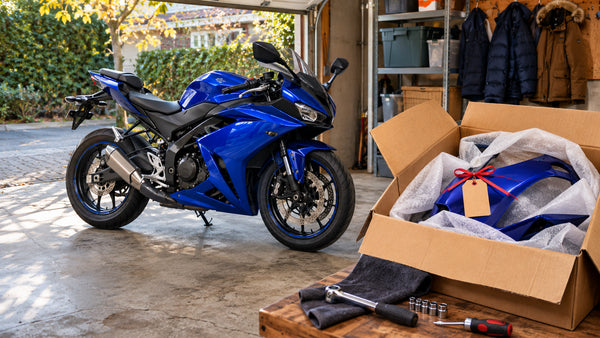
Cover: a real GSX-8R photographed by PauleMeister / Wikimedia Commons, CC BY-SA 4.0. The surroundings were extended using AI. The photographed motorcycle has a modified rear plate holder; it is not a 2026 U.S. specification or a NiceFairings installation test.
Start with the exact machines
| Published specification | 2026 Suzuki GSX-8R, U.S. | 2026 Honda CBR650R E-Clutch, U.S. |
|---|---|---|
| Engine | 776 cc liquid-cooled parallel twin | 649 cc liquid-cooled inline four |
| Gearbox and assistance | Six-speed manual; Suzuki lists a bidirectional quick shift system | Six-speed manual with Honda E-Clutch |
| Seat height | 31.9 in | 31.9 in |
| Published curb weight | 452 lb | 466 lb; Honda includes standard equipment, required fluids and a full tank |
| Fuel capacity | 3.7 U.S. gal | 4.1 U.S. gal |
| Base MSRP | $9,699 | $9,199 |
| Published destination charge | $700 | $600 |
Sources checked November 19, 2026: Suzuki's U.S. GSX-8R page and Honda's U.S. CBR650R E-Clutch specifications. Suzuki's price plus destination is $10,399; Honda's is $9,799. Neither is an out-the-door price. Taxes, registration, dealer charges, options, promotions and local availability can change the comparison. Request an itemized quote for the exact motorcycle and confirm the current manufacturer pages.
The equal published seat heights do not mean both motorcycles will feel identical when stopped. Seat shape, your inseam, boots, handlebar position and the motorcycle's balance are all part of the experience. Likewise, the listed 14 lb weight difference is not a test of how easily either motorcycle turns or feels in your hands.
Twin or four: start with how you like to ride
Suzuki specifies a 776 cc parallel twin; Honda lists a 649 cc inline four. That is a real design difference, but cylinder count alone cannot establish which motorcycle is faster on your favorite road, cheaper to maintain or more comfortable for your commute. Engine tuning, gearing, throttle response and your preferred way of riding all matter.
On a legal test ride, pay attention to the everyday parts of the ride: pulling away smoothly, a gentle roll-on at normal road speed and settling into a comfortable cruising rhythm. Does the power delivery feel natural to you? Is the sound and character something you enjoy when you are riding normally, not just when watching a short video? Try the same kind of route on each bike if the dealer permits it.
The CBR's inline-four character may be part of its appeal to someone who enjoys that engine layout. The GSX-8R's twin is equally legitimate for a rider who prefers its character. Do not choose by a displacement badge or assume that one configuration guarantees a particular real-world fuel economy or maintenance bill. Ask dealers about their service schedules and costs for your anticipated mileage.
E-Clutch and quickshifter are related, but not the same decision
The distinction matters most in traffic. Honda describes the CBR650R's E-Clutch as assisting clutch operation for starts, stops and gear changes while retaining a clutch lever for the rider to use. It remains a six-speed motorcycle shifted with the foot; it is not an automatic gearbox that selects gears for you. Ask the dealer to explain the system, settings and manual operation on the actual 2026 U.S. model.
Suzuki lists a bidirectional quick shift system on the GSX-8R, along with a conventional wet clutch and six-speed transmission. A quickshifter assists applicable upshifts and downshifts; it should not be assumed to replace ordinary clutch operation when starting from a stop. Follow the owner's manual for the applicable operating conditions. Do not infer that all quickshifters behave the same way at every speed or throttle setting.
If your commute has long queues, test whether Honda's clutch assistance appeals to you. If you prefer a conventional clutch at starts and a quickshifter once moving, evaluate the Suzuki. Neither technology removes the need to learn smooth control, braking and low-speed maneuvering. If a bike is used, check that the systems work correctly and that modifications or prior service have not changed the setup.

The riding-position test a spec sheet cannot do
Visit both dealers in the boots and riding gear you actually use. With the motorcycle securely supported and a staff member assisting, sit with your hands on the bars and your feet on the pegs. Notice whether your elbows bend naturally and whether you can turn the bars without stretching awkwardly. Then find a stable stopping position without trying to force a particular posture.
Stay in that position for ten to fifteen minutes if the dealer allows it. A seating position that feels exciting for a minute can put pressure on wrists, knees or hips after a longer ride. Ask to try the normal pillion arrangement if carrying a passenger matters, and check whether any seat cowl on a display bike is an accessory. A stationary test is helpful but cannot establish comfort on every road; a suitable, insured test ride is better evidence.
Also consider your parking space. A small difference on paper may matter less than the slope of your driveway, where your foot lands or how confidently you can walk the bike backward. Ask for help during the first stationary checks, and compare the bikes under similar conditions.
Electronics: compare functions, not a list of acronyms
Suzuki lists selectable drive modes, traction control, ABS and its bidirectional quick shift system on the 2026 U.S. GSX-8R. Honda lists ABS, Honda Selectable Torque Control and E-Clutch on the U.S. CBR650R E-Clutch. Check the official descriptions and owner's manuals for system operation and settings; names that sound similar need not have identical functions or behavior.
Before committing, ask the dealer to demonstrate how to view and adjust the available settings while stationary. Check that you can read the display in the riding position and understand what each warning light means. Rider aids do not create traction where there is none, and they do not replace training, good tires or braking technique. The decision should be about features you understand and will use, not the longest list.
What will each bike cost after you leave the showroom?
The base MSRP comparison is only a starting point. For the 2026 U.S. figures above, the Honda's listed base plus destination is $600 lower, before any other charges or adjustments. Obtain itemized out-the-door quotes from local dealers on the exact color and trim; do not assume a promotional offer or availability from a national page applies to your purchase.
Ask your insurer for a separate quote for each motorcycle using your location, experience and preferred coverage. Check service intervals, local labor rates, tires, chain maintenance and replacement-parts availability. A nearby dealer with convenient service can be more valuable than a small difference on a list price. If you buy used, compare condition, modifications and service records rather than only the model names.
Budget for protective gear and training, too. If luggage, a windscreen or a seat change is important, price those options for the actual motorcycle. Check that an accessory is designed for the specific year and configuration; a beautiful accessory on one showroom bike may not be standard equipment.
Bodywork: keep the motorcycle choice separate from the kit choice
The GSX-8R and CBR650R have distinct noses, lights and side-panel shapes. If you choose one and later want a new finish or replacement bodywork, identify the exact motorcycle, model year, market and modifications before selecting a kit. A similar displacement or a shared styling theme is not evidence that panels fit both bikes.
For the Suzuki, our GSX-8R versus GSX-8S bodywork guide explains why a shared platform is not a complete conversion plan. For the Honda, our CBR650R E-Clutch fairing check identifies the questions to ask about the actual variant. Neither article proves that parts interchange across every year or configuration.
If you are ordering, ask for an itemized panel list and clarification on the original lights, brackets, fasteners, rubber mounts and heat protection that must be reused or purchased separately. Mention aftermarket sliders, exhausts and changes to the tail. Request a written application confirmation for your specific bike. Product photographs can show a design, but they are not a measurement of every hidden attachment or clearance.
A useful dealer checklist
Take the same questions to both showrooms:
- Is this the exact 2026 U.S. model and configuration being quoted, and what is the complete price including fees?
- Can I sit on it securely for long enough to judge the seat, knee bend, wrist pressure and reach to the ground?
- How do the clutch and shifting systems operate at a stop and while moving? Can the dealer show me the relevant settings?
- Is a legal, insured test ride available on a route that includes the type of traffic I normally ride in?
- What are the expected service intervals and local costs, and how quickly can the dealer obtain routine parts?
- If buying used, are there records of damage, repairs, modifications and service? Can an independent mechanic inspect it?
- If I later change the appearance, which accessories and bodywork parts are specific to this exact year and variant?
Write down your impressions immediately after each visit. If your hands or knees felt cramped, note when that happened. If you liked a machine mainly because of its sound or color, write that down too. Enjoyment matters; the aim is to compare it honestly alongside comfort and cost.
Which one should you choose?
Put the GSX-8R higher on your list if you prefer a parallel twin, a conventional clutch at starts and the listed quickshifter, and the motorcycle feels right in your own test. Put the CBR650R E-Clutch higher if an inline four and Honda's clutch assistance appeal to you, and you prefer its fit and dealer support. Those are starting points, not a verdict based on a spec sheet.
If both suit you, compare the real quotes, insurance, local service and the one you look forward to riding. Already own either motorcycle? Explore Suzuki fairings or Honda fairings, then confirm your specific model and year with the seller before ordering.
Which would matter more to you: the engine's character, the way it shifts, or how it feels after a long ride?