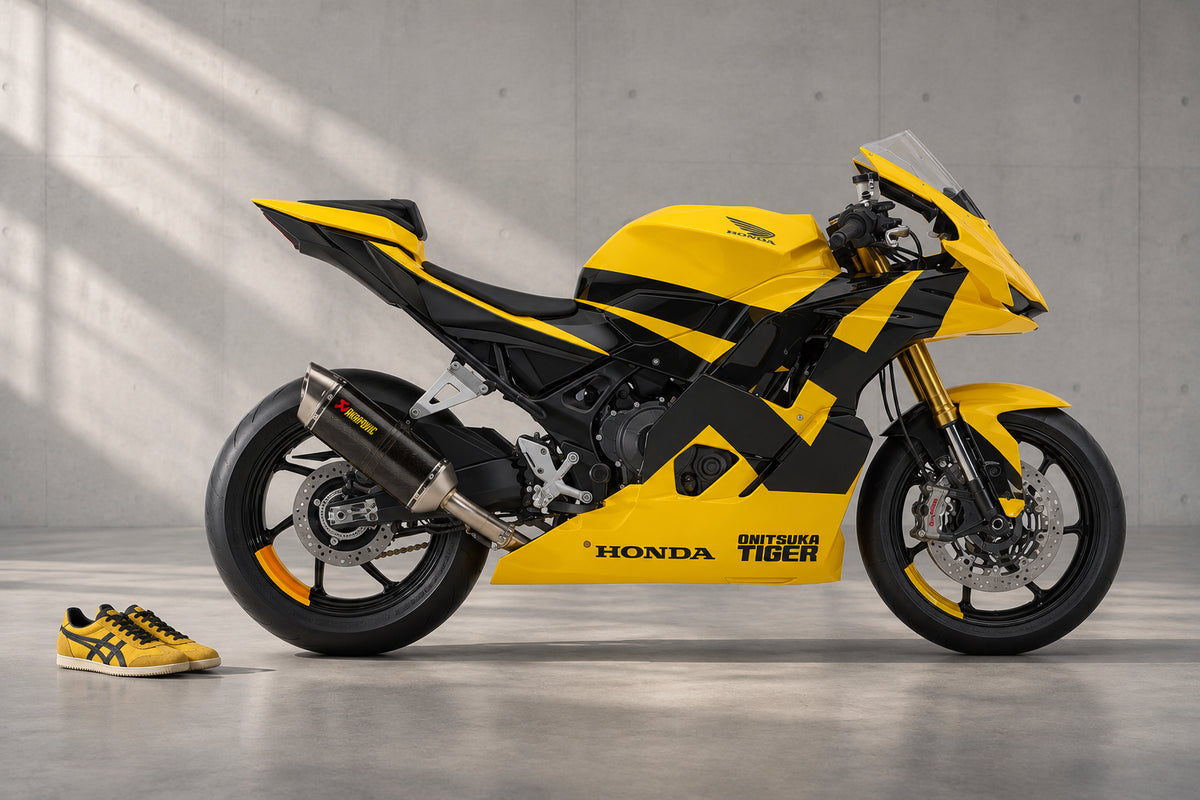
Cover: user-supplied yellow-and-black sportbike design illustration, not an official Honda Onitsuka Tiger concept photograph or a NiceFairings installation.
Would you ride a motorcycle in the colors of a sneaker brand? Honda and Onitsuka Tiger asked a version of that question with the Onitsuka Tiger Honda Mid Sports Concept. It is a useful design lesson even if you never want the collaboration logos on your own bike: a recognizable look can come from a small number of strong decisions, repeated consistently across the motorcycle.
Honda describes a middleweight sport motorcycle with Tiger Yellow as the main color, black stripes running across both sides, and yellow accents on predominantly black wheels. It was unveiled at Milan Fashion Week in September 2026 and shown at EICMA afterward. Honda identifies it as a concept, not a NiceFairings product. The Honda exhibit announcement does not establish that a production version or matching aftermarket kit is available.
For a custom-fairing buyer, the transferable idea is not a trademark or an exact factory recipe. It is how a bright base, a contrasting gesture and a few well-placed details create a design that reads at a distance and rewards a closer look.
What the concept actually shows
Honda's announcement calls it the Onitsuka Tiger Honda Mid Sports Concept and describes the inspiration and visible color layout. The company's September collaboration announcement places its unveiling at the fashion show on September 23. The EICMA announcement followed on November 3. Those dates matter: the exhibit is a later public appearance, not a brand-new launch on the day a rider happens to see a post.
The official description identifies a middleweight sport motorcycle as the basis, but does not name an exact base model in that announcement. Do not identify a specific Honda model or infer that a particular year's bodywork is interchangeable from the silhouette. Equally, a yellow-and-black painted kit is not an official Honda or Onitsuka Tiger collaboration.
The striking feature is the hierarchy: yellow carries the large visual area, black stripes define direction, and the wheel accents connect the body to the lower part of the motorcycle. That hierarchy can be studied without claiming that a reference photograph is a paint sample or that every detail can be reproduced on a different bike.
Why a simple palette can be memorable
A dominant color establishes the first impression. Before a viewer notices small sponsor marks or tiny pinstripes, the motorcycle reads as a single color family. Yellow creates a light, saturated field against the darker engine, tires and trim. Another owner might choose white, blue or green instead; the useful principle is to decide which color leads.
Contrast gives the eye a path. A black stripe does more than add another color. Its width, angle and endpoint tell the viewer where to look. A stripe that follows the side of a motorcycle can make several panels read as one composition. If every vent, fastener and edge receives a different accent, the most important line can become harder to see.
Repetition makes separate parts feel related. Honda's stated wheel accents echo the body color. On an existing motorcycle, the equivalent could be a small color detail near the front fender or tail. It does not have to match the concept's placement. It should have a purpose: connecting front to rear, relating the wheels to the body, or framing the bike's shape.
These are observations about visual design, not evidence that a given color improves performance, visibility or resale value.

Yellow is not one decision
“Make it yellow” leaves important questions unanswered. A warmer yellow can lean toward orange; a cooler yellow can look sharper beside blue or silver. Saturation changes the mood, and gloss can make the same reference appear brighter under a strong reflection. Metallic and pearl effects add another variable. A screen image can establish a direction, but it cannot guarantee a match on a painted panel.
Start by collecting a reference that shows what you like. Is it the warmth of the yellow, the contrast with black, or the balance between them? If you only say “Tiger Yellow,” a supplier may not know whether you mean an exact licensed color, an approximate visual family, or a broader yellow-and-black mood. Describe the desired result in ordinary terms and ask what reference or sample process is available. Do not assume an exact brand color or official paint specification is offered.
Look at your existing tank, wheels, frame and seat in daylight and shade. If the tank stays red while the new side panels become yellow, the combination needs its own plan. A photo of the concept does not show how that choice will look on your motorcycle. Our wheel-color planning guide gives a useful starting point for parts that remain on the bike.
Design an original stripe instead of copying a logo
The fashion collaboration uses distinctive branding. A rider can borrow the design logic while developing original artwork: one long black gesture, a pair of tapering lines, or a dark lower section that climbs toward the tail. Avoid presenting another brand's marks or distinctive graphics as your own official partnership. If a proposed graphic includes someone else's branding, clarify rights and supplier availability before approval.
Start with a simple outline of your own motorcycle. Mark the nose, side fairings, lower pieces, tank area, front fender and tail. Draw the main line through the shape you want the bike to communicate. Then stop and inspect the boundaries. Does the stripe cross a removable panel? Does it end at a vent, change width on a curve, or appear too high when viewed from the other side?
Choose whether the left and right designs are mirrored, related but different, or deliberately asymmetric. Supply a separate annotated view for each side. If one side has a different vent or panel seam, mirroring a flat image may create an awkward break. The guide to graphics across seams explains the physical handoff between panels; here the choice is the visual identity before those seam details are finalized.
Three ways to make yellow and black your own
1. Yellow body, one confident black line
Keep most visible panels yellow and use one black line to create movement. This is closest to the concept's principle of a dominant color plus contrast, but your line can follow your bike's own side profile. Decide whether the tail carries the line or whether it ends cleanly before the rear seat. A smaller black accent on the front fender can connect the wheel area without turning every panel into a separate pattern.
The tradeoff is precision. With a simple scheme, a misplaced endpoint or unexpectedly different black finish is easy to notice. Agree on a side view and note whether the black is a painted block, a graphic, or another method the supplier actually offers.
2. Dark body, yellow as the accent
Black or dark grey can be the main field, with a yellow stripe along a specific edge or a modest panel near the nose. This may be easier to integrate with a retained dark tank and black wheels. The yellow becomes more concentrated and can be adjusted in size without rewriting the whole design.
The tradeoff is that a small accent may disappear in a thumbnail or in shade. Review a complete side image as well as the close-up. If the intended effect depends on a tiny detail that is invisible from a few steps away, decide whether you still like the bike as a mostly dark motorcycle.
3. Two-tone body with a restrained stripe
Divide the body into a light upper zone and dark lower zone, then use a yellow line to separate them. The line is a boundary rather than a logo. On one bike it may follow the fairing crease; on another it may stop at the edge of a removable panel. Choose a boundary that suits the actual shapes, not one that exists only on a different model.
A two-tone design involves more decisions. Specify which panel carries each color and what happens at the seams. The goal is not to remove all breaks; some are natural to the construction. The goal is to make the intended breaks visible in the approval views.

Turn the idea into an order brief
Before sending references, collect the motorcycle's exact model, model year and market. Note known modifications and photograph both sides, the front and any retained tank area. Choose a model-specific collection and ask the seller to confirm the exact listing and contents. A concept-bike photo cannot establish that a kit fits your machine.
For the design discussion, provide:
- A complete side reference for the desired mood, with the source identified.
- A note explaining what to borrow: the yellow family, the amount of black, stripe direction or wheel relationship.
- Separate left and right views, plus a front view showing the centerline.
- A panel list distinguishing supplied pieces, retained parts and unresolved items.
- The desired finish and how a color reference or sample will be agreed.
Ask what is feasible through NiceFairings custom fairings, and request a clear confirmation of the design scope before approving a custom order. A rendering can help communicate the composition; it is not a fit test or a guarantee that colors will look identical on every screen. Ask about revision and approval steps rather than assuming they are included.
What a good approval should answer
A useful approval view should show where the dominant yellow stops, how the black shape meets each seam, whether any front-fender detail is included, and what happens around the tank and seat. It should make the direction of left and right markings unambiguous. If the wheel color is retained, include it in the visual reference even though the fairing kit does not change it.
Keep a record of the agreed reference, finish and final changes. When the actual panels arrive, compare them with the approved scope in consistent light and before altering or installing them. An accurate review looks at the agreed work rather than judging a custom kit against a concept motorcycle it was never sold as.
Frequently asked questions
Is the Honda Onitsuka Tiger motorcycle a production fairing kit?
Honda's cited announcement identifies the Mid Sports Concept as an exhibit. It does not establish that NiceFairings sells an official collaboration kit or that the concept is available as a standard production motorcycle.
Can I ask for a yellow-and-black design on my own motorcycle?
You can discuss an original color direction for the exact kit and motorcycle with the supplier. Availability, finish, graphic method and price require confirmation for the specific order.
Will a photo produce an exact color match?
A photo is a reference, not a calibrated paint sample. Lighting, camera processing and screen settings affect appearance. Ask what physical reference or approval method is available and agree on the limits.
Which parts should be checked before ordering?
Confirm the model, year, market and modifications, then ask which panels and accessories are included, what will be reused and what remains unresolved. Do not assume a tank cover, front fender or hardware is included just because it appears in a reference image.
The most memorable fairing is not always the busiest one. A strong main color, one intentional contrast and a clear approval process can turn inspiration from a show floor into a design that belongs to the motorcycle you actually ride.