A low-speed parking-lot drop can leave a sportbike looking far worse than it rides: a scraped side fairing, cracked nose edge and broken tab may be visible at once. That does not tell you whether to file a claim, accept a settlement, repair one panel or order a complete kit. It tells you to preserve evidence before those decisions get tangled together.
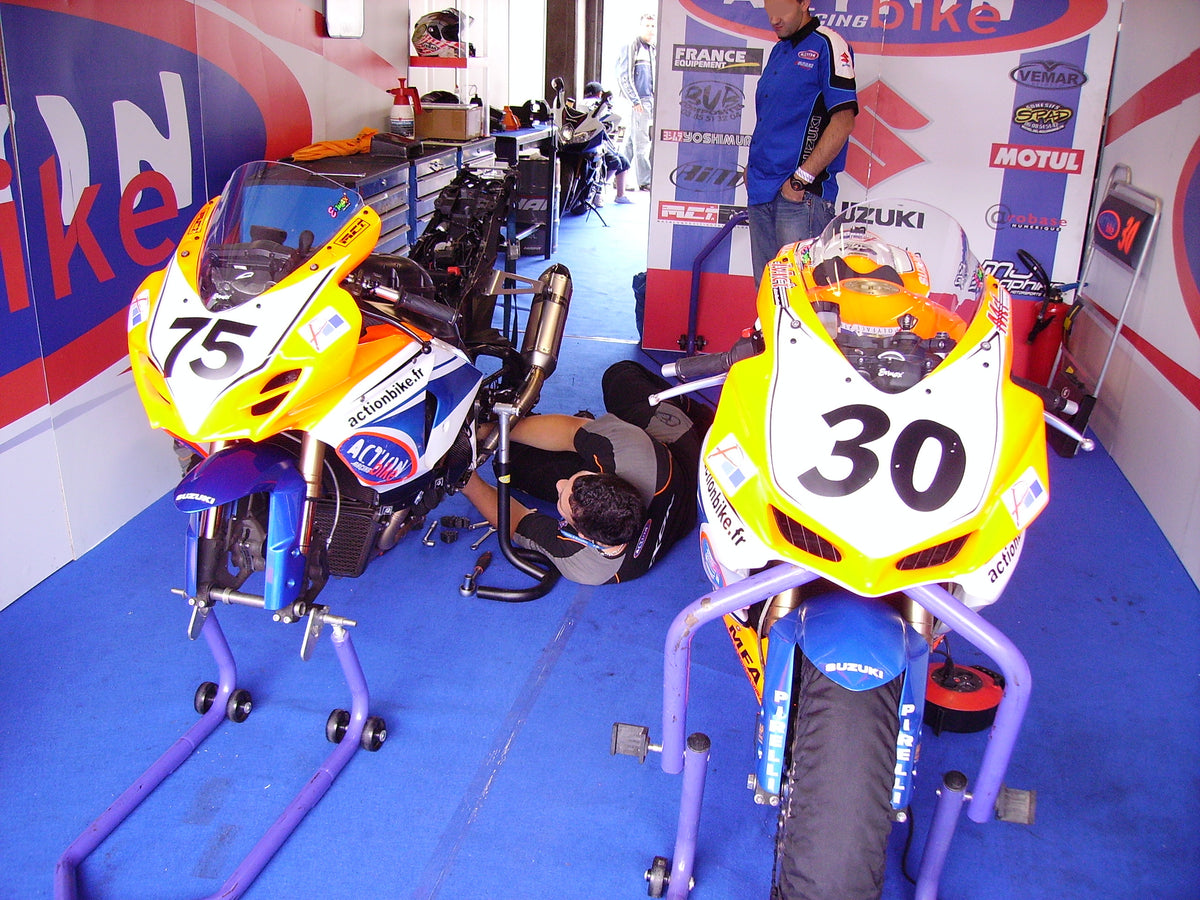
Cover: a real 2009 Suzuki GSX-R race-pit repair photograph by Cjp24 / Wikimedia Commons, CC BY-SA 4.0. It illustrates sportbike bodywork access, not a NiceFairings customer, a crash, an insurance claim or an insurer inspection.
This is a documentation and comparison guide, not legal, insurance or financial advice. Coverage, deductibles, valuation, repair authorization, salvage retention and title rules depend on your policy and jurisdiction. A qualified motorcycle repairer should assess safety and hidden damage. A replacement fairing is a cosmetic/bodywork decision, not proof that the bike is roadworthy.
First, separate a safe motorcycle from a good-looking one
Do not ride merely because the outer damage appears superficial. Check for leaking fluids, compromised brake or control operation, steering interference, a loose light or mirror, rubbing at the front wheel, and panels that could detach. If anything is uncertain, transport the bike for professional inspection. A fairing can conceal a bent stay, damaged mount, displaced wiring or a fracture that a wide photograph misses.
Ask the repairer to write down what was checked and what remains unverified. Distinguish three categories: visible finish damage; broken or missing bodywork and mounting parts; and mechanical or safety-related damage. That distinction matters even if you ultimately choose a new paint scheme. Buying plastics cannot straighten a stay or repair a brake component.

Build a claim record before removing parts
Start with one wide image of the whole motorcycle on each side, then photograph the impact side from front, rear and above. Add close-ups of every scuff, crack, tab, fastener, mirror base, screen mount, lamp edge and lower-cowl joint. Include a scale reference without obscuring the damage. Make a short walk-around video if it helps show panel movement, but do not manipulate a suspect mount to make the damage look worse.
Record the date, location, sequence of events, mileage, exact year/model/trim, accessories and any immediate rideability concern. Keep original image files and communications. Photograph the VIN and relevant part labels for your private records, but redact identifiers before posting publicly. If the motorcycle was modified before the incident, keep dated photographs or receipts that establish that prior condition. Do not present an old scratch as new claim damage.
Before disassembly, ask the insurer and repairer whether they need to inspect the bike as found. Retain removed OEM panels and hardware until the inspection and estimate are complete. Photograph each removed piece and where it came from. A bag of unidentified fasteners is poor evidence and makes a later fitment check harder.
Read the estimate as a parts-and-labor map
A useful written estimate identifies each affected component and the operation proposed: repair, replace, refinish, inspect or remove-and-refit. Look for separate lines for painted outer panels, inner covers, tabs or retainers, windshield, lights, mirrors, brackets or stays, decals, fasteners and labor. Ask which items are confirmed damage and which are provisional pending teardown. Hidden damage may justify a supplement; it should not be assumed from the first photograph.
For every replacement line, ask whether the part is OEM, aftermarket or used, whether color matching or paint work is included, and whether the estimate includes shipping, taxes and installation. Do not compare a bare aftermarket panel price with an installed, painted OEM line as if they cover the same scope. Conversely, do not order a complete fairing kit solely because a claim estimate lists several OEM pieces. The quote may include parts a kit does not contain.
Ask the shop to show you the damaged part and the reason for its proposed treatment. A scratched but structurally sound panel may be refinishable; a fractured tab at a loaded mount may require a different decision. Repair feasibility depends on the exact material, location, extent of damage and the shop's assessment. No universal dollar threshold decides it.
Ask the insurer questions without assuming the answer
Before choosing a claim route, read the policy and ask the adjuster what coverage is potentially applicable, what deductible applies, how the estimate is prepared, whether there is a preferred-shop condition, what documentation is needed for supplements, and whether aftermarket or used parts are permitted. Ask for the answer in writing. The California Department of Insurance's accident guide is a useful example of consumer documentation and estimate questions, but it is California guidance, largely written for auto claims; it is not a universal motorcycle rule.
Do not confuse a repairable-bike payment with a total-loss settlement. A total-loss decision involves valuation and policy/jurisdiction rules, not just how dramatic the fairing looks. Progressive's motorcycle total-loss explainer describes actual cash value and says owner retention, where available, can reduce payment by salvage value. It does not establish the outcome of your claim. Request the insurer's actual calculation and the applicable policy wording before making a decision.
Never assume that keeping the motorcycle means keeping a clean title. Texas DMV's salvage-brand guidance includes an owner-retained brand after a total loss; that is a Texas example, not a nationwide rule. Verify your own state's DMV and insurance regulator requirements. For UK riders, GOV.UK's write-off guide describes category and retention rules in a separate system. Do not transplant UK categories into a US estimate.
Only then decide whether NiceFairings bodywork belongs in the plan
Once safety, insurer inspection and the parts scope are settled, replacement plastics may be sensible if the original panels are unusable or you deliberately want a visual refresh. Browse NiceFairings motorcycle fairing collections by the exact make, model and year, then check the specific listing's included pieces. A product photo is not an inventory sheet. Confirm whether the proposed kit includes the nose, sides, tail pieces, fender or tank cover you need; do not assume it supplies lamps, brackets, fasteners, mirrors or labor.
If your project is a deliberate design change, the NiceFairings custom-fairings page can start a color and graphics discussion. Keep that elective upgrade separate from claim damage. Ask the insurer what, if anything, it authorizes or reimburses; do not represent a custom kit as a guaranteed covered equivalent to every OEM line. Keep the original hardware and panels until fitment and claim questions are resolved.
A practical order of operations is: identify exact fitment; compare the written repair estimate with the exact kit contents; price missing OEM or repair parts separately; account for labor and paint; confirm return/lead-time terms; then decide. If a support stay or threaded receiver is bent, resolve that before forcing a new shell into place. Our tabs-and-hardware audit illustrates the distinction between a panel and its mounting structure, although its model-specific conclusions are not transferable to every bike.
Use a blank comparison sheet, not a viral payout story
Keep four kinds of evidence separate. Each answers a different question, so one attractive photo or one lump-sum figure cannot replace the whole packet.
| Record | What it should establish | What it cannot establish alone |
|---|---|---|
| Initial whole-bike and detail photos | Visible condition, side, location and date | Hidden structure or claim coverage |
| Qualified shop inspection | Observed faults, safety concerns and unknowns | The insurer's payment decision |
| Itemized estimate and revisions | Which operations, parts and labor were proposed | That a photographed aftermarket kit contains every line item |
| Exact product listing and seller reply | Confirmed supplied and retained pieces for a selected option | Fitment on an uninspected or modified bike |
Write three columns: repair existing panels; replace bodywork; and insurer-approved settlement or total-loss route. For each, leave spaces for verified panel parts, hidden mechanical repair, labor, finishing, freight, deductible, insurer payment, salvage deduction where applicable, title or registration consequences, downtime and out-of-pocket cost. Put a source beside each figure: a dated quote, policy clause, adjuster letter or agency page. Leave unknown cells blank.
A statement such as “cash out, keep the bike and pocket the difference” hides the most important variables: actual coverage, hidden damage, deductible, valuation, salvage and title rules, safe-repair cost, taxes and the difference between a repaired bike and a total loss. Even if the math works for one owner under one policy, it is not a reusable purchasing formula. If you are uncertain, ask your insurer, local regulator, DMV or a qualified professional before committing.
What to put in the photo and estimate packet
A strong packet is not a hundred dramatic close-ups. It is a short, ordered record that lets another person match a mark to a part and an estimate line. Name the files by side and location: whole-bike-left, nose-front, left-upper, left-lower, mirror-base, inner-mount, then the equivalent views on the other side. Photograph the same point again after the repairer removes a panel, and label that later image as a teardown finding. The distinction prevents a newly exposed crack from being mistaken for something that was visible in the first inspection.
Attach a one-page chronology: event; first photographs; any transport or storage; first shop inspection; insurer contact; estimate revision. Note who took each image and when. Ask the shop to identify parts by manufacturer number where feasible, but do not guess a part number from a similar model-year photograph. Keep private identifiers in the claim packet, not in a public forum. Where an adjuster or shop revises the estimate, keep both versions and a short explanation of what changed.
Four estimates that can look comparable but are not
One quote may repair and refinish the existing side panel; another may replace the painted outer and reuse the inner; a third may include a complete aftermarket shell but omit installation; and a fourth may include a new bracket and lamp discovered after teardown. Their totals cannot be read as a simple expensive-to-cheap ranking. Normalize the scopes first. Ask whether each route leaves the same mounting integrity, finish consistency, warranty, downtime and documented roadworthiness. If the repairer cannot yet determine the stay condition without removal, mark that item as unknown—not zero.
For a NiceFairings order, list each desired piece against the exact product page and compare it with the estimate. A fairing kit may make sense for a broad cosmetic rebuild, but it should not be presented as a substitute for every OEM line. Keep graphics or a custom color as a separate owner-choice line, not a hidden addition to a claim. If your insurer agrees to an aftermarket-part option, obtain its actual terms in writing; the existence of a product on our site does not prove that it is covered, approved or mechanically suitable for a damaged bike.
When to pause the order
Pause if the fork, steering, light mounting or fairing stay has not been inspected; if the insurer still needs to view the original bike or parts; if the quoted kit's year/variant differs from the motorcycle; or if a title or salvage question remains unanswered. Pause also if the estimate is a single lump sum with no parts and labor breakdown. None of these automatically rules out replacement; each is a reason to resolve a material unknown before paying for painted bodywork.
If the repairer concludes that only a small finish area is affected and the mount is sound, document why refinishing the original panel is preferable to a full kit. If several panels are damaged but the bike is mechanically sound, document why replacement scope is justified. The best decision is the one supported by the record, not by the most visually dramatic photograph or the largest imagined payout.
A decision sequence worth keeping
Make the bike safe and document its condition before disassembly.
Get a written, itemized motorcycle-specific inspection and repair estimate.
Ask the insurer to explain coverage, supplements, valuation and any title implications in writing.
Compare repair and replacement on matching scopes, using the exact kit listing and missing-part costs.
Choose the repair, replacement or claim route only after the unknowns are resolved.
The rider controls the quality of the record and the questions asked, even when the insurer controls its own coverage and settlement decision. A thoughtful claim file can protect a good original panel from needless replacement—and prevent a beautiful new fairing from hiding an unresolved safety problem. This guide is general information; your policy, local regulator and qualified repairer govern the real decision.