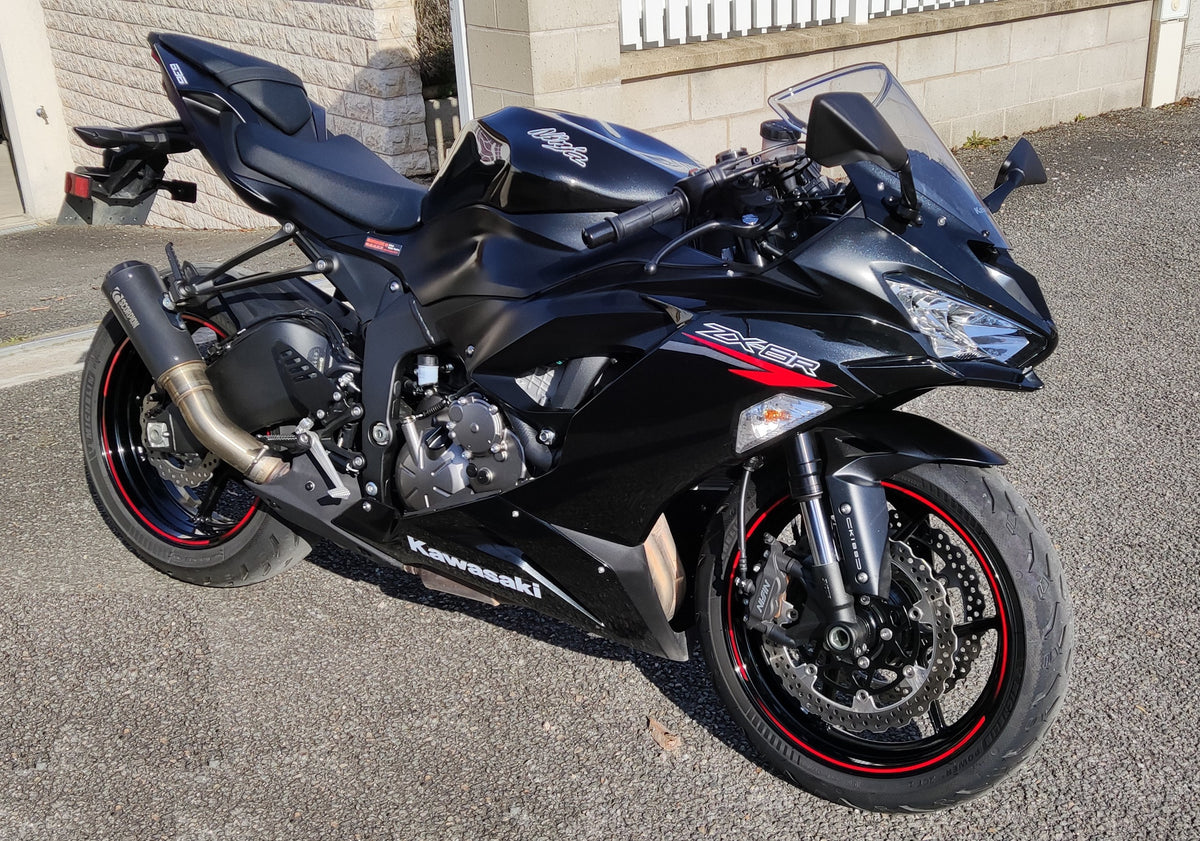
A low-mileage sportbike appears on Marketplace with one side of its fairing scraped. The photographs are bright, the asking price is tempting, and the seller says it was “only a driveway drop.” None of those details establishes a safe motorcycle or a cheap project. The useful first move is to gather enough evidence to decide whether an in-person viewing and independent inspection are worth arranging. This guide is the before-you-travel stage: a seller-message and photo workflow for a U.S. buyer, not a ten-minute certification of frame, engine, title, or roadworthiness.
Read the listing as a claim, then request the missing evidence
Save the listing date, claimed model year, mileage, asking price, location, and every photograph. The seller's language is a lead to investigate, not a diagnosis. “Cosmetic only” can mean the rider has checked the motorcycle carefully, or simply that they see scratched plastic and have not looked behind it. “Low-speed slide” does not quantify what hit the ground, which parts took the load, or what was repaired afterward. Even genuine low mileage does not tell you whether a bike was maintained, stored properly, or repaired competently.
Look for a whole-bike left and right profile, front three-quarter and rear three-quarter views, and close photographs of the damaged side. A listing that crops away the front wheel, lower fairing, engine case, bar end or tail leaves critical areas unknown. Compare the scuffed side with the apparently clean side. Do not classify a different panel gap as crash damage without a closer look; assembly variation, aftermarket parts, lighting and angle can affect appearance. Record the observation and ask for a direct photograph.
Pay attention to dates and consistency. A “before” photo taken years earlier cannot describe today's panels, tires or controls. If a seller posts the bike in several places, compare the photos and descriptions, but do not assume every difference is suspicious: a bike can be washed, repaired or photographed under different light. Ask when the incident occurred and whether the current pictures were taken afterward. Request a fresh whole-bike image with a harmless date cue if the timeline is unclear. The point is not to conduct a remote investigation of the seller; it is to establish that you are evaluating the present motorcycle rather than an attractive old image.
Our used-sportbike fairing inspection guide covers what installed bodywork can and cannot tell you during a viewing. This article starts earlier: how to avoid a wasted journey or an overconfident deposit based on a few selected images. Do not treat a clean fairing as proof that the motorcycle has no crash history, and do not treat one scrape as proof that its structure is bent.
Send one concise message that invites a useful reply
Instead of opening with “What's your lowest price?” ask for the documents and images that determine whether there is a deal to discuss. A short version works: “I'm interested if the bike checks out. Can you confirm the exact model year and title status, describe what contacted the ground, tell me what was replaced or repaired, and send daylight photos of both sides, the damaged panel, bar end, lever, engine cover, fork area and tail? Are you comfortable with an independent motorcycle shop inspecting it before I commit?”
Request the title status as it appears on the actual paperwork, not a casual “clean title” message alone. Rules and transfer steps vary by state; the relevant DMV or a licensed title professional can advise on your transaction. In the U.S., a National Motor Vehicle Title Information System report can help reveal title-brand, salvage, total-loss and odometer records. The U.S. Department of Justice explains that NMVTIS is not a repair-history database; a report that shows no problem does not prove the motorcycle was never dropped. Check applicable NHTSA recall information for the bike as a separate task. Neither a title report nor a recall lookup is a mechanical inspection.
For privacy, exchange a complete VIN only through a sensible channel and do not post identity documents in a public thread. Ask to compare the VIN on the bike with ownership documents at the viewing. If the seller cannot or will not establish their right to sell the motorcycle, stop. Do not send a deposit merely to reserve the opportunity to inspect a bike when ownership and condition remain unverified. If you want to continue, arrange a safe, lawful meeting and agree in advance whether a qualified shop may inspect it.
A coherent reply might say, “I tipped it in my driveway in May. The left cowl and mirror touched down. The mirror was replaced; the panel is still scratched. I have the invoice and the bike is available for inspection.” That is useful because it names the event, the parts and the available evidence. It is still only the seller's account. A reply such as “tiny scratch, no more pictures, decide tonight” leaves too many questions open. Neither response proves dishonesty or mechanical condition; they simply justify different next steps. Keep screenshots of the important claims so you can compare them with the documents and the bike at the viewing.
The photo sequence that tests the “only plastics” story
Ask for a daylight whole-bike image of the damaged side first, then closer views that keep the location recognizable. Include the front brake side and rear brake side, both bar ends, levers, mirrors, front wheel, fork legs and seals, engine cases and any case guards, foot controls, tail and rear subframe area, radiator/hoses visible without dismantling, and the lower belly area. A photograph of the steering-stop region may help a professional assess a concern, but an image alone cannot establish alignment or the extent of an impact.
Good evidence is not glamorous. Dirt, scratches and mismatched fasteners may be useful to see in consistent light. Ask the seller not to hide the damage with filters or wet-looking dressing. If a panel has already been removed, request an image of its backside and mounting tabs, plus the exposed motorcycle-side mounts. Do not ask an untrained seller to remove fairings or run a damaged motorcycle for your photos. A seller's reluctance to dismantle a bike is not, by itself, proof of a problem; it may be reasonable. You can then decide whether the uncertainty justifies professional inspection before any offer.
Ask whether the original scraped components are still available if replacements have already been installed. Original panels can provide useful evidence of the impact location and help identify what was changed, although they too cannot prove the condition of the rest of the motorcycle. If the seller discarded them, simply record that limitation. Do not demand that every legitimate private seller maintain a perfect accident archive. Your job is to know what evidence exists and what a mechanic must still determine. A missing mirror, lever or bar end also deserves a parts-specific question; it is not automatically explained away by a fairing-kit budget.
The Motorcycle Safety Foundation's T-CLOCS checklist is a helpful map of important systems: tires/wheels, controls, lights/electrics, oil/fluids, chassis and stands. It is a pre-ride inspection aid, not a buyer's structural certificate. Notice how many items lie outside the painted fairing. A person promising that a $600 panel set will “fix the bike” has not answered questions about wheels, brakes, steering, leaks or electronics.
Sort replies into go, inspect, and walk-away categories
Worth a viewing: the seller identifies the bike and ownership documents, gives a coherent timeline without pretending to know everything, shows the damage clearly, and accepts independent inspection. This is not a green light to ride home. It simply means the next cost—time and perhaps a shop inspection—may be justified.
Proceed only with a professional condition check: evidence is incomplete, the repaired panel hides the original impact area, the bike pulls or feels strange according to the seller, a fork or wheel may have contacted something, or the engine case shows a mark whose depth cannot be understood from photographs. Avoid inventing a remote diagnosis. A trained technician can inspect the affected systems and recommend whether the motorcycle is an appropriate purchase candidate. If the seller refuses an inspection, you can choose to walk away.
Stop or pause: title documents do not match the seller's story, the bike's identity is uncertain, a safety-critical part is visibly damaged, fluids leak, or the sale depends on immediate payment before inspection. Be especially skeptical of absolute claims such as “guaranteed straight frame” based solely on the seller's photographs. The aim is not to accuse someone of deception; it is to avoid accepting unknown risk as a known cosmetic repair.
For a dropped Yamaha R3, our model-specific mount-evidence article shows why a neat-looking new panel cannot substitute for inspecting the mount beneath it. The broader logic applies to other sportbikes, but the exact mounting points and parts are model- and year-specific. Never use an R3 diagram to certify an R7 or Ninja 400.
Before traveling, agree on the viewing conditions. Ask for daylight or a well-lit workshop, access to the documents, and enough time for an unhurried walk-around. Do not let a short slot between other buyers become the reason you skip the shop inspection you had planned. If the motorcycle cannot lawfully or safely be ridden to the inspector, ask the shop about transport or an on-site option. If you cannot arrange a useful assessment, the correct category may remain “unknown,” even when the seller's price is appealing. A failed attempt to gather evidence should not be converted into a positive finding.
Keep the bodywork plan separate until the bike passes inspection
If a professional assessment and records support a manageable repair, then discuss the paint and panel scope. NiceFairings has model-year-specific products, such as a Ninja 400 EX400R 2018–2024 fairing listing and a YZF-R7 2021–2025 listing. Those links are shopping examples, not evidence that a particular bike on Marketplace is sound or that its exact broken pieces are supplied. Check the motorcycle's model/year/configuration, the offered kit's actual included-parts list and what original hardware must be retained before budgeting a swap.

Actual NiceFairings Ninja 400 EX400R listing. This image illustrates a possible later bodywork-shopping step. It is not a photograph of the hypothetical used bike, a crash inspection, or proof that every damaged item would be included.
You might discover a single scratched panel that is better repaired than replaced. You might also find broken tabs, missing inner trim or damaged mounts that make a whole kit insufficient. The panel-by-panel replacement list is a better next step than immediately ordering the largest glossy set. The best potential bargain is not the ugliest listing; it is the bike whose known defects and remaining unknowns can be inspected and priced honestly.
A copyable viewing request
“Thanks for the details. Before I travel, please send the exact model year, a photo of the title status with personal information covered, and a brief account of the fall or scrape and any repairs. Please add natural-light whole-bike photos from both sides and close-ups of the damaged panel, bar end, lever, engine cover, front wheel/fork area, lower fairing and tail. Are you willing to meet at a motorcycle shop for an independent pre-purchase inspection? I would make any offer subject to matching ownership documents and inspection findings.”
That message does not promise to buy. It gives an honest seller a clear path to demonstrate what they know, and it protects you from turning an appealing photograph into an unsupported mechanical conclusion. If the seller responds with useful evidence, the next article in this three-part series is the budget decision: calculate a maximum offer from comparable clean bikes and all expected costs, rather than assuming a fixed discount or an instant increase in value.
Editorial note: This is general U.S.-market buyer guidance, not legal advice or a mechanical diagnosis. Private-sale, title and inspection requirements differ by state. No Marketplace listing, seller, accident, price discount or repaired bike is presented here as a verified customer case.
Cover photograph: a real parked Kawasaki Ninja ZX-6R 636 ABS photographed by Ponpon026, CC BY-SA 4.0. It is editorial context, not the listing or scraped motorcycle described in the hypothetical opening, and not a NiceFairings product photograph.