
In October 2026, BMW announced the F 450 RR and Honda put the CBR500R FOUR in its UK range. Both make the fully faired sportbike look available below the traditional 600 and 1000 classes. That is exciting for riders who care about the shape of a machine as much as its displacement. It is also a good moment to remember a less glamorous truth: a similar silhouette does not make one bike's panels fit another.
Two new bikes, two different ideas
BMW's October 15 announcement positions the F 450 RR as a standalone supersport in the 48-hp class. BMW describes a parallel-twin engine, sport-specific chassis and geometry, and clear RR family styling. It is an entry point to that design language, not a reduced S 1000 RR with interchangeable bodywork.
Honda UK describes the CBR500R FOUR as a new inline-four model with E-Clutch and dedicated CBR styling. The engine layout alone should stop a buyer from confusing it with the familiar CBR500R twin. Honda's 2026 US CBR500R specification lists a 471 cc parallel twin; the UK CBR500R FOUR specification lists a 502 cc inline four. The names are close. The motorcycles and their bodywork applications are not established as the same.
The new launches are therefore best read as design signals. Manufacturers are willing to give smaller-capacity motorcycles a complete sportbike identity: a considered nose, side surfaces, screen and tail rather than just a token half fairing. This does not mean every owner needs a brand-new machine to enjoy a cohesive look.
What an existing owner can actually change
If you ride a Ninja 500, CBR500R or ZX-4RR, first decide what bothers you about the current appearance. Is the paint tired, or is the shape itself wrong for your taste? Paint and graphics can change the first problem. A replacement fairing kit may change the painted surfaces while preserving the bike's underlying design. Neither path transforms your existing bike into an F 450 RR or a CBR500R FOUR, and the two new models' panels should not be treated as conversion parts.
For an existing CBR500R, begin with the exact model year. NiceFairings currently separates 2019–2021, 2022–2023 and 2024–2026 listings. Those collections refer to the conventional CBR500R, not the newly announced CBR500R FOUR. A new badge or similar name is not a fitment shortcut. If your bike sits near a generation change, use our 2023 versus 2024 CBR500R visual check before choosing a kit.

For Ninja 500 and ZX-4RR owners, confirm the available stock before assuming a shop carries a compatible kit. In this review, NiceFairings' product search did not return a verified Ninja 500 or ZX-4RR fairing listing. A Ninja 400 result is not evidence that it fits a Ninja 500; a ZX-6R result is not a ZX-4RR option. Until a verified listing exists, use the same design planning checklist without presenting a product link as a solution.
Plan the look before choosing parts
Take straight front, side and rear photographs of your bike in daylight. Mark the panels you want to change and the components that will remain visible: wheels, tank, frame, inner trim and seat. A graphic that looks dramatic in a cropped product image may clash with the unchanged pieces on the real motorcycle. Decide whether you want a restrained factory-like color, a race-inspired layout or an intentionally different palette. Send reference images as design direction, not as a guarantee of an exact paint match across different lighting and materials.
Next, ask for the actual kit contents. A full-color photograph does not prove that every visible panel, screen, seat cover or small trim piece is included. The seller should confirm the year, the specific design, the supplied pieces and any parts to be reused from the stock bike. Request finished-product photographs when available and compare both sides before dispatch. Keep your OEM panels until the new bodywork has been trial-fitted.
Three different riders, three sensible paths
Consider an owner of a conventional 2025 CBR500R who loves the new FOUR's energy but wants to keep the bike they already know. Their best starting point is the 2024–2026 CBR500R collection, then an exact product listing and a deliberate paint brief. They should not order “FOUR panels” on the strength of a badge. The twin and the new four-cylinder bike have different published specifications; no source reviewed here establishes their bodywork interchangeability. If the owner wants a red-and-white race influence, the seller can discuss that graphic direction on the year-correct CBR500R kit without claiming to reproduce Honda's new motorcycle.
Now consider a Ninja 500 owner who sees a striking Ninja 400 kit in a search result. The right action is to stop at the model name. Product search can surface nearby names, and search relevance is not fitment verification. Compare the exact Kawasaki model designation, headlamp, side-panel interfaces and tail, and request a written seller answer. If the store cannot identify a listing specifically for that bike, a paint or graphics specialist working on the owner's existing, sound panels may be the more honest route. A custom color idea does not require pretending a different bike's plastic fits.
A ZX-4RR owner has a different problem: they may already love the factory body shape and want a stronger color story. Ask whether a matching replacement set actually exists before designing around a product photograph. If it does not, consider reversible graphics on the original bodywork or wait for a verified, model-specific offer. Keep the stock parts and record the original paint references. These examples are planning paths, not endorsements of a currently unverified kit for either Kawasaki model.
| If your goal is… | First question | Sensible next step |
|---|---|---|
| A different look on an undamaged bike | Are you happy with the existing body shape? | If yes, plan color or graphics on year-correct surfaces. |
| Replacing cracked panels | Is the underlying support straight and complete? | Inspect brackets and mounts, then verify an exact kit. |
| Copying a new launch | Which parts of the look are graphic ideas, and which are model-specific shapes? | Translate the palette rather than assuming a panel conversion. |
| A future resale-friendly change | Can the original panels be stored safely? | Keep them labeled and avoid irreversible cuts where possible. |
Why “RR look” is not a technical specification
BMW's press release describes the F 450 RR as a standalone model, with its own sport-specific chassis and geometry. Honda's description of the CBR500R FOUR likewise combines an engine, controls and dedicated styling. A replacement fairing on another motorcycle can borrow a color or a visual rhythm; it does not transfer the new model's frame, handling, electronics or homologation. That distinction protects the buyer from overpaying for a graphic that implies a performance change it cannot deliver.
It also matters for wings, ducts and screens. A decorative wing-shaped detail on a product photograph is not evidence of aerodynamic benefit. A vent on one model may sit over an intake or radiator opening; a similar-looking cutout on another may have different clearance requirements. When planning a custom exterior, keep the original airflow paths, lights, controls and heat clearances functional. Ask the seller how the kit relates to the stock mounting system rather than requesting an unverified transplant of a newer nose.
For street use, visible lights, indicators, mirrors and plate equipment must remain appropriate for the bike and local requirements. A full fairing should not be selected solely from a race-paddock image that omits road equipment. A track-only build has a different rulebook and inspection path. This article's subject is visual design and fitment for existing street motorcycles, not a claim that a paint change makes a machine race-ready.
A five-minute product-page audit
Before adding any kit to a cart, read the whole title and year range aloud. Search for the exact model name, including suffixes such as FOUR, RR or R. Open the chosen design option rather than relying on the first gallery image. Scroll to the parts description and make a list of what is explicitly included. If a tank cover, windscreen or seat cowl appears in a photo but is not confirmed in the description, ask. Photographs can show an example design or optional pieces rather than the exact box you will receive.
Then compare the front and tail of your bike to the photographed layout. A well-lit side photograph of your actual motorcycle is more useful to support than a long paragraph saying “it looks like the 2026 one.” Tell them the exact year, market if relevant, existing modifications, the product URL and which parts are damaged. Keep the answer in the order record. This may feel slower than clicking a color swatch, but it prevents the much slower process of discovering a wrong generation after the paint is finished.
Finally, plan how the new look will age. If the motorcycle is ridden daily, think about boot rub, luggage straps, cleaning products and where hands touch the panels. A matte finish and a high-gloss finish can look equally dramatic in a launch photo yet need different care. Confirm the finish and any graphic placement in natural light if samples or completed photos are available. Do not infer abrasion resistance from the word “premium” alone.
The practical conclusion
BMW and Honda have made a persuasive case for smaller fully faired sportbikes. For current owners, the useful lesson is more precise than “make my bike look like the new one”: make your own bike look complete, and buy only bodywork designed for its exact model and year. If you have a conventional CBR500R, browse the year-specific CBR500R range that actually matches your bike. If your model is not listed, ask for a written fitment answer rather than borrowing a similar model's listing.
Questions readers should ask after the launch headlines
Can an F 450 RR panel be fitted to another BMW 450? BMW calls the RR a standalone supersport with its own chassis and geometry work. That announcement does not provide a panel interchange chart. Anyone planning a conversion should obtain OEM part numbers, bracket information and a complete compatibility plan before buying a single painted piece. A shared engine family is not enough.
Does the CBR500R FOUR replace every existing CBR500R? The Honda UK site presents the FOUR as a distinct model, while Honda still lists the conventional CBR500R. Availability is market-specific. The FOUR's inline-four specification and the conventional bike's twin-cylinder specification make it particularly important to use the full name in a parts enquiry. The article does not claim a future rollout date or availability in every country.
Could a paint scheme alone produce the “mini superbike” effect? It can change visual emphasis without changing physical panels. Dark lower sections can visually tighten a bike; brighter upper panels can draw attention to the nose; a continuous accent line can connect front and tail. These are design observations, not performance claims. A rider should test a rough digital mockup against photographs of their actual bike, especially where the tank and frame will remain unchanged.
Should I keep the original fairings? If they are sound and you have storage space, labeling and protecting them preserves an option to return to stock. This can matter if you later change your taste or sell the motorcycle. It does not guarantee a higher resale price; a buyer will still assess the bike's condition and history. Save installation photos and receipts so the change is easy to explain.
What if a product page says “fits 2024–2026” but my bike has a later registration year? Confirm the model year independently. A registration year, launch year and catalog year can differ. Ask the seller to identify the exact model designation and any market-specific variant it supports. Do not stretch a listing beyond its advertised range because a newer bike looks similar in a small photograph.
The common thread is disciplined enthusiasm. The new bikes make full fairings feel exciting at approachable capacities, but the best-looking existing-bike project begins with the exact machine in the garage. Keep launch news, model identification, graphic design and physical fitment as four separate questions. Then a color choice can be expressive without making a false promise about what the plastic will do.
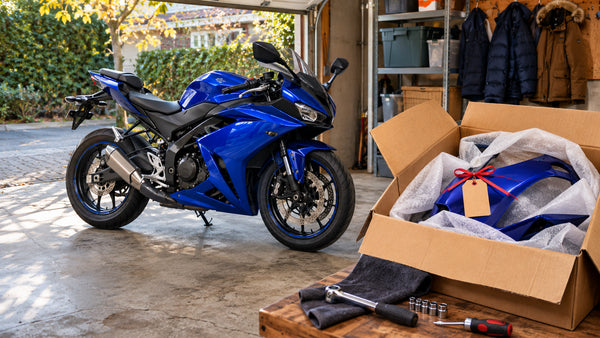
Cover photo: Hondianer / Wikimedia Commons, CC BY-SA 4.0. It shows a real conventional CBR500R, not the newly launched FOUR or a NiceFairings installation.