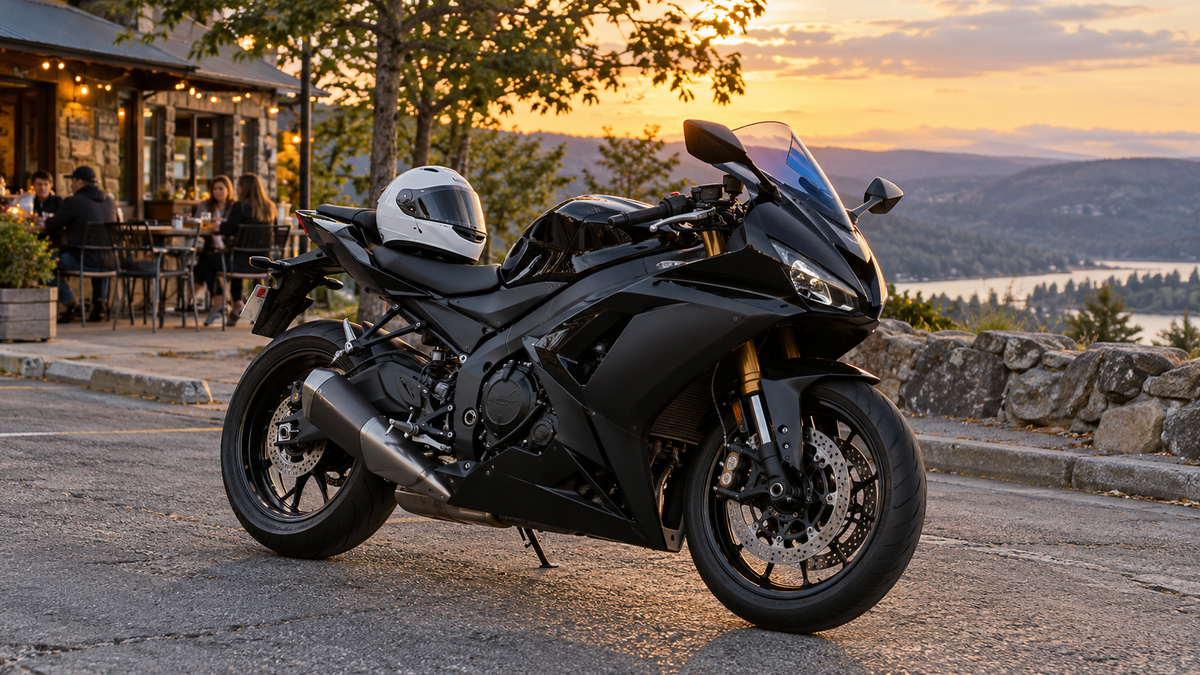
Scroll through a sportbike forum and you will eventually see the familiar reveal: the colored panels are gone, the bike is black, and its owner posts a photo with some version of “blacked her out.” The appeal is easy to understand. Black can let the motorcycle's shape carry the design without a busy sponsor package. But a good black build is more demanding than ordering every visible part in the darkest shade available. The finish has to work across different materials, the bike still needs to be conspicuous on the road, and the decision to paint, wrap or replace panels depends on what you want to keep.
This is a design-and-ownership guide, not a claim that black sportbikes are objectively the dominant 2026 trend. A BMW S1000RR owner post and an “obligatory black Ninja” discussion are inspiration and rider conversation, not market research. If you are ordering parts, begin with your actual model, year, panel condition and preferred sheen. The safest aesthetic decision is one you can describe clearly before money changes hands.
Cover: AI-generated editorial concept showing a styling idea, not a real motorcycle, customer installation or NiceFairings product. Do not use its panel shape to judge compatibility.
Why an all-black bike can look so good—and why some look unfinished
Black reduces the number of competing shapes and colors in a photograph. On a fully faired sportbike, that can make the windscreen, headlamp outline, frame, wheels and exhaust read as one deliberate silhouette. It also works with several identities: polished street machine, satin test-bike look, or restrained track-inspired build. That flexibility helps explain why owners keep returning to it even when the same basic color has been used for decades.
The weak version is a collection of unrelated blacks. A glossy tank beside a chalky matte fairing, faded black plastic trim, satin vinyl and a smoked screen may read as four different projects. Dirt, polish residue and handprints make the mismatch more obvious. The answer is not automatically to make every part identical. It is to choose a hierarchy: which surfaces should catch light, which should sit quietly, and where the eye should land first.
Take photographs of the motorcycle in open shade and direct sun before ordering anything. The same sample can look deep and neutral under indoor lighting, blue-gray in shade and slightly brown beside a warm streetlamp. Ask for a sample or a clear finish reference, and compare it with the existing tank, frame and trim. If the fuel tank will stay original, design around it; a black “full kit” does not magically repaint a metal tank or make its shade match a new plastic cover.
Three routes: wrap, repaint or replace the bodywork
Vinyl wrap makes sense when the underlying panel is sound and you want a reversible color trial. It can be efficient on broad, accessible surfaces. Deep ducts, tight returns, damaged edges and complex compound curves are harder. A film can hide a color, but it does not repair a cracked mounting tab or correct poor panel alignment. Ask an installer how seams, edges and high-heat locations will be treated, and how removal may affect an older or previously repainted finish. Do not promise that every wrap will leave every original paint surface untouched.
Repainting existing panels gives the most control over sheen, color and small accent placement, provided the panels themselves are worth keeping. Good results depend heavily on preparation and on what is beneath the old coating. A cracked tab, stressed hole or broken inner support remains a structural problem after the outside shines. Get a written scope: which pieces are included, whether repairs and decals are included, whether the tank is in scope, and what finish the painter means by “matte.” If the motorcycle has an original limited-edition livery, permanent repainting may sacrifice something you would rather preserve.
Buying a second painted fairing set can keep usable original panels in storage while giving the bike a new look. It is not a shortcut around fitment work. Confirm the exact model and production year, generation, headlamp arrangement, trim and mounting points before ordering. Check the listing's actual panel inventory rather than assuming “full kit” includes every visible cover, fastener or windscreen. Photograph modified exhausts, sliders and other accessories that might touch the bodywork. Our fairing quality evidence guide explains why a polished listing image is not proof of material, fit or finish life.
| Decision | Wrap existing panels | Repaint existing panels | Second painted fairing set |
|---|---|---|---|
| Reversible in principle | Usually, but assess existing paint | No | Yes, if originals are stored well |
| Fixes broken tabs or mounting | No | Only if repair is separately included | Replaces some damaged panels, not motorcycle-side mounts |
| Color/finish control | Limited by film range and installation | High if scope is specified | Depends on the actual product and custom options |
| Main hidden work | Surface prep, seam placement | Repair, prep, tank/trim coordination | Fitment, hardware transfer, storage |
Those are planning differences, not universal price or durability rankings. Compare a written, matched scope and the final appearance you actually want. A cheap wrap that leaves a cracked panel in place is not equivalent to new panels; a replacement set that excludes the tank is not equivalent to repainting the whole bike.
Before selecting one route, take a panel-condition inventory. Mark each damaged tab, scraped face and mismatched area on photographs. If the black project is motivated by one scratched side, compare repairing that side with changing the entire motorcycle. If the motivation is protecting rare OEM graphics, record how and where the originals will be stored. If you want to return to stock quickly, make sure the new scheme does not require irreversible cutting or changes to permanent parts. A design choice becomes easier when the desired reversible state is written down alongside the desired color.
Gloss, satin and matte: write a brief someone else can execute
“Black” is a color family; gloss is a surface behavior. A high-gloss black upper and side set can make fairing creases legible through reflected light, but it shows swirl marks, dust and imperfect surface preparation readily. Satin can soften those reflections without flattening the bike completely. Very low-sheen matte can look dramatic in carefully lit photographs, yet patchy cleaning, oily fingerprints and mismatched replacement pieces may be especially conspicuous. Follow the care instructions for the actual finish rather than assuming a routine for one coating works on all of them.

Actual NiceFairings ZX-10R 2011–2015 glossy-black listing photo, shown as a loose-panel finish reference—not an installed-bike result, a universal kit inventory, or proof of fit. Match the listing to your exact motorcycle before ordering.
Decide whether the tank, front fender, tail, mirrors, wheels and inner black trim participate in the scheme. Your brief might say: “gloss black exterior fairing panels; retain existing tank; satin black lower; no faux-carbon texture; no dark tint over lamps; one narrow red accent that continues across the side-panel seam.” This is far more useful than “make it stealth.” Request a design preview from both sides and a front three-quarter angle. A stripe that looks straight on a flat graphic can wander over a real vent or break at a panel joint. Our graphic placement guide focuses on that handoff.
Small contrast can make the motorcycle look more intentional without abandoning the black theme. Red pinlines, restrained gold fastener details or a single contrasting logo area can define an edge. More accents are not automatically better. On an asymmetrical bike, mirror the visual balance, not necessarily an identical shape on each side. On a road bike, do not choose a design that obscures required lights, indicators, plate or reflectors.
Before approving a finish, ask how adjacent surfaces will be matched. A glossy fairing beside a sun-faded tank may make the tank look older. A black panel against black plastic trim can expose a blue or brown undertone. If the project is meant to preserve the original set, photograph and label every removed piece, keep hardware mapped, and store the panels where painted faces are not pressed together. That gives you a way back if your taste changes or a future buyer values the original configuration.
Build a small approval sheet rather than relying on a phone screenshot. Include a daylight photograph of each side of your own bike, one finish reference, an exact list of panels being changed, and a note about the tank and wheels. Circle where any red or gold accent starts and stops. Ask the supplier or painter to confirm whether the preview is a color intention or an exact reproduction of a sample. Digital displays, compression and camera white balance can all change the apparent shade. If the result depends on a near-perfect match to an untouched tank, a physical sample is more informative than a social-media photograph.
A black motorcycle should not make its rider disappear
An attractive dark color is not a visibility plan. There is no honest percentage by which a particular black fairing increases crash risk; road visibility depends on lighting, contrast, motion, weather, viewing angle and driver attention. But a bike, rider, helmet and gear that all blend into a low-contrast scene deserve a deliberate check. The U.S. National Highway Traffic Safety Administration's rider-conspicuity guidance discusses bright helmets, conspicuous clothing, headlight use and retroreflective material as visibility measures. Its motorcycle safety page also suggests reflective material on the motorcycle and keeping the headlight on. These measures can help a rider be noticed; none guarantees that another road user will see them.
For a black build, consider a white or other light-colored helmet, a jacket with visible panels, and retroreflective details on luggage, gear or compatible body areas. At night, retroreflective material works when light hits it; it does not substitute for functional headlamps, brake lamps and indicators. Choose road-legal placement and do not cover vents, labels, moving parts or lights with decorative film. Keep the required reflectors present. If you darken the windscreen or lamps, check local requirements and your own sight line before riding; the blacked-out look is not worth obscuring information or being harder to see.
The useful test is mundane. Look at the parked motorcycle from a car driver's height at dawn, in open shade and against a dark parking structure. Then check the same bike while the rider is seated in their usual gear. Which elements distinguish it from the background? If the only answer is “the headlight when it happens to face you,” improve the rest of the setup. A contrast accent, visible helmet or reflective detail can preserve the black-bike aesthetic while acknowledging how the motorcycle is actually used.
Do not mistake aesthetic contrast for a certified safety device. A small red pinstripe may clarify the fairing's shape in a photo yet contribute little in a rain-soaked intersection. Conversely, a light-colored helmet or reflective panel on riding gear may be more noticeable than a large decorative decal placed low on the bike. Keep the motorcycle's lighting clean and functional, and consider how the whole rider-and-bike combination appears from the side as well as the front. The aim is not to calculate an unmeasured risk reduction; it is to avoid designing away every available cue of presence.
Preserve the option to change your mind
Think beyond reveal day. A wrap can become damaged at edges; repainting can be difficult to reverse; a second set creates a storage problem. Record the original condition and the new work. Keep any invoice, finish specification, product link, color approval and installation photos. If you sell the motorcycle later, describe the swap plainly instead of implying the black panels are factory-original. A well-documented cosmetic choice gives a buyer more confidence than a mysterious fresh shell.
NiceFairings has a glossy-black ZX-10R example for its listed 2011–2015 application, plus ZX-6R fairing options and Yamaha R6 fairing options to browse by exact generation. These are design starting points, not universal-fit or finish-match promises. Confirm product availability, actual photos, included pieces, model year and the desired sheen with the store before placing an order; a title saying “matte” is not enough if the photographs appear glossy. If your bike is already black, a second set may still make sense to preserve original paint; if its current panels are sound and you only want a temporary look, a wrap may be the better experiment.
The best blacked-out sportbike is not the one with the fewest bright pixels in a photo. It is the one whose finish looks coherent in ordinary light, whose panels are secure, whose rider remains visible in traffic, and whose owner understands what was changed. Make those decisions first; the reveal photo will take care of itself.
Editorial scope: this guide does not claim that a social-media discussion measures 2026 sales or popularity. The cover is an AI concept, not a real NiceFairings product or road-safety test. Product applications must be checked against the live listing and the actual motorcycle.