
The year printed on a registration document is a useful clue, but it is not a description of every painted panel on a used motorcycle. A 2009 Triumph Daytona 675 makes that distinction unusually easy to see. Triumph's own tyre-selector document divides Daytona 675 entries around a VIN threshold within the 2009 model year. That document is about tyres, not fairing interchange. Its value here is narrower and more important: the maker itself does not treat every bike first registered in 2009 as one undifferentiated specification. A fairing buyer who skips the individual bike and jumps straight to a search result can miss precisely the question that needs answering.
NiceFairings lists painted ABS bodywork for the Daytona 675 2009–2012. That is a catalog application, not a promise that a registration date, a familiar headlight shape or somebody else's finished-bike photograph proves the kit will fit your motorcycle. This guide is a practical way to check the claim. It deliberately separates evidence about vehicle identity from evidence about part shape, and both from evidence about what will actually arrive in the carton.
Start with the small fact the factory document really establishes
Triumph's official tyre-selector table lists an early Daytona 675 group through VIN 381274 and a following Daytona 675/675R group from VIN 381275 to 564947. Both rows touch 2009; a later row begins at VIN 564948 and is labeled 2013 onward. These are manufacturer-defined groups for choosing approved tyre specifications. They are not a cross-reference for upper cowls, fairing stays, mirrors or tail shells. It would be a category error to turn a tyre table into a body-panel interchange table.
What the table does prove is that “2009” by itself can collapse distinct manufacturer-defined populations. Record the full VIN from the motorcycle, not a number guessed from a title, auction description or decal. The VIN is sensitive ownership information: share it only with a legitimate Triumph dealer or seller when needed, and do not post a full, readable VIN in a public comment or photograph. Ask a Triumph parts specialist to identify the exact model and relevant original bodywork part references against that VIN and market. If the bike is imported, confirm its original market as well as the paperwork year.
You should also distinguish model year from first registration. A motorcycle built for one model year may be registered later, and an older panel can be fitted to a newer bike after a repair. Neither fact makes the registration wrong; it just means the paper record and the bodywork history answer different questions. The useful result of the VIN check is not an automatic “buy” or “reject.” It is a reliable starting identity for the physical comparison that follows.
Turn one attractive gallery image into a list of answerable questions
The black-and-blue-teal Daytona 675 set is a good example of how to read a listing carefully. Its description identifies the advertised 2009–2012 Daytona 675 application, ABS material with a carbon-fiber-look surface, a particular photographed paint design, and a source-price group that does not include a fuel-tank cover. It asks buyers to inspect the pictured parts to confirm kit contents. None of those statements says the photograph verifies your fairing stay, lamp mounts or previously repaired tabs. The dark finish can make a line look continuous in a small thumbnail; enlarge the gallery and examine each meeting edge.

NiceFairings catalog image. The carbon-style pattern describes a surface appearance on ABS, not structural carbon fiber. It is not a photograph of the real motorcycle in this article's cover.
Make a short inventory before you compare colors: upper cowl and headlight aperture; windscreen lip; left and right side pieces; lower cowl; front fender; tail pieces; and the smaller infill or trim pieces you actually need. Do not assume that every item a complete motorcycle displays is included in a painted kit. Conversely, if a kit picture contains an item you do not recognize, ask for its name and purpose rather than calling it “extra.” A product image can identify the offered appearance. A parts list or written confirmation identifies the offered contents. Your bike determines whether the existing mating parts are suitable.
This is especially relevant when ordering a visual change rather than replacing crash damage. A sound stock screen, mirrors and lights might be reused, but only if their shape and mounting arrangement match the offered shells and the seller confirms what is expected to transfer. If a previous owner installed an aftermarket screen or modified a bracket, the advertised model-year range cannot undo that modification. For a damaged bike, inspect the support structure before spending on paint. A crisp new shell is not a repair for a bent stay.
Photograph the motorcycle that exists, not the one in the brochure
Start with five clear daylight photographs: straight-on front, both full sides and both front three-quarter views. The whole bike should remain in frame. Then add close-ups of each headlight edge, the screen and mirror bases, the junction between upper and side pieces, the lower seam, indicator mounts and the tail around the exhaust. Take a close-up of any cracked tab or non-original fastener. When possible, photograph the underside or back of an already removed panel; do not dismantle a sound motorcycle merely to satisfy a blog checklist. A Triumph service document or a qualified technician should guide any removal.
The purpose is to make a written question precise. “Is this the right kit for a 2009 Daytona?” is broad. “My verified VIN is in the relevant factory group; the installed upper cowl has this lamp opening and these visible mounting points; will the exact NiceFairings black-blue-teal set accept the screen, lamps and side trim shown in these images?” can be investigated. If there is an R badge, an aftermarket exhaust or evidence of front-end repairs, say so. A badge or paint scheme may suggest a trim; it is not a substitute for model identification.
This is also where the 2013 boundary matters. Triumph's 2013 Daytona 675 product summary describes developments to the engine and chassis, while its tyre guide starts another Daytona VIN group at 564948. Neither source gives us a part-by-part fairing interchange table, and we do not infer one. They are enough reason not to roll a 2013-looking bike into the 2009–2012 catalog group on the strength of an online image. If the machine has mixed-year components, have the parts identified individually. The Daytona 675 fairings index is a navigation page, not a technical compatibility certificate.
Keep the 675R and aftermarket-modification questions separate
Triumph's documents name a Daytona 675R alongside the standard 675 in the later VIN group, and the 2013 675R factory summary describes its own equipment and trim. Neither source proves that every painted exterior piece on every pre-2013 675R matches every 675 kit. The NiceFairings product page above names the Daytona 675; it does not explicitly promise all 675R combinations. An R owner should therefore ask the seller to confirm the exact bike and pieces in writing instead of assuming that an extra letter never affects a bodywork order. An owner of a standard 675 should not assume that a photographed R-style paint design changes their bike's physical specification.
Modification is a different axis. An accessory exhaust can change the space or heat environment near a tail or lower panel. A track-oriented conversion may have removed road lights or mirrors; a previous owner may have replaced a fairing stay after a fall. We cannot diagnose those configurations from a model name. Note the part brand and photograph the actual clearance. If electrical wiring, lighting, steering or exhaust heat may be affected, get an appropriate mechanic to assess it before cosmetic installation. The general complete-kit versus stock-bodywork guide explains the replace-versus-reuse decision, but this Daytona needs its own observations.
It is tempting to solve uncertainty by ordering first and “making it fit.” That is the wrong way to protect a painted part. The NiceFairings listing itself recommends a loose test fit and stopping before drilling, trimming or forcing a panel if substantial modification appears necessary. A careful dry fit means supporting every piece at its natural position, confirming gaps and fastener locations, and only then following the proper installation guidance. It does not mean pulling an opening sideways until a screw catches. Keep the packaging and the seller's correspondence while a discrepancy is being resolved.
Choose color only after the compatibility conversation is complete
The 2009–2012 Daytona collection offers several visual directions, from restrained dark designs to brighter schemes. That range is useful once the model and kit scope are understood. The black-and-blue-teal example makes the upper-to-side color transition a design feature; a plain black option puts more attention on the body's silhouette and the condition of the finishing edges. Neither choice fixes a missing bracket or clarifies an uncertain year. Select the finish after the mechanical questions, not as a way of avoiding them.
Before committing to a paint scheme, ask whether the tank is staying in its present color; the example listing says its group does not include a tank cover. Picture the motorcycle assembled, not only the parts laid flat. The same bodywork can appear very different beside a bright factory tank, a worn black tank or a custom-wrapped tank. Compare the gallery under more than one screen brightness and remember that lighting and camera settings can alter apparent shades. Request confirmation of the exact numbered design if a product page presents multiple numbered choices. Record the chosen number, color description and any custom instructions in the order conversation.
The decision can be practical as well as aesthetic. A rider preserving an original-looking road bike may prefer a quiet color boundary. Someone refreshing a track-used motorcycle may favor a scheme that makes panel gaps and fastener access easy to see during inspection. Those are preferences, not claims about safety or performance. If your main priority is matching one retained panel, ask whether a single-piece order or color match is actually offered for this listing; do not infer it from a full-set photo. The NiceFairings Daytona product listing is the place to confirm the current offer, while the bike itself remains the reference for what must fit.
Send a useful enquiry—and know when to pause
A good pre-order message includes the verified model designation, VIN-derived identification from a Triumph parts specialist where needed, market, the seller's exact product link, and clear photographs. State whether the motorcycle is standard, an R, or uncertain; list aftermarket screens, mirrors, exhausts and brackets; identify every missing or repaired panel. Ask which photographed outer pieces the offer includes, which original pieces are expected to be reused, whether the seller has checked the R configuration if relevant, and what to do if a dry fit exposes a mismatch. Ask the seller to answer the uncertain point, not merely repeat the catalog year range.
Pause if the VIN and registration story conflict, the bike's nose or tail has visibly been changed, a support is bent, or the seller cannot establish what is inside the box. Pausing is not a lost sale. It prevents a good finish from being judged on an unresolved mechanical problem. Conversely, when the motorcycle identity, bodywork edges, kit contents and reused hardware all line up in a documented conversation, selecting a design becomes the enjoyable part. The 2009 Daytona's lesson is not that every bike is incompatible. It is that a year label is the beginning of the enquiry, not the end of it.
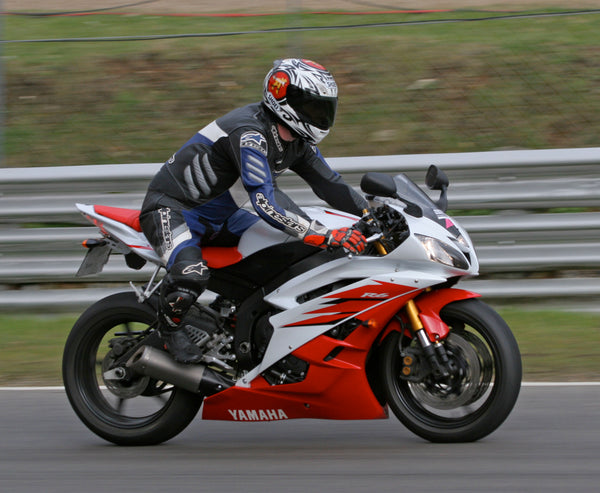
Cover photograph: Greg Knapp, “Gold Triumph Daytona 675 with rider pan shot”, CC BY 2.0. This is an actual Daytona 675 photographed in motion in 2009. The file does not establish the bike's model year, original bodywork or fit with any NiceFairings kit. Used as editorial context, not as an installation or product result.