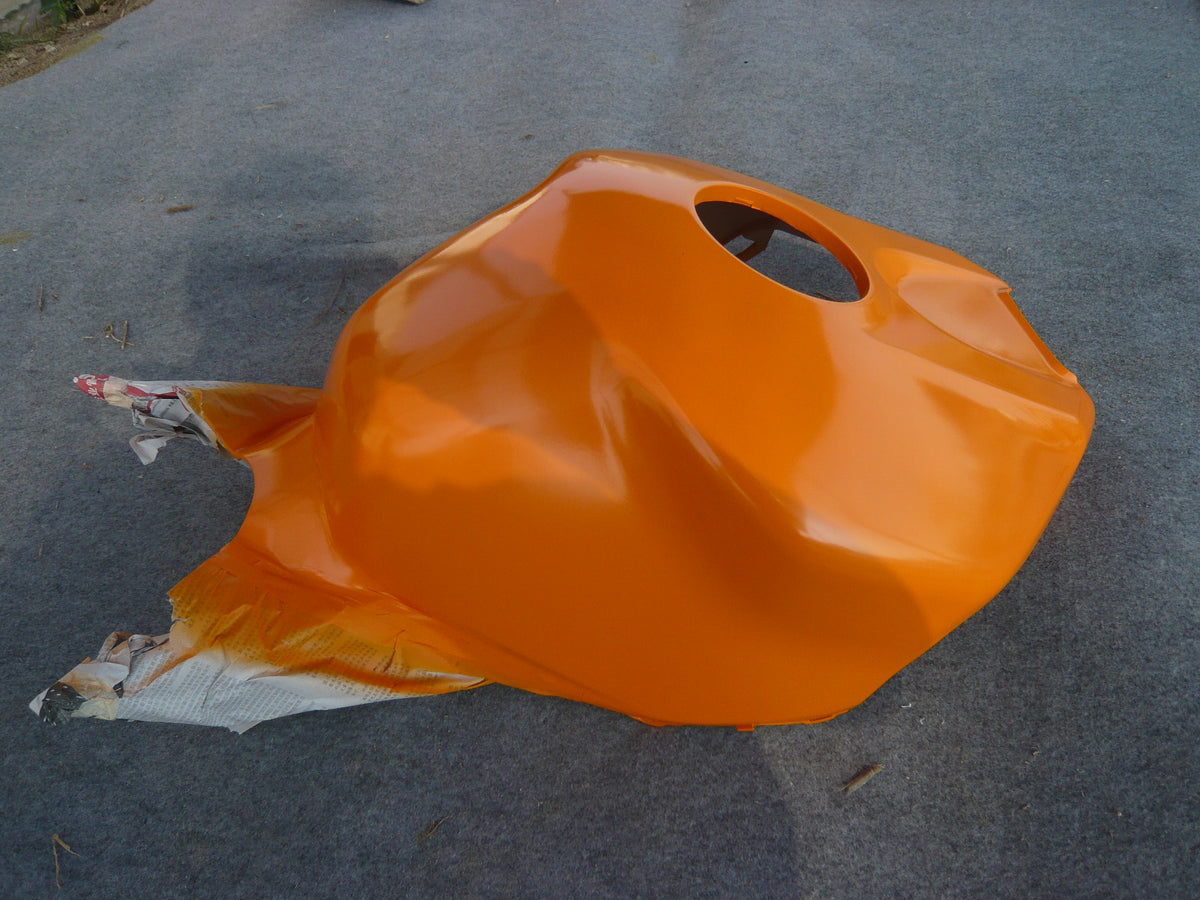
Cover: a NiceFairings production photograph of an orange painted tank-cover panel with masking still in place. It records production-stage appearance, not long-term durability. The illustrations within this guide are labeled separately.
Will a fairing finish still look right after time and use? A delivery photograph cannot answer that alone. This guide explains how to read evidence across unboxing, mounted first impressions and later reports. It offers a comparison table and a neutral notes template rather than a scored product test. Calendar time, riding exposure and the history of the particular panels all belong in that record.
Key Takeaways
Tell the difference between facts and opinions in finish reviews to make honest judgments.
Keep track of calendar time and riding time separately to get an accurate finish analysis.
Take steady photos with the same lighting to compare how the finish changes over time.
Use a plain notes template to write down dates, exposure, and what you see.
Look at the finish quality over the whole time you use it, not just when you unbox it.
Long Term Motorcycle Fairing Finish Review
What A Finish Review Can And Cannot Prove
This guide evaluates the evidence in a long-term finish review; it does not present a hands-on product test or a brand ranking. You gather observations at different stages. Then you compare them under similar conditions. This method records visible change. It cannot promise durability or a set lifetime. No review can guarantee how a finish will act in your garage or on your roads.

A dated series can record what was visible on particular panels between two observations. Storage and cleaning notes provide context; they do not establish the cause of a change. One panel set offers evidence about that recorded example, not every kit made by the same supplier.
You can look at general fairing options at motorcycle fairing options and learn about custom work at custom fairing design. These pages give context for your own research. They do not mean that any certain model kit is in stock or available.
Facts Versus Editorial Interpretation
You must keep facts and interpretation apart in any finish review. Facts include photos with dates, exposure notes, and storage descriptions. Interpretation is what the writer thinks those facts mean. A photo from June and another from December are facts. A claim that the finish "held up well" is interpretation. Both have a place. You need to know which is which.
A good review labels each part clearly. It shows the raw evidence first. Then it gives the writer's reading of that evidence. You can accept the facts and question the interpretation. That is how you stay in control of your own judgment. This separation keeps a review honest and useful for your needs.
Unboxing And Mounted First Impressions
What Delivery-Day Photos Can Support
Photos taken on delivery day have one clear job. They show the condition of your fairing when it first arrives. You take pictures of scratches, scuffs, or shipping damage. You capture how the surface looked when it came out of the box. These images give you a starting point for later comparison.

A delivery-day photo cannot show how the finish will hold up after months of sun, rain, or road debris. It only shows where you started. Nothing more. You need follow-up photos under similar lighting to track any real change. Without that later evidence, a delivery photo is just one single data point.
What Mounted First Impressions Cannot Show
After you mount the fairing, you notice panel gaps and alignment. You feel how the pieces fit together. You see how the surface catches light in your garage. These observations matter for fitment and how it looks right away. They do not predict how the finish will behave long term.
A mounted first impression cannot tell you if the clear coat will fade after a summer of riding. It cannot show how stone chips will build up over thousands of miles. Those results depend on calendar time and riding exposure. You must track both separately to build a useful long term motorcycle fairing finish review.
The table below shows what each stage can and cannot support.
Stage |
What It Can Support |
What It Cannot Support |
|---|---|---|
Unboxing photos |
Arrival condition, visible damage |
Finish behavior over time |
Mounted first impressions |
Panel gaps, immediate handling |
Long-term finish change |
Follow-up reports |
Visible change under comparable conditions |
Durability or lifetime promises |
This section is different from a delivery-inspection checklist. That checklist helps you document arrival condition and raise questions with the supplier. This guide helps you judge finish evidence across months and miles.
Tracking Calendar Time And Riding Exposure
You need to keep two different things apart in your notes. Calendar time is the days or months since you put on the panel. Riding exposure is the real miles or hours the bike traveled with that panel on it. They put stress on the finish in different ways. A good long term motorcycle fairing finish review tracks them on their own.

Elapsed Time Versus Use Hours
Elapsed calendar time and recorded riding use answer different questions. Neither is a substitute for the conditions the panels experienced. A stored motorcycle may have a very different history from one ridden regularly, but the difference cannot be converted into a damage prediction without evidence. Record the variables before interpreting the photographs.
| Variable | What to record | What not to infer |
|---|---|---|
| Calendar time | Dates and period since baseline | A fixed aging rate |
| Riding use | Miles or hours, with unknowns stated | Damage per mile |
| Storage | Location and known exposure | A guaranteed finish outcome |
| Care history | Products, methods and dates | Cause from correlation alone |
Consider two hypothetical reports covering the same number of months. One motorcycle was mostly stored; the other was ridden regularly. That difference makes the reports incomplete comparisons unless both explain their actual use and storage. It does not show which finish will age faster, or establish a track-versus-commuter damage ratio.
Use a descriptive entry such as “Hypothetical example: 14 months since baseline, 11,500 recorded miles.” Add uncertainties when the log has gaps. These numbers describe the example’s history; they do not identify what caused a mark or establish a durability score.
Storage, Cleaning, And Climate Notes
Describe where the motorcycle was stored and any known changes in that arrangement. Note direct sunlight, outdoor parking or other relevant conditions when you actually know them. A hypothetical entry could read: “Attached garage; no direct sunlight observed during normal storage.” Do not turn that description into a guarantee of less damage.
Record the cleaning process actually used, including product names if known, tools and dates. Do not invent details to make the record look complete. If the method changed, note when. Follow the applicable care guidance for the actual finish; this observation template is not a cleaning or coating procedure.
If the panel has film, wax, sealant or another added surface treatment, record the covered area and application date when known. A treated and an untreated area are not automatically comparable. These notes identify a difference in the history without claiming a particular treatment effect.
Include relevant conditions you can document, and label missing information as unknown. You do not need an invented UV estimate or a fixed observation period to make a useful record. More dates may reveal when something became visible, but elapsed time alone never makes a causal conclusion certain.
Reading Long-Term Finish Evidence
Same Panels, Comparable Lighting
When you compare photos from different dates, you need the same panel in the same spot under the same light. A change in sun angle or shadow can make a perfect finish look faded or scratched. You cannot trust a before-and-after comparison if the lighting is very different.

Set up a photo station you can repeat. Use the same place, same time of day, and same camera settings every time. Take the panel from the same distance and angle. Put a neutral object in the frame, like a white card or a known gray surface. This object helps you judge if the lighting changed between shots.
Photograph every main panel at the same time during each session. Do not mix a left-side panel image from June with a right-side panel image from December. Track each panel on its own with its own date and exposure history. This method builds a reliable record for any long term motorcycle fairing finish review.
Without similar lighting, you cannot tell a real finish change from a trick of the light. A photo taken in late afternoon sun will show warmer tones and deeper reflections than one taken under garage lights. The finish itself may be the same in both cases. You need steady conditions to draw honest conclusions.
Reflections, Dirt, Chips, And Unexplained Change
Describe the visible mark before assigning a cause. A bright line may be a reflection; a patch may be contamination or a surface change. Record the location, appearance and observation conditions. Avoid calling every mark a defect or dismissing it as normal wear from a photograph alone.
Haze, lines, chips or peeling-like areas warrant careful documentation, but appearance alone does not identify the material or the cause. Keep original photographs and describe what remains uncertain. If the change needs assessment, share the record with the supplier or a suitable professional rather than presenting a visual guess as a confirmed finish failure.
Hypothetical example: a cloudy area is visible on the right panel in a later photograph but not in the earlier image. The storage notes say that side faced a window. That is context, not proof that sunlight caused the patch. First check whether the panel identity, lighting and image conditions match; then keep the cause marked as unresolved unless further evidence supports it.
Admit the limits of your own records honestly. One bike, one rider, one storage location. You cannot apply results from a single set of panels to all products from a manufacturer. Incomplete records also lower confidence. If you missed a photo session at six months and only have one at unboxing and one at eighteen months, you lose the ability to see when the change started.
A thorough long term motorcycle fairing finish review documents what it can observe and honestly notes what it cannot. Label any hypothetical examples clearly so readers know they are examples, not real findings. Avoid claims about competitor quality or promises of lifetime performance. Let the evidence speak for itself within its limits.
A Neutral Longitudinal Notes Template
Dates, Exposure, And Observations
You need a simple log to fill in at each check-in. Start with the date and the time since you put on the panel. Write down riding exposure as total miles or engine hours on that panel. Describe where you store the bike in plain words: garage, covered outside, direct sun, or climate-controlled space. Note your cleaning method and any products you use, like wax, sealant, or paint protection film. Then write neutral notes about each panel. Use facts: "right fairing shows three new stone chips near the front edge" or "left panel reflection looks a bit less sharp than at month six." Do not use words like "bad" or "cheap." This template is for taking notes, not for deciding warranty or giving legal advice. It gives you a clean record for any long term motorcycle fairing finish review.
Comparing Stages Without Scoring
Use this blank log at each observation, keeping the original files alongside it. No entry is a rating, and “unknown” is an acceptable answer.
| Field | Record |
|---|---|
| Observation date and panel identity | To be recorded |
| Baseline date and elapsed period | To be recorded |
| Recorded miles or hours | To be recorded |
| Storage and care history | To be recorded |
| Photo filename, angle and lighting | To be recorded |
| Visible observation | To be recorded |
| Unknowns and next comparison | To be recorded |
You compare stages by matching panels, lighting, and camera angles. You do not give scores or rank brands. If you want to compare finish types before you buy, read the OEM vs aftermarket guide at OEM and aftermarket fairing comparison. That guide helps you understand general differences. It does not say any specific kit is in stock. Your notes stay descriptive and helpful for your own choices.
Look at finish quality over the whole timeline, not just at unboxing. Keep calendar time and riding exposure apart in every note you write. Take photos of panels on delivery day, write down your first impressions after mounting, and record how you store and clean them. Check each panel again after every season. Use the neutral notes template and the stage comparison table when you read any long term motorcycle fairing finish review. These tools keep your evidence clear and your conclusions honest. They do not promise durability or rank brands. They just help you see what changed, when it changed, and under what conditions.