The motorcycle still looks like your motorcycle. One side fairing is cracked, the tank has a small dent and the insurer has declared it a total loss. Then comes the emotionally difficult offer: take the settlement and surrender the bike, or retain it for a lower payment and repair it yourself. A set of new plastics makes the second route look tempting. It is also the wrong first purchase. Before thinking about color, establish the claim numbers, inspect the safety-critical parts, and learn exactly what title, registration and insurance treatment the bike will receive where you live.
A 2026 ZX-6R owner described a situation like this in a public forum. The poster reported roughly 1,000 miles, an approximately $13,000 insurer valuation, and a $5,300 salvage-retention deduction. They also reported a visibly bent rim, despite saying it was not noticeable at speed. These are one person's unverified figures and description, not a NiceFairings inspection or a typical claim. In fact, a bent rim is exactly why “mostly cosmetic” must not become “safe to ride.” We use the numbers below only to show how to structure a decision, not to recommend retaining that particular motorcycle.
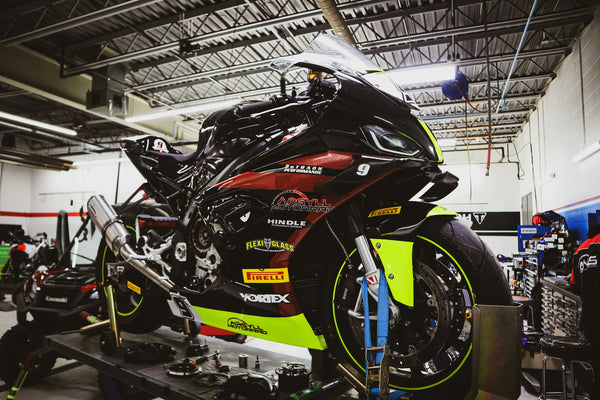
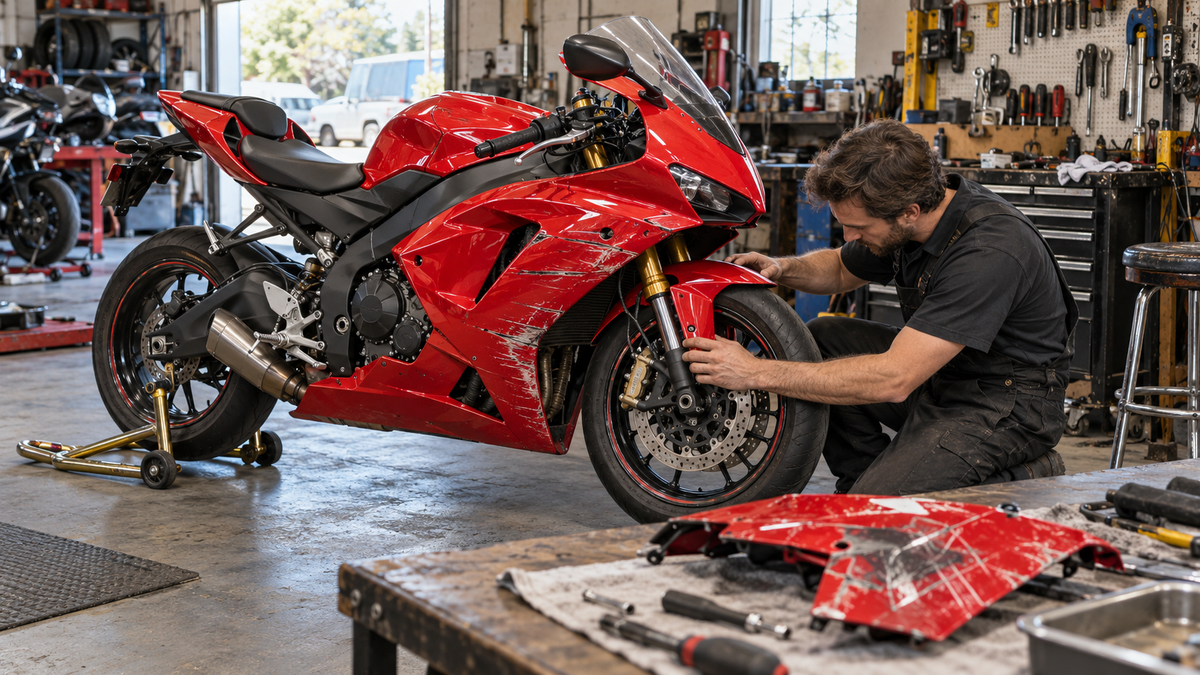
Cover: AI-generated editorial concept. The pictured bike, mechanic and damage are fictional; the image is not an inspection record, a customer story or evidence that a damaged wheel can be ridden.
Why a cosmetic-looking motorcycle can be totaled
An insurance total-loss decision compares the vehicle's pre-loss value with the cost and rules for settling its damage. The estimate can include manufacturer bodywork, a tank, lighting, brackets, labor, paint, taxes and other items that are not obvious from one photograph. It may also account for hidden damage discovered during disassembly and the vehicle's salvage value. The legal threshold or formula varies by jurisdiction and policy; there is no sound universal claim that “bikes total at 40%” or that every fairing scratch means a total loss.
Ask for the written valuation, itemized repair estimate, salvage-retention amount and the settlement calculation. If the vehicle is financed, ask how the lienholder is paid and whether retaining it is permitted. Confirm whether taxes, fees, deductible and any prior damage are included. If a line looks wrong, ask the adjuster for its basis. A parts estimate prepared for an insurer is not automatically the cheapest technically responsible DIY plan—but a cheaper DIY plan also does not undo the insurer's title or settlement decision.
Put those documents in one folder before negotiating. Read the valuation and estimate as separate statements: one asks what the motorcycle was worth immediately before the loss, while the other prices a specified repair. A rider can disagree with either for different reasons. A missing accessory, incorrect mileage or wrong trim belongs in the valuation discussion; an omitted bent stay or wheel belongs in the damage discussion. Ask how a supplement for damage found after disassembly would be handled and whether accepting the settlement closes that route. Do not silently assume you can reopen a claim after retaining the vehicle. If the bike is financed, a quoted gross settlement may not be cash available to fund repairs at all.
The National Association of Insurance Commissioners' auto-insurance guidance describes an insurer's option to take title after paying a total-loss claim and the possibility of negotiating to retain a vehicle at an agreed salvage value. Washington's insurance regulator gives a concrete owner-retained example in which salvage value is deducted from the payment. Both are auto-insurance guidance, not a guarantee for a particular motorcycle policy or state. Get the actual written offer rather than relying on a telephone shorthand such as “you can keep it for five grand.”
Put the safety gate before the price calculation
The decision is not “OEM fairings or aftermarket fairings?” until the motorcycle is found repairable. Arrange an independent motorcycle-qualified inspection and provide the crash history and adjuster's estimate. The inspection should go beyond the exposed side. Frame and subframe alignment, steering head, fork tubes and yokes, wheel runout, swingarm, brakes, tire bead, handlebar, controls, cooling, engine cases, mounts and wiring can all matter. A body panel may hide a bent stay or a leak. The exact inspection method belongs to the professional evaluating the actual machine.
Treat any damaged wheel as a stop item. A rider's inability to feel a bend at speed is not a measurement or a clearance to continue using it. The online ZX-6R poster's proposed low-cost route included leaving the bent rim in place; that is precisely the line a responsible budget should not cross. Replacement or a professional assessment and repair, if allowed by the manufacturer and relevant standards, must be priced before the build is called viable. Do not use an aftermarket fairing kit to conceal questionable running gear or structural damage.
Ask the inspector to separate three categories in writing: safety-critical repair required before use, legally required road equipment and cosmetic work that can wait. If the frame, forks, steering or wheels cannot be returned to safe specification economically, the answer may be to release the bike to the insurer even if the visible shell looks repairable. An emotional attachment can be honored without becoming a safety assumption.
Work the settlement math without counting the same money twice
Using the forum poster's rounded numbers only as an illustration, a $13,000 payment with a $5,300 retention deduction would leave $7,700 cash and the damaged motorcycle if the buyback were accepted. Surrendering the motorcycle would leave $13,000 cash, subject in either case to the actual policy, lien, deductible and settlement terms. The decision is not “pay $5,300 plus $1,900 out of pocket” unless the insurer has structured the transaction that way. Economically, keeping the bike gives up $5,300 of the settlement and accepts the future repair and title obligations.
The poster estimated about $1,900 for an OEM-spec repair including a new wheel, and about $900 for a cheaper cosmetic repair that would leave the bent wheel. The $900 path should not be treated as a valid roadworthy comparison. If the $1,900 estimate were complete, the retained-bike route would leave roughly $5,800 of the $7,700 cash after repair, plus a rebuilt bike. That arithmetic omits taxes, title fees, inspection, insurance changes, unseen damage, towing, equipment, labor and any extra parts. Every omitted line makes the apparent cash advantage less certain.
| Question | Release the motorcycle | Retain and rebuild |
|---|---|---|
| Immediate settlement in the illustrative post | About $13,000 before actual adjustments | About $7,700 before actual adjustments |
| Ownership of damaged bike | No | Yes, with all repair and title responsibilities |
| Required inspection and repair | Not the claimant's rebuild project | Must be priced and completed safely |
| Title and future resale | Replacement bike's title depends on purchase | Possible salvage/rebuilt brand and disclosure obligations |
| Exposure to hidden damage | Mainly affects replacement choice | Remains with owner after settlement |
This table is not an expected return calculation. The poster mentioned potential marketplace offers, but an informal offer before the claim is settled is not a guaranteed sale price. Rebuilt-title value and insurability cannot be inferred from one listing or a comment thread. Obtain real quotes for insurance and a written inspection before giving a speculative resale number any weight.
Learn the title path before accepting the buyback
“Salvage” and “rebuilt” are not interchangeable. A salvage certificate may limit or prohibit public-road use until repair, inspection and retitling are completed. Requirements differ by state and can also depend on whether the title is already in your name, whether a lien is recorded and whether the bike comes from another state. For example, Virginia DMV describes a rebuilt-salvage examination, receipts and permanent rebuilt branding, while New York DMV describes a separate salvage examination and a “REBUILT SALVAGE” title brand. New York explicitly says its salvage examination is not the safety inspection; that is a separate requirement. Neither state's page should be copied into a rule for every U.S. rider, and an administrative examination should not be mistaken for an independent motorcycle repair assessment.
Before you sign, contact your state DMV and ask: What exact title will be issued after retention? Can you register or ride the bike while it is salvage? Which inspection, receipts, photographs and fees are required? Can the same VIN later receive a rebuilt title? What happens if a major component has been replaced? Then ask your insurer—or several insurers—whether they will cover that VIN after rebuilding, at what level, and with what documentation. Do not assume comprehensive or collision cover will be available on the same terms as before.
Keep a dated file from the start: accident photos, insurer estimate, professional inspection, parts invoices, repair photos showing uncovered structural and mounting areas, inspection approvals and title correspondence. This is not just paperwork for a future buyer. In some jurisdictions the sequence of documents is part of the process for returning a salvaged vehicle to road use. It also protects you from later telling a vague story that accidentally understates the damage.
Ask the DMV about the sequence, not only the final title name. Can parts be purchased before an initial inspection? Must the vehicle be towed rather than ridden to the inspection site? Are photographs of the vehicle before repair required? Is there a separate safety inspection after the anti-theft or VIN examination? What proof is needed for a replaced wheel, fork or frame component? Rules differ, and the order matters: a beautifully painted bike with no before-repair documentation may be harder to process than an ugly but carefully recorded one. Treat the DMV answer as a project prerequisite rather than an administrative task to be solved at the end.
Only then choose OEM or aftermarket appearance parts
Once the safety-critical work and title route are known, ask what the remaining cosmetic job actually is. One damaged side panel may not justify an entire painted set. Conversely, several cracked panels, a damaged nose and mismatched older paint may make a coordinated second set sensible. Match the comparison scope: included panels, headlamp opening, tank coverage, inner trim, fasteners, shipping, tax, installation and any paint finishing. Keep required road equipment in the plan. Our damage-evidence packet guide helps organize the initial photos and estimate; this article addresses the separate post-total-loss buyback decision. The quote-math guide provides a neutral worksheet for known and unknown costs.
OEM parts may preserve the original configuration and specific factory color, but a manufacturer part number still needs to be checked against the VIN and market. Aftermarket painted bodywork may offer a more affordable or more coordinated visual route, but a listing photograph cannot verify tab strength, exact fit or what is inside the carton. Read our fairing quality evidence guide before relying on broad claims. If the motorcycle-side mounts were bent in the collision, new outer plastics cannot correct them. Ask the repairer to document the underlying support work separately.
For a ZX-6R, browse the NiceFairings Kawasaki ZX-6R collection only after verifying the bike's production year and exact configuration. The online example concerns a 2026 bike; a kit listed for 2019–2023 or 2024–2025 should not be presumed to fit it. If a matching listed kit cannot be confirmed, send the model/year, variant details and relevant damage photos to the store for an application answer rather than forcing a near match into the budget; share a VIN only through an appropriate private support channel if needed. NiceFairings sells appearance parts; it does not certify that a salvage motorcycle is structurally sound, street-legal or insurable.
The buyback can be rational for an owner who has a sound, repairable motorcycle, the skills or professional help to rebuild it, a workable title path and a realistic all-in budget. It can also be a costly mistake if the decision starts with the color of replacement fairings and ignores a wheel, fork, frame or paperwork problem. If your independent inspection, state DMV or insurer leaves a key question unanswered, pause the decision. A total-loss designation is not proof the bike is beyond repair, but neither is a clean-looking photograph proof that it should be ridden again.
One practical way to make the decision is to write three numbers on a page: the confirmed cash difference between surrender and retention; the minimum safety-and-title cost required to return this exact motorcycle to legal use; and the amount you can afford to lose if hidden damage increases that cost. Keep cosmetic upgrades in a separate column. If the plan only works when the wheel repair is skipped, an informal resale offer materializes, or no hidden damage exists, it is not yet a robust plan. If the plan still works after conservative allowances and an independent inspection, the buyback can be evaluated on its merits rather than on the shock of seeing “total loss” on paperwork.
Editorial/legal note: U.S. examples only; state law, policy language and claim terms control. This is a decision framework, not legal, insurance or mechanical approval. Forum amounts are the poster's statements, not verified estimates or NiceFairings pricing. The cover is AI-generated and depicts no actual claim.