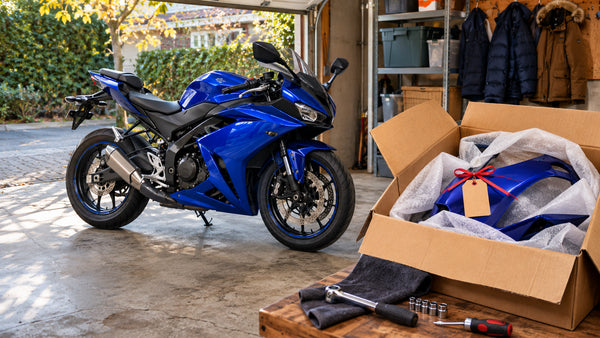
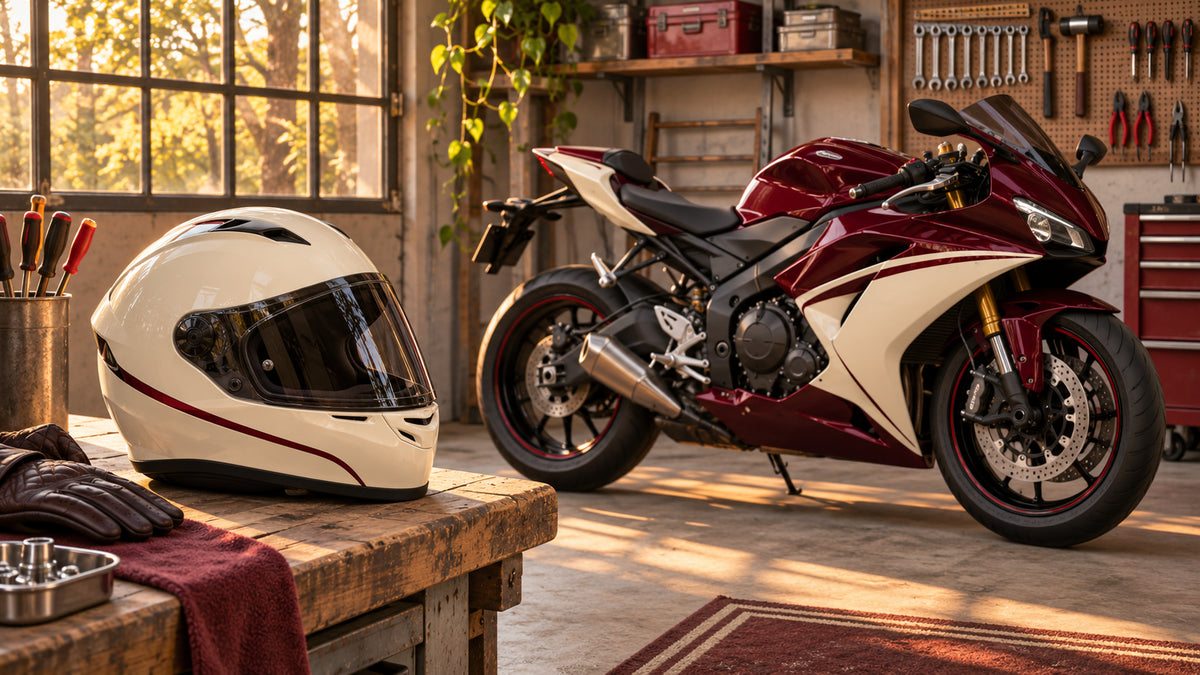
Cover: AI-generated editorial illustration of a helmet and a sportbike color concept; it does not depict a specific product or demonstrate helmet performance or fairing fitment.
Your motorcycle has a new paint idea. Your favorite helmet is already sitting on the shelf. Do you match the fairings to the helmet, buy a new helmet to match the bike, or let the two do their own thing?
Start with the gear you actually ride in and choose a connection you can live with: one shared color, a related accent, a similar finish, or simply a deliberate contrast. The helmet does not need to disappear into the motorcycle. Fit, condition and appropriate protection come first; styling comes after those decisions.
This guide is about building a coherent color story around gear you own, not about proving that a particular color prevents collisions. We will use imaginary examples to show how to make choices clearer before a custom fairing order.
First decide what needs to stay
Lay out the actual items, not just saved product images: helmet, jacket, gloves and, if relevant, the luggage you use most. Photograph the motorcycle in natural light and write down the colors you do not intend to change. These might include the fuel tank, wheels, frame, seat or a favorite riding jacket. A motorcycle viewed alone in a paint rendering can look very different once the rider and their gear are part of the picture.
Now choose your anchor. If a well-fitting white helmet is staying, it can be the light element that connects a white nose stripe to a white tail accent. If the tank and wheels must remain black, a helmet with black details might bridge them to brighter panels. If your jacket is vivid red, you may decide the fairings need only a small red line rather than a second large red area.
An anchor is a design constraint, not an instruction to replace perfectly good equipment. A neutral helmet can support many future liveries. An expressive graphic helmet can be the hero while the fairings stay simple. Either approach can look intentional.
Four ways to connect the helmet and the bike
| Approach | Example | Why it works | What to check |
|---|---|---|---|
| Repeat one accent | White helmet, dark blue bike, small white nose and tail details | Creates a visual link without a full match | Keep whites and line widths deliberate |
| Match the main color | Red helmet with red-and-black fairings | Gives a strong, unified look | Compare colors in daylight; near-matches can be noticeable |
| Use a controlled contrast | Light helmet above a deep gray motorcycle with a small light graphic | Keeps the rider visually distinct from the machine | Make sure the contrast is a choice, not an accidental mismatch |
| Echo a graphic | A helmet with diagonal stripes and fairings with a related stripe direction | Connects the designs without copying every mark | Avoid duplicating protected logos or another brand's exact artwork |
You only need one of these to start. Combining every technique can make the design feel crowded: matching the helmet's base color, copying all its stripes and adding every accent to every panel leaves little room for the bike's shape.
The one-accent approach
Pick one small color from the helmet and repeat it in two or three places on the motorcycle. A cream stripe on the helmet might reappear along a side panel and on the tail. The rest of the fairing can stay burgundy or black. On a blue bike, a warm orange accent on the helmet can be echoed by a narrow orange detail instead of a full orange panel.
The locations matter more than the number of stickers. Look at the bike from the front, rear and both sides; a single accent hidden under the seat will not create the same connection as one visible beside the helmet when the rider is seated. Ask for both sides of the proposed design before approving production.
The quiet-bike approach
A graphic helmet can have a lot of detail in a small area. If it has several colors, choose the dominant color and one supporting accent for the bike, then let the remaining helmet graphics remain on the helmet. For example, a red, white and blue helmet does not require a replica racing livery. White fairings with a thin blue stripe and a small red accent can keep the connection while making the motorcycle's lines easy to read.
This is also helpful if the helmet is likely to change before the fairings do. A simpler bike design can work with another helmet later. Choose the motorcycle paint because you like it on its own, not only because it matches one piece of gear today.
The contrast approach
Matching is not the only way to create a complete look. A light-colored helmet can provide a clear visual break above a dark motorcycle, and a dark jacket can keep a bright fairing from feeling overwhelming. Contrast can be warm versus cool, light versus dark, or colorful versus neutral. The goal is a deliberate relationship that still looks good when the helmet is off the bike.
For road visibility, the Motorcycle Safety Foundation recommends bright clothing and a light-colored helmet, along with other visibility practices. Visibility depends on lighting, angle and surroundings; neither a color choice nor reflective details guarantee that other road users will see you.
How to compare colors without chasing a perfect digital match
Screen images are useful references, not reliable paint standards. Phone screens, white balance, lighting, camera exposure and metallic or pearl effects can all change the appearance of a color. A helmet may also use a different material and finish from a painted plastic panel. Even when two colors share a name, that does not establish they will look identical.
Use this simple review process:
- Photograph the helmet and motorcycle together in diffuse daylight, then separately in sunlight and shade. Avoid filters and heavy color edits.
- Identify the color that matters: “a warm off-white stripe” is more useful than “white like the photo.” If you have a verified paint code or physical sample, share it and explain where it came from.
- Mark the desired finish for each area: gloss, satin or matte. A similar hue can look different at different sheen levels.
- Tell the supplier which pieces are staying original, especially the tank and wheels, and ask what can and cannot be matched.
- Review the left side, right side, front and tail layout. Ask for a color sample or finished photographs if available, and agree on the approval process before production.
Do not promise yourself an exact match from a mockup. Metallic flake, viewing angle and different substrates can produce visible variation. If the helmet and panel will be viewed next to one another, ask the supplier what level of matching is realistically possible and what happens if the finish differs from the agreed reference.
A light helmet on a dark bike: three examples
Example 1: Gloss white and deep blue. A white helmet can connect to white lettering or a narrow sweep on dark blue side panels. If the tank remains blue, repeat the white in the nose and tail, keeping the central panel mostly blue. This gives the design a clear direction without making the entire motorcycle white.
Example 2: Warm ivory and burgundy. A warm off-white helmet might look more natural with an ivory accent than a very cool, bright white. Test the two references side by side before approving the paint. Gold or black hardware already on the bike can stay as quiet supporting details; there is no need to repaint them just for symmetry.
Example 3: Silver and black. A silver helmet can sit above black fairings with a restrained silver panel or stripe. Decide whether the bike should be gloss black, satin black or a mixture. A small red accent is optional; if it is already prominent on the helmet, use it sparingly on the panels so it remains an accent.
These are styling scenarios, not claims that the pictured finishes or parts are available for every model. Your motorcycle's panel breaks, tank color and available kit determine how the idea should be adapted.
When the helmet is colorful and the bike is already colorful
Two busy designs can compete, but they do not have to match. List the largest colors on each and circle the one they share. That shared color can become the bridge. If there is no shared color, add a neutral such as black, white or gray to the fairing design and use it as a pause between graphics.
If your helmet has a race-inspired graphic, take inspiration from the balance of broad shapes and small accents rather than copying a team's trademarks. The same principle works with stripes, geometric blocks or a gradient. Ask for an original design and be explicit about any logos you have permission to use. A visual reference is a starting point, not proof that the seller can reproduce an official branded design.
Consider what is visible from a distance. A small graphic on the rear of a helmet may not be a useful anchor for the whole motorcycle. The base color and one strong side accent are usually easier to integrate. Stand back, squint at your photographs and ask whether the main shapes still read clearly.
Fit and protection come before color
Never choose an uncomfortable or unsuitable helmet merely because it matches your bike. Follow the helmet manufacturer's sizing and fitting guidance, and choose equipment appropriate to the road rules and standards where you ride. In the United States, NHTSA explains the federal helmet standard and how to check a helmet. NHTSA also warns that a certification label by itself is not conclusive proof of compliance; buy from a reputable source and check the manufacturer's details.
Do not modify a helmet's shell, straps, liner, vents or visor to make it match a fairing. Painting, solvents, adhesives and accessories can be incompatible with some helmets: consult the manufacturer before changing anything. A safe, well-fitting helmet in a different color is a better starting point than a questionable match.
Your jacket, gloves, pants and boots matter too. The MSF's protective gear overview covers proper fit and recommends gear designed for motorcycling. Choose the equipment for the conditions and your protection, then use the color plan to bring the bike and gear together.
Turn the idea into a useful custom-fairing brief
Before contacting a supplier, make a one-page brief containing:
- Exact motorcycle make, model, model year and relevant variant; include clear photos of your own bike.
- The pieces that must remain unchanged, including the actual tank color and wheel finish.
- One photo of your helmet in daylight, with its main and accent colors identified.
- A side-view design sketch or reference with front, tail and both sides described.
- Finish requests for each area, and whether graphics should be painted or supplied another way.
- Your priorities: for example, “the ivory stripe should coordinate with the helmet; the black wheels stay.”
- Questions about the kit's exact contents, sample or photo approvals, and realistic color-matching limits.
Check the seller's listing for your precise motorcycle; a design sketch does not establish fitment. A tank cover, windscreen, hardware or other piece should never be assumed to be included. Our guide to planning around an existing tank color provides another useful way to keep unchanged parts in the design conversation.
Review the design from the rider's point of view
Before approving the final layout, put on your normal gear and have someone photograph you standing next to the parked motorcycle and, if safely supported, seated on it. Look at the helmet, jacket and bike as one composition. Then check the motorcycle alone: does the design still work with the helmet on a shelf?
Look at the front and tail as well as the side. Where a stripe crosses panel joints, ask how it will meet on the actual kit rather than trusting an illustration with invisible seams. If the sides are intentionally different, label the left and right views clearly. Keep a copy of the final approved design and any stated color limitations for your records.
The result does not need to be a perfect color match. A recognizable accent, a comfortable helmet and a motorcycle you enjoy looking at can be a much better combination.
Ready to explore a design? Start with your exact model and year at NiceFairings, then share the colors and reference views you want to discuss. Would you match your helmet to the bike, or use it as a contrast?