
How can you tell what material a motorcycle fairing is made from before ordering? Start with the exact listing and a clear description of its construction. This guide is for US and European street-sportbike buyers comparing a carbon-pattern appearance with a claimed carbon-fiber composite panel. Carbon-look describes appearance; the pattern alone does not establish the material underneath. Your practical task is to ask what the seller is supplying, which panels the description covers and what evidence supports it. Keep that material enquiry separate from confirming the part application for your motorcycle.
Key Takeaways
-
Carbon-look describes a decorative appearance. Carbon-fiber composite describes a material construction; confirm what the specific panel contains.
-
Before you buy, ask the supplier to identify the substrate and explain any claimed carbon-fiber content in writing.
-
Write down the product ID and fit details on their own, apart from what the seller says.
-
Never test a fairing by scratching, burning, or bending it. This harms the part.
-
Clear order records help you compare the seller’s stated materials and resolve discrepancies; paperwork alone is not a material test or quality guarantee.
Carbon Look vs Carbon Fiber Motorcycle Fairings
Decorative Finish vs Structural Material
Carbon-look can be created with a printed, transferred or other decorative pattern. It does not specify the material carrying that finish. Carbon-fiber composite bodywork, by contrast, contains carbon reinforcement combined with a resin system. The actual construction can differ between products, so a broad material name is not a complete specification. Ask the seller whether the description refers to a decorative surface, a carbon-containing overlay or the construction of the supplied panel. Avoid treating the words “carbon” and “carbon-look” as interchangeable in the order.
A carbon-pattern finish does not tell you what material is underneath. You cannot tell how it is made just by looking. A fairing may have a weave pattern but still be made from ABS plastic. Another fairing may use fiberglass with a thin carbon layer on top. The pattern does not show what holds the weight. Always separate how it looks from how it is built when you check fairing materials.
|
Feature |
Carbon Look |
Carbon Fiber |
|---|---|---|
|
Appearance |
Printed or dipped pattern |
May show reinforcement or have an opaque finish |
|
Base material |
Often ABS plastic |
Carbon reinforcement and resin; confirm the supplied construction |
|
Documentation |
Request the actual substrate description |
Supplier declaration should state construction |

Substrate and Overlay Explained
The substrate is the base material of a panel. It holds the weight and gives the part its shape. Common substrates include ABS, fiberglass, and carbon composite. An overlay is a layer put on top of that base. A carbon overlay adds a carbon cloth layer over a substrate. This overlay may be for looks, for strength, or both. You cannot assume an overlay has no strength. You also cannot assume all carbon composites act the same. The type of resin, how the cloth is placed, and the number of layers all change the final part.
When you shop for a fairing described as carbon fiber, ask what the base construction is and where the carbon reinforcement is used. A panel may combine materials or include a surface layer; that does not automatically make it poor quality, but the scope should be clear. “Full carbon” is a marketing description that still needs explanation. It does not mean the component contains nothing but carbon: a composite also includes its resin system and may have other features. Match the documented product to the reason you are buying it rather than assuming one phrase establishes performance.
Why the Distinction Matters
Safety and Performance Expectations
Do not assume a particular weight saving or handling improvement simply because a listing says carbon fiber. A meaningful weight comparison requires equivalent parts and a clearly stated measurement scope: the same panel coverage, relevant finish and any included attachments. Neither the material name nor the impression of holding an unrelated panel provides that comparison. If a measured weight matters to your project, ask whether product-specific information is available. If it is not, do not turn a styling preference into a promised performance result.
Ask about the specified finish and the manufacturer’s care requirements. Appearance alone does not establish UV resistance, heat suitability or service life. Do not assume every transparent coating provides the same protection, or that the presence of a clear coat proves a durable construction. If the intended exposure matters—for example, where the component sits near heat—ask for application-specific guidance from the supplier and installer. A generic decorative illustration cannot answer that question.
Material verification is also separate from suitability for use. A description of carbon content does not certify the condition of the motorcycle, the installation or compliance with applicable requirements. If the change affects an area with an approval or inspection requirement, seek the relevant local guidance for the actual component and use. This article does not determine whether a particular panel is approved for road use, and a supplier’s fit statement should not be presented as a safety certification.
A surface pattern does not establish strength, safety or approval. Written product information is useful evidence to evaluate, not a substitute for appropriate testing, application guidance and a suitable installation.

Cost and Resale Value
Compare the price against the actual supplied scope: which panels, which construction, which finish and which associated items are included. A small carbon-containing trim cover and a complete side panel are not equivalent purchases. Request clarification if one quote describes the material precisely while another gives only a visual style name. Do not infer better quality, a fixed premium or a better resale outcome from price alone. The comparison is about understanding the offer, not ranking every material category by cost.
Keeping the product ID and construction information can help you describe the part accurately to a future buyer. It does not guarantee what that buyer will pay. Record the seller’s statement as a statement, and keep any supporting documents with it. If the construction remains uncertain, disclose that uncertainty rather than upgrading a carbon-pattern description to a genuine-carbon claim. Finish condition, product history and buyer requirements may also matter; this guide does not forecast resale value.
What to Ask Sellers
Asking the right questions before you buy helps you tell a documented part from a marketing claim. You need written proof of the substrate, the construction method, and the scope of the carbon content. Without this information, you cannot evaluate carbon look vs carbon fiber motorcycle fairings. Use the checklist below to guide your talk with every supplier.
Supplier Question Checklist
Send these questions before you place an order. Save the written replies as your record.
-
What is the exact product ID for this kit? Write down the number.
-
What is the substrate material? Ask directly. Is it ABS, fiberglass, or a carbon composite?
-
Is carbon used as a surface overlay, within a mixed-material construction or as the principal reinforcement of the panel? Ask the seller to describe the supplied product rather than infer its makeup from the name.
-
Please provide a written material description and any available supporting specification. Ask what it says about the substrate, reinforcement and resin system; not every retail supplier provides a detailed laminate schedule.
-
Please confirm the scope of the carbon fiber content. Confirm that your statement covers every panel in the kit.
A clear written answer gives you something to check later. A vague answer means you should keep looking for better information.

Documentation and Panel Identification
Written documentation helps you compare stated offers and gives you a record if the delivered item appears inconsistent with the order. During delivery inspection, compare the product identification with the invoice and check the supplied scope. A visual receipt check cannot establish every internal material detail. Keep uncertain observations separate from confirmed discrepancies and ask the supplier how to investigate them before modifying the part.
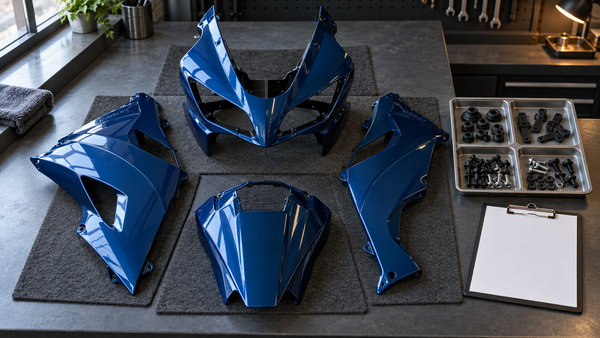
For a concrete listing example, the NiceFairings custom-painted R6 kit page describes ABS bodywork. That listing should not be represented as a genuine carbon-fiber product. Its stated model range also does not establish compatibility with every modified motorcycle. Confirm the exact application and chosen finish with the seller; do not infer that a carbon-pattern option is offered unless it has been confirmed for the order.
The Ducati Superleggera V4 design page discusses visible carbon and painted areas on that particular OEM project. This is a limited example of a manufacturer describing its own design. It is not evidence for the composition, quality or fit of an aftermarket panel from another seller.
Both a carbon-pattern product and a carbon-fiber composite product can have clear documentation—or inadequate documentation. The presence of a weave-like finish tells you nothing about the availability of records. Ask whether the material description covers every supplied panel or only selected pieces. If the answer is vague, record the unresolved point and decide whether to seek further evidence or another product. A document’s usefulness depends on what it actually establishes, not on a carbon label alone.
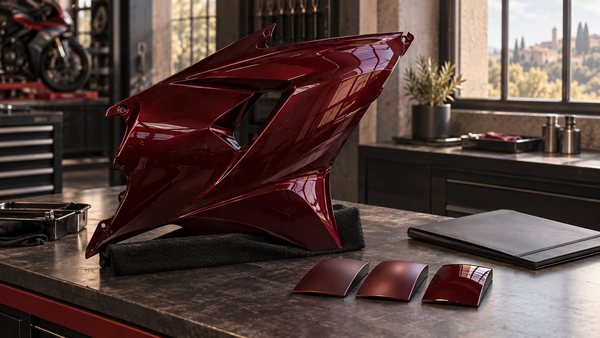
Photos may show the outer face, rear surface and visible edges, and can help explain a construction question. They do not necessarily reveal the internal arrangement or certify the material, strength or fit. Ask whether the pictures show the actual product and which part of the seller’s description they illustrate. Keep photographs as supporting context rather than treating an attractive weave or clean finish as proof of a technical claim.
Combining the checklist with a clear written answer makes the purchasing discussion more specific. You can compare product identity, the claimed construction and the intended application without merging them. If technical performance is important, ask what product-specific evidence is available and whether it applies to the exact component you are considering. Leave unsupported expectations unresolved; good record keeping cannot create missing test evidence.
Pre-Order Checks for a Motorcycle Fairing
Weave, Texture, and Weight Impressions
Light and viewing angle change how a patterned or coated surface appears. A visible weave can be attractive, but apparent depth is not a reliable consumer test for carbon content. A decorative finish may imitate depth, and a genuine composite may be painted or otherwise covered. Use close photographs to discuss appearance and finish expectations, not to label a product authentic or fake. If the surface and written description seem inconsistent, ask the supplier to explain the discrepancy.
Do not identify the substrate by touch or an impression of weight. Finish texture, panel size, shape, thickness and associated items can all affect those impressions. If you compare measured weights, make sure the products and measurement conditions are meaningfully comparable. Even a reliable weight measurement does not, by itself, identify a material. Request a specific construction description rather than guessing from a smooth, heavy or light-feeling surface.
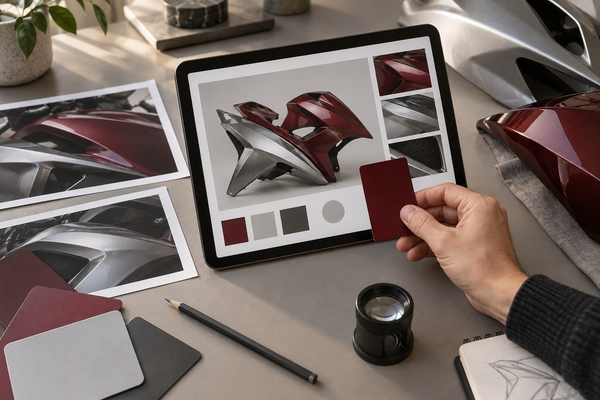
Photographs can help you discuss weave alignment, finish appearance and how several visible panels look together. A consistent appearance does not establish identical construction. If you want a coordinated look, describe the visual requirement; if you want a particular material, ask for that specification separately. A custom-fairing design enquiry should clearly distinguish requested appearance from any material requirement. Do not assume a design service can supply a material that is not listed or confirmed.
Do not scratch, burn, bend or drill a purchased panel to investigate its material. These actions can damage the part and are not appropriate consumer identification methods. A casual tap-tone or magnet check also cannot certify the construction, although it is inaccurate to say every such check necessarily causes damage. If a material claim remains disputed or technically important, ask about an appropriate qualified assessment. Supplier documentation is a sensible starting point, not the only possible form of evidence and not a laboratory certificate.

Recording the Exact Part and Confirmed Fit
Record the exact product ID for the kit you want. Write the number from the supplier listing. This ID identifies the set. It does not describe the substrate. The product ID and the construction claim are separate facts. Keep them as two different records in your notes.
Start a note file for each kit you consider. Record the listing identifier, selected variant and the motorcycle application stated by the seller. Add the date and source of that information so you can distinguish an old listing screenshot from a later clarification. Record relevant current-bodywork modifications separately. The notes identify what is being considered; they do not independently prove physical compatibility or the material of a delivered component.
Confirm the fit separately from the substrate claim. The supplier must state which motorcycle model and year the kit fits. This fit confirmation does not prove the substrate. Model and year fit requires its own written statement from the seller. Do not merge fitment and substrate into one assumption.
Keep the fit enquiry and the material description linked by the same exact product and selected variant. This prevents an answer about one finish option from being applied to another construction or kit. Compare the order confirmation with your recorded request and ask the seller to resolve conflicting descriptions before production or dispatch, as appropriate. During receipt review, report concerns without assuming a visual difference proves an internal material substitution.
Some listings have several selectable variants, while others assign a separate identifier to each product. Record whichever identifier and option combination the seller actually uses. Do not assume that a particular listing offers ABS, an overlay and full-composite versions simply because those options exist elsewhere. Ask which construction is supplied for the option in your cart. Price alone cannot answer that question, and a familiar product name may not describe every selected detail.
A useful scope statement identifies the supplied panels and describes the construction being offered. Where different pieces use different materials, ask the supplier to distinguish them. If detailed reinforcement or resin information is unavailable, record that limit rather than inventing a specification. Keep any product-specific test or application documents separate from a marketing description, and check that their identifiers match the order. A clear record helps later enquiries about the supplied bodywork; it does not guarantee quality or future value.
Carbon-look describes an appearance; carbon-fiber composite describes a construction that still needs a product-specific explanation. Use the questions in this guide to distinguish the two. Record the exact listing and variant, the supplied-panel scope, the seller’s material statement and the separate fitment enquiry. If the evidence is incomplete, seek clarification before ordering rather than relying on a pattern, price or photograph. That is a more useful basis for a purchase decision than an unsupported promise about performance.
FAQ
How do I verify a fairing is real carbon fiber before buying?
Ask for the exact product and selected-variant identifier, a written construction description and any relevant supporting specification. Clarify whether carbon is a surface layer or part of the panel construction. Evaluate the evidence and any limits; a seller statement alone is not independent certification.
Is carbon look always made from ABS plastic?
No. Carbon look describes a decorative pattern, not a base material. Many carbon-look fairings use ABS, but fiberglass with a printed finish also exists. Some panels combine fiberglass with a carbon overlay. You must ask for the substrate in writing. The pattern alone tells you nothing about construction.
Does a lighter fairing prove it uses carbon fiber?
No. An impression of weight does not identify a substrate. Equivalent measured components can be compared for weight, but the measurement still does not establish what materials are present. Ask for the actual construction information instead of assuming every lighter panel contains carbon fiber.
What should I record before ordering fairings?
Write down the exact product ID and the confirmed motorcycle model and year. Keep the substrate declaration separate from the fit confirmation. Store the seller's written scope statement. These records help you check the delivered part against what you ordered. They also support resale later.
Can I test a fairing at home to check for carbon fiber?
Do not use scratch, burn, bend or drill tests on a finished panel. They can damage it. Casual visual, tap-tone or magnet checks do not certify its construction either. Begin with product-specific information from the supplier; if an important dispute remains, seek a qualified assessment rather than experimenting on the part.