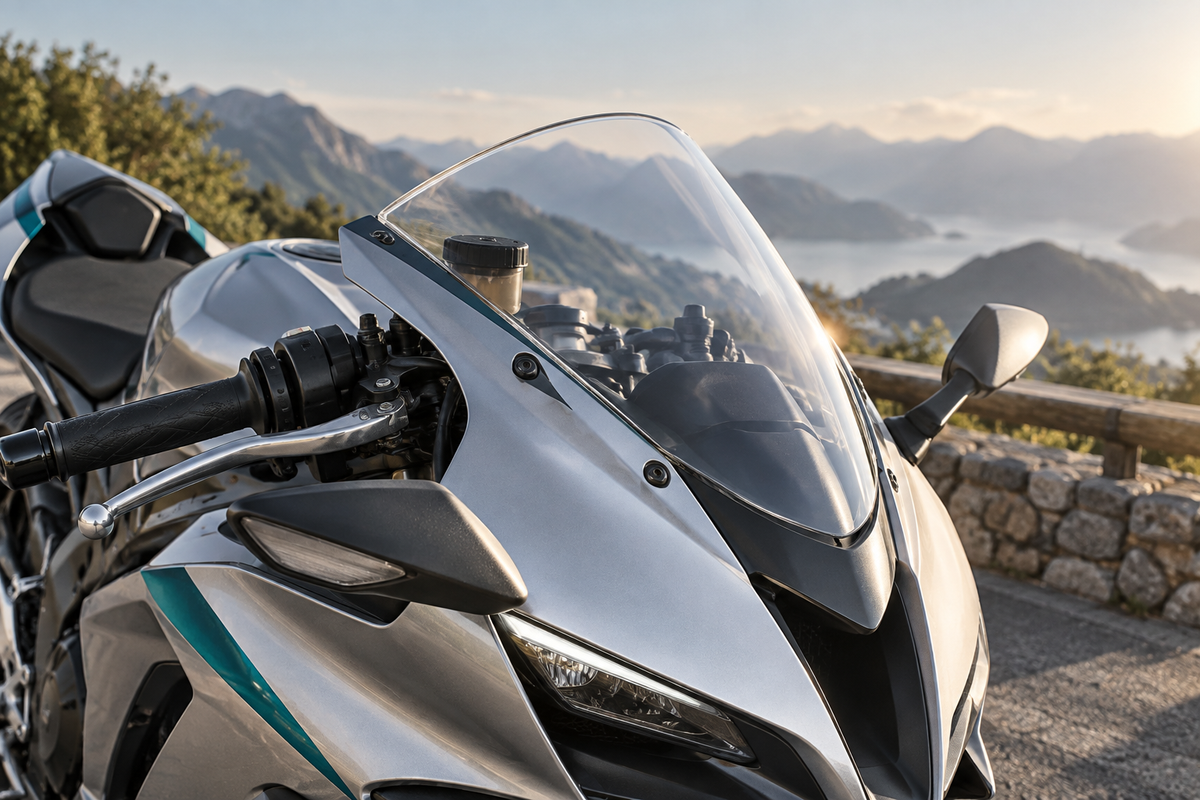
Before you pay for a replacement fairing and windscreen, identify your motorcycle and the bodywork actually fitted, confirm the proposed upper-cowl and screen combination, and check the required hardware and order terms. A screen intended for original equipment is not automatically verified with every aftermarket cowl. The two parts need not come from the same brand or have been designed together, but their compatibility must be supported for the actual combination. This guide follows that coordinated purchase decision from the first supplier question to checking what arrives.
Key Takeaways
-
Establish the model year and market from reliable records; document the bodywork actually fitted.
-
Check the fairings already on your bike for aftermarket parts that change how they fit.
-
Confirm the exact screen, cowl and specified attachment arrangement; hole count alone is not enough.
-
Confirm required hardware and inclusions; reuse depends on the specification, condition and applicable instructions.
-
Ask both companies in writing if their parts work together for your specific bike.
-
Try fitting the fairing and windscreen together without forcing any parts.
-
Learn the return policy before painting, drilling, or modifying any parts.
Identify the Actual Cowl and Screen Combination
Start by identifying both the motorcycle and the parts you intend to combine. Vehicle records establish the base model; current part references and supplier information establish what is fitted or proposed. If either is uncertain, resolve that uncertainty before ordering. Matching a familiar outline or counting mounting holes is not sufficient. Ask whether the specific screen, cowl and specified hardware work together, including any relevant clearance and attachment requirements.
Identify Your Exact Motorcycle First
Use reliable vehicle records and manufacturer or qualified-dealer assistance to establish the exact model, model year and market. The VIN is important identifying information, while paint and graphics are not reliable evidence of a motorcycle’s original specification. Record later changes separately. If the bike has converted bodywork, the proposed screen must be checked against that actual cowl rather than the stock application inferred from the model name.
Read the VIN, Not the Paint
Use an appropriate official vehicle-identification source or ask the manufacturer or a qualified dealer to interpret the VIN for your motorcycle. Do not assume one decoding shortcut covers every market, age or vehicle. Resolve conflicting model-year information before selecting parts. Vehicle identification describes the base motorcycle; it does not establish the origin or compatibility of a cowl fitted later. Keep both the vehicle identity and current bodywork information in the supplier enquiry.
Cross-Check Registration and Parts Catalog
Model year, manufacture date and first-registration date can differ. If the documents appear inconsistent, ask the manufacturer or a qualified dealer to clarify them. A parts catalog can help identify original components for the established application, but a changed part number alone does not prove a different exterior shape or incompatibility. Record the relevant cowl and screen references and any supersessions, then ask about the specific replacement combination. The custom fairings guidance can help organize details about a non-standard bodywork setup.
Inspect the Bodywork Currently on the Bike
Inspect the bodywork currently fitted and record any known conversion or replacement history. Extra holes, trimmed edges or unusual gaps are reasons to investigate, not proof that a panel is aftermarket; they may also reflect damage or installation problems. Look for identifiable part references and ask the previous owner or installer when appropriate. If the cowl cannot be identified confidently, provide clear photographs and seek supplier assistance. Photos supply context but do not verify compatibility on their own.
Check the Specific Model-Year Application
Upper-cowl shape, screen curvature and mounting arrangements can change between applications, while some components may carry across years. Do not infer either interchangeability or incompatibility from the model name or year range alone. Ask which exact part the listing supplies and whether its stated application includes your model, year, market and current configuration. The NiceFairings FAQ provides general ordering guidance; it is not an engineering compatibility chart for every screen and cowl.
Accurate vehicle and component identification gives the supplier a useful starting point. Carry the same references into the pairing enquiry rather than assuming that identifying the model year completes the fitment check. Even a documented application still needs the specified hardware, an undamaged supporting structure and an appropriate installation check.
Confirm the Fairing and Windscreen Are a Matched Pair
A windscreen intended for OEM bodywork may or may not be compatible with a particular aftermarket upper cowl. Likewise, an aftermarket screen may be intended for an original cowl. Neither the OEM label nor the aftermarket label settles the question. Identify the two exact products and ask what application information supports using them together.
Upper-Cowl Tabs and Windscreen Hole Pattern
For the proposed screen and cowl, check the specified attachment arrangement rather than assuming every motorcycle uses the same design. Relevant details may include mounting-hole positions, mating surfaces, supports and hardware. Hole count and a familiar outline are only preliminary clues. Use the supplier’s application information and instructions to establish the intended combination and how it is supported.
For example, Zero Gravity’s windscreen series information describes mounting profiles and holes intended for OEM fairings. That stated scope does not establish compatibility with every aftermarket upper cowl. If you propose a different combination, ask for information addressing that combination specifically rather than treating an OEM-oriented description as a universal fit claim.
Hole count by itself does not prove fitment. Two screens for the same motorcycle model can both have four holes but place them in different spots. The bike name on the product page does not promise a fit. A page that says "fits Suzuki GSX-R1000" may mean only one generation. You must check the real screen-and-cowl combination. Confirm that your exact aftermarket cowl works with your chosen screen.
Ask the fairing supplier which exact screen references are supported for the proposed cowl, and ask the screen supplier about that cowl application. Request relevant installation documentation or testing information when available. Keep the answers tied to the actual product references. Written replies reduce ambiguity, but their value depends on the evidence and the precise combination they address; they do not replace inspection and correct installation.

Headlight Cutout, Ducts, and Side-Panel Joins
Check the upper cowl’s relationship to the rest of the motorcycle as well as to the screen. The cowl needs to suit the actual headlight assembly, supports and adjoining bodywork for the stated application. This does not mean the windscreen must follow the shape of a headlight opening. Ask about the relevant interfaces rather than inferring them from a front-view photograph.
Ducts, vents, brackets and adjoining panels are separate interfaces to consider when replacing the upper cowl. Their arrangement depends on the motorcycle and bodywork design. Do not assume the screen is a structural bridge between the side panels or that it determines whether every side-panel joint sits correctly. Ask the supplier which existing components are retained and how the replacement cowl accommodates them.
Aftermarket fairings can have different internal support structures. The tab positions, duct locations, and side-panel mounting points may shift compared to OEM parts. You cannot assume the screen from your stock fairings will move to a new aftermarket cowl. Treat each fairing and screen combination as its own unique pairing.
Ask for photographs of the actual products or a documented installation of the same combination when available. Such images can help identify components and questions, but they cannot reveal every dimension, attachment detail or clearance. Use them alongside specific application records and instructions, not as stand-alone fitment proof.
Why Photos and Mockups Do Not Prove Fit
A product page may use an image across several options, so check that the selected product reference and photograph correspond. Confirm any uncertainty with the supplier. A photograph can communicate shape and appearance, but perspective and hidden mounting details limit what it establishes. Do not use visual similarity alone to approve a purchase.
AI-generated illustrations and mockups communicate a concept, not an actual component or verified installation. A plausible rendered pairing may never have been assembled in reality. Similarly, ask what a “direct fit” description covers for your exact combination and what instructions support it. Do not treat either a marketing phrase or a generic illustration as a substitute for application evidence.
The same issue applies to user reviews and forum posts. A review may confirm the screen fits a 2020 model. Your 2021 model may have a different cowl shape. A forum user may own a motorcycle with aftermarket bodywork that differs from yours.
Use a combination of identifiable product references, supplier application information and the relevant fitting instructions. If the supplier requests measurements, agree the measurement points and method; a single hole-spacing measurement does not establish full compatibility. Final inspection and an appropriate supported trial fit remain important after delivery. A generic product image is a visual reference, not a dimensional drawing or proof that every supplied variant is identical.
Keep the fairing and windscreen suppliers’ answers with the exact listing references and selected options. If an answer is vague or does not cover the proposed combination, ask for clarification before ordering. The NiceFairings FAQ is a starting point for general ordering questions, not a substitute for the specific application confirmation.
Check Mounting Hardware, Inclusions, and Condition
What the Listing Says Is Included
Kit contents vary by listing, application and selected option. Read the actual inventory rather than assuming that every kit includes a screen, mounting hardware or all other required components. Identify the upper cowl and screen separately in the order record, including whether they are bought together or from different suppliers. If instructions or hardware are not listed, ask what is required and where it is supplied. Do not assume existing fasteners can be reused merely because new ones are absent.
Where the order includes left and right panels, identify them separately and compare their references with the listing. Their openings and attachment details may differ. For this two-item purchase, also distinguish the upper cowl from any neighboring panel pictured alongside it. A photograph of a full motorcycle does not establish the contents of the order.
Grommets, Clips, Heat Shields, and Reused Parts
Reuse depends on the specified hardware, its condition and any replacement requirements in the applicable instructions—not age alone. An apparently clean bolt is not automatically the right length, type or specification. Inspect the required fasteners, washers, rubber components and clips, and replace unsuitable or damaged items with the specified parts. The exact screen attachment arrangement varies. Heat shielding belongs to the relevant bodywork requirements; it is not a universal screen-mounting component. Confirm its inclusion and placement separately where applicable.
The kit contents checklist helps you record what is included and what must be sourced separately. For exact screen hardware, use the applicable supplier documentation rather than a general FAQ.

Inspect Every Panel and Fastener on Arrival
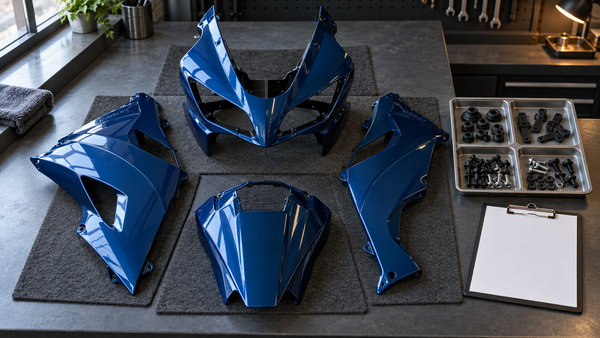
When the package arrives, unpack the parts carefully on a clean, protected surface in good light. Compare the product references, selected options and included items with the order record. Inspect accessible edges, mounting areas and painted surfaces for visible damage without flexing or forcing the parts. Photograph concerns and retain the packaging. Contact the supplier before installing or modifying affected components, and follow the relevant reporting instructions. An inspection records visible condition; it does not certify every aspect of the installation.
Lay out the included parts and specified hardware on protected surfaces and compare them with the agreed inventory. Check the actual cowl and screen references, not just the motorcycle name. If something is missing, damaged or inconsistent with the order, pause and contact the supplier. Do not substitute unspecified hardware simply to complete the assembly. The panel and kit inventory guide can help organize the record while the screen supplier’s instructions address its particular attachment requirements.
Screen Profile and Tint Are Choices, Not Fit Proof
Screen style and mounting compatibility are related but distinct questions. First identify supported screen options for the actual upper cowl, then compare the exact variants you are considering. A profile name or tint does not prove compatibility. A different profile may also affect clearances or visibility, so do not assume that changing the style leaves every other check unchanged.
Application and Mounting Come First
Use the actual product reference and attachment requirements to check compatibility. Hole positions are only part of the arrangement; mating shape, support and clearances may matter as well. A screen’s styling label or color cannot establish these details. Ask which specific variants are supported for the proposed cowl and check each selected variant rather than extending a general model-name claim.
The earlier OEM-oriented manufacturer example illustrates a limit of scope: an application statement should be read for the bodywork it actually addresses. An aftermarket cowl may retain the original interface or use a different one. Ask about the real combination instead of assuming either outcome from the aftermarket label.
Ask both suppliers about the exact screen and cowl references, including the selected profile variant. Request the applicable instructions and clarify any limits to the answer. If the combination is unsupported or unresolved, do not turn a generic compatibility claim into certainty. Consider a documented alternative or seek qualified advice before committing.
Confirm the supported combination, then record the exact profile and tint selected. Recheck the reference if you change an option before ordering.
Height, Shape, and Tint as Preference
Among supported options, compare the exact profile, height and tint against your intended use and the information available for that product. These choices are not merely cosmetic: visibility and clearances can matter. This guide does not establish that a taller screen will improve airflow for a particular rider or that any tint is suitable for every condition. Ask for relevant product information before deciding.
Do not infer a particular wind-protection result from a generic shape or photograph. Rider position and the actual motorcycle configuration can affect the experience. Check the selected variant’s intended use, visibility considerations and applicable local requirements through appropriate current sources. No legal tint threshold or performance guarantee is established here.
A label such as double-bubble or touring describes a style family, not a universal interface. Two similarly named screens may have different applications. Conversely, several profiles may be offered for one application. Confirm the specific product and variant; neither its category name nor a visually familiar curve proves that it works with the chosen cowl.

What the Official Screen Page Does Not Prove
A product page that lists your motorcycle model name does not confirm fit for your specific cowl. That page may show a generic picture. The photo may not match the exact screen you get. One photo can stand for several screen versions.
The Zero Gravity series page describes that the screen is meant for OEM fairings. It does not prove that every aftermarket cowl works with their screens. The same limit applies to any brand that says they work with OEM parts. The series page is a guide to intended use, not a list of all fits.
Zero Gravity’s instructions and technical information page links to general and model-specific documents. This guide has not verified an individual installation PDF for your combination and does not supply its torque values or dimensions. Ask which document applies to the exact screen and bodywork before relying on it. A technical-document index alone is not approval for a proposed aftermarket pairing.
Compare the supplier’s specific answers with the actual listing and relevant instructions. If they conflict, resolve the discrepancy before ordering. A message is not automatically more reliable than a product page simply because it is written separately. What matters is whether the information clearly addresses the same products and is adequately supported.
Ask Both Suppliers Before You Pay
You have found your motorcycle and checked the fairing and windscreen as a pair. Now you need written answers from both suppliers. This step is the main part of your checklist before you buy. Ask the fairing supplier and the windscreen supplier which exact screen and cowl combo they checked. Include your model, year, and any changes on your bike. A supplier who cannot answer this question leaves your order check incomplete.
Model Year, Market, and Stock or Modified
Start with your motorcycle's exact identity. Tell both suppliers your model year, your market region, and whether your bike has stock or modified bodywork. A US-market bike may use different parts than a European-market bike of the same year. Previous owners may have put on aftermarket fairings. Your VIN confirms the original build, but it does not prove the current bodywork matches. The supplier needs this context to check fitment details against real parts.
Ask the fairing supplier, “Which screen references are supported for this exact upper cowl and application?” Ask the screen supplier, “What information supports using this screen with the cowl I have identified?” Request the relevant documentation and clarify any uncertainty. Naming two references is useful, but it does not itself prove testing or compatibility. A vague answer such as “should fit” needs clarification, not an assumption about what work the supplier has or has not done.
Panel List, Hardware, and Real Photos
Request the actual inventory for each order. Separate the upper cowl, screen and required attachment parts from any other panels pictured in a full-kit image. Ask which fasteners, washers, rubber components or other specified items are included, sourced separately or eligible for reuse. Confirm relevant heat-shielding requirements separately; do not treat every bodywork accessory as part of the windscreen attachment.
Ask these specific questions before you pay:
-
What is the screen part reference number for my cowl?
-
What is the interface profile between the screen and the upper cowl?
-
Which original or kit fasteners does the screen require?
-
Are washers and well nuts included or reused?
-
What items are in the box, and what is not?
Request photographs of the actual selected parts when available and keep them with the product references. A photographed assembly may help clarify the application, but it does not reveal every installation detail. Generic AI images cannot certify fitment. Compare the full confirmed purchase—including required additional parts—without assuming that price alone proves material thickness, quality or the final cost of installation.
Clarify Return Terms Before Modifying Parts
Read each supplier’s current return and modification terms before ordering. Ask what process applies if the delivered parts differ from the order or the pairing remains unresolved, what information is needed and how shipping is handled. Keep the response with the listing and order details. Do not drill, paint or otherwise modify a questionable component while awaiting guidance; this article does not determine your legal rights or promise a particular return outcome.
Do not assume that all suppliers use the same return window, eligibility criteria or modification rules. Clarify the terms for both orders and ask promptly about a mismatch. Keep the affected components and packaging in their received condition while the supplier reviews the issue. Avoid treating the ability to modify a part as a substitute for confirming the correct application.
A supported pairing can reduce uncertainty, but it does not guarantee a flawless order or installation. Retain the exact references, selected variants, required hardware, outstanding questions and relevant correspondence in one record. The FAQ and custom-order information provide general NiceFairings guidance; ask separately about the specific combination and any non-standard setup.

Dry-Fit and Installation on Arrival
Prepare a Clean, Protected Workspace
Prepare a stable, clean, protected surface before unpacking the components. Keep tools and hard objects away from finished surfaces, and use good lighting for the condition check. Gather the product references, order inventory and applicable instructions first; select tools according to those instructions rather than a generic list. Confirm what arrived before beginning assembly. If you cannot support and handle the parts securely, seek help from a qualified installer.
Test-Fit Loosely and Follow the No-Force Rule
A pre-fit check is a supported trial assembly conducted according to the applicable instructions, not a universal sequence beginning with the windscreen. Do not ride with loose or partly fitted components. Avoid forcing tabs or fasteners and do not drill, heat or reshape a questionable part to overcome a mismatch. Stop if attachment or alignment cannot be achieved as instructed, document the issue and ask the supplier or a qualified installer to assess it. The pre-fit checklist explains the general preparation; the specific component instructions govern the actual procedure.
Compare the delivered product references and hardware with the applicable installation instructions. If the parts or proposed combination do not match that documentation, pause and ask for clarification. Do not improvise a universal assembly order or assume the original motorcycle specification automatically applies to a changed screen attachment. Keep the supplier’s answer with the order record and have a qualified installer address any unresolved mismatch.
Final Safety Check Before the First Ride
After the supported trial fit, complete installation and the required checks using the instructions applicable to the actual components and motorcycle. A visual glance at mounting holes is not a complete safety assessment. Relevant attachment security and clearances must be assessed without unsafe lifting, unsupported wheel movement or improvised suspension testing. If you cannot perform the required checks safely or cannot resolve conflicting instructions, use a qualified technician. Do not use a high-speed road test to investigate uncertain fitment.
Use the motorcycle’s appropriate service information together with the instructions for the exact replacement components. Do not assume every owner’s manual contains all attachment specifications or that a stock fastener value applies to a changed screen assembly. Ask the manufacturer, supplier or a qualified technician to resolve gaps or conflicts. This buying guide provides no universal torque value, assembly sequence or certification that a stationary check alone establishes safety.
Your confirmation chain has five links: the right model year for your motorcycle, a cowl and screen that match, all the hardware you need, written answers from both suppliers, and a dry-fit with no forcing. Each link holds up the next one. If you skip even one step, the whole purchase gets weaker.
Pre-purchase checks help reduce avoidable mismatches, missing-item surprises and pressure to improvise an installation. Keep the order record and supplier correspondence together. If a problem appears after delivery, use that record to explain the actual products and the unresolved issue. A documented purchase is a better starting point, not a guarantee that installation will be effortless or that no further technical assessment is needed.
FAQ
How do I know if a windscreen fits my aftermarket upper cowl?
Identify the exact screen and upper-cowl references, including the application and selected variant. Ask both suppliers what supports that combination and which instructions apply. A screen intended for OEM bodywork is not automatically verified with a different cowl. Specific written confirmation is useful evidence, but it is not an unconditional guarantee or a substitute for correct installation.
Can I reuse my original windscreen screws and grommets?
Reuse depends on the exact hardware specification, condition and any replacement requirement in the applicable instructions. The motorcycle model year alone does not identify every fastener in a modified screen-and-cowl arrangement. Inspect the specified items and replace unsuitable or damaged parts as directed. Ask the supplier if the required type, dimensions or reuse policy are unclear.
What if the fairing listing says "hardware not included"?
Ask which attachment parts are required and which are supplied with the screen, the cowl or neither. Obtain the correct specified hardware separately where necessary. Do not assume a generic fairing-bolt kit includes suitable screen fasteners or that heat shielding is part of every screen installation. Record the exact additional items before ordering.
Do product photos prove the windscreen will fit my bike?
No photograph on its own establishes every dimension, attachment detail or clearance. Check that actual product images correspond to the selected variants and use them alongside application information and instructions. Generic AI illustrations are not real-product evidence. An assembled photograph may be useful context, but it is not complete compatibility proof.
What should I ask both suppliers before I pay?
Ask the fairing supplier which screen part numbers they confirmed fit their cowl for your exact model year and market. Ask the windscreen supplier which aftermarket cowls they tested with their screen. Request the screen part reference, interface profile, required fasteners, and included items. Keep all written replies with your order record.
Can I return the fairing or windscreen after I paint or drill it?
Check the current terms for each order and contact the supplier before changing a part that is questionable or mismatched. Ask what review process applies, what records are needed and how any approved return is handled. This guide does not determine return eligibility or legal rights. Keep the products and packaging in their received condition while seeking guidance.
Does a taller or tinted windscreen change whether it mounts to my cowl?
A style or tint label does not establish mounting compatibility. Different profile variants can have different applications or clearances, even when their names sound similar. Confirm the exact selected product with the actual cowl, and separately consider intended use and visibility. Do not assume every variant in a style family has the same mounting arrangement.
What if the fairing and windscreen do not line up during dry-fit?
Stop and document the mismatch. Do not force the attachment or drill, heat or reshape the component to make an uncertain pairing work. Check the references and applicable instructions with the supplier, and use a qualified technician when the issue remains unresolved. Do not ride with loose or incompletely fitted parts.