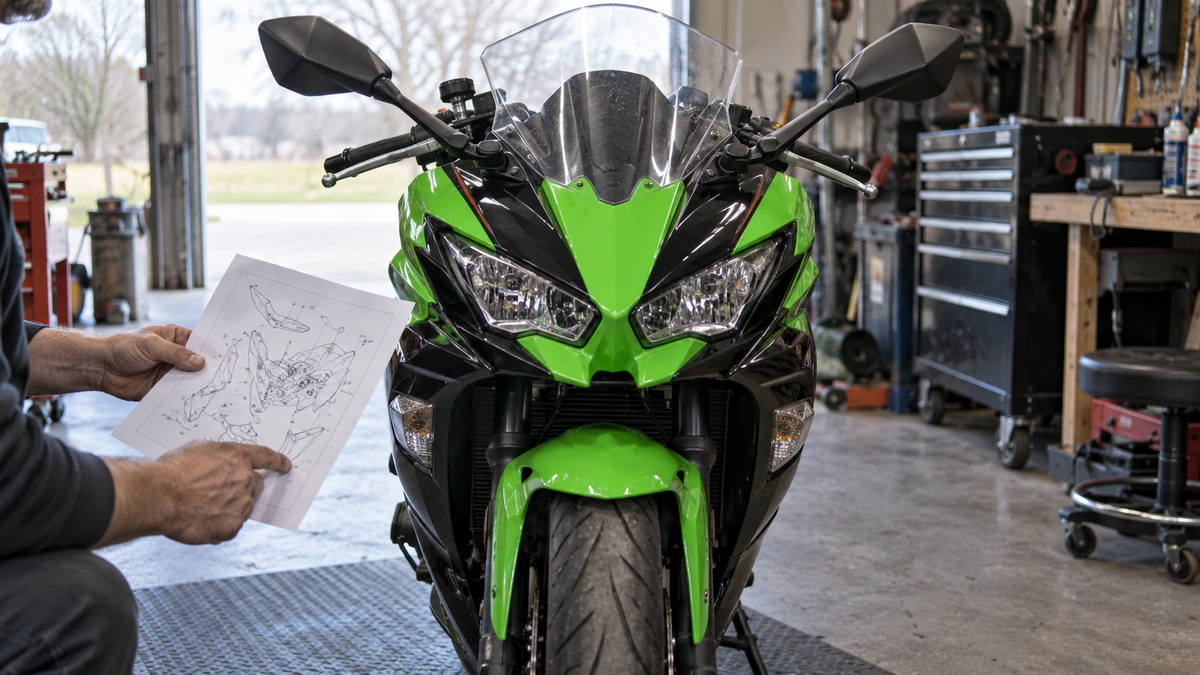
A 2019 Ninja 650 and a 2020 Ninja 650 share a name, but do not treat their front bodywork as the same order. Kawasaki's 2020 US launch information identifies a new upper cowl, redesigned windscreen and twin LED headlamps. Its parts catalog also lists a different headlamp assembly for the selected 2019 and 2020 US models. That is enough to require a year-specific nose-and-light check before you pay for fairings; it is not a claim that every panel, bracket or fastener on the two motorcycles differs.
This article answers a narrow buyer question: if the front of your Ninja 650 is damaged, which evidence should you collect before choosing a replacement kit or a single panel? It does not certify interchangeability, a conversion, or a universal fit across 2020–2026. The cover is an AI editorial workshop concept, not a Kawasaki identification photograph or a NiceFairings fitment test. The two in-article images are actual NiceFairings product-listing photographs, used to show the different catalog groups—not to compare hidden mounting dimensions.
The 2020 boundary is more than a change of green paint
Kawasaki's 2020 Ninja 650 launch release calls out a new, wider upper cowl, a lower flush-fit windscreen, twin LED headlights and a revised passenger seat. It even describes fairing bolts replaced by hooks in the styling treatment. Those details tell a buyer where to look first: the lamp opening, nose contour, screen interface and visible upper-cowl fixing arrangement. They do not establish that every 2019 side or lower panel is different, or tell you exactly which old fastener might be reusable.
The practical mistake is to search only for “Ninja 650 fairings,” choose a color and assume the year can be sorted after checkout. A glossy green 2019 panel can look close to a 2020 panel in a cropped side view. The front assembly has a documented change. Identify the motorcycle and the pieces around that assembly before talking about a paint design. If the bike has already been modified or repaired, identify what is on it now as well as what it left the factory with.
A factory parts page can answer a smaller, stronger question
The US Kawasaki 2019 Ninja 650 headlight parts list for model code EX650JKF names a lens assembly, two H7 bulbs and related sockets. The US 2020 Ninja 650 headlight list for EX650NLF names an LED headlamp assembly. These selected diagrams support the 2020 lighting change described in the press release. They are not a complete international interchangeability database and they do not, by themselves, approve any aftermarket cowl or conversion.
The important method is to compare the right diagrams for your VIN, year, market and variant. The Kawasaki parts catalog separates headlight, cowling and lower-cowling assemblies; a painted outer shell is not automatically the lamp, its support, the screen or the inner trim. If a seller says a single nose fits both years, ask which lamp, windscreen, stay and other retained pieces that statement assumes. An exact factory component number helps identify the question, while the NiceFairings product handle or paint-option number identifies a seller's offer. They are different reference systems, as our part-number versus SKU explanation details.
Identify the motorcycle before you identify the panel
Record the model year, country of original sale and precise model designation from reliable documents. Registration date is not necessarily model year. Photograph the VIN label for your own records, but redact personal and identifying information before posting publicly. If the paperwork and motorcycle disagree, ask a Kawasaki dealer to resolve the identity rather than using a fairing color as evidence. The model name “Ninja 650” is not enough to select an upper cowl across the 2020 boundary.
Next ask whether the front is original. A used machine can have a replacement lamp, aftermarket windscreen, mirror bases, repaired upper stay or an entire front-end conversion. Photograph the motorcycle assembled before any disassembly. A supplier needs to know whether you are replacing like-for-like, restoring the factory configuration, or trying to complete a previous owner's unfinished conversion. Each is a different parts problem. Do not order the newest-looking shell merely because the previous owner called the motorcycle a “2020 style.”
For a partially dismantled bike, keep the removed pieces and their fasteners in labeled groups. Photograph the rear of the lamp, accessible mounting areas and each broken tab without forcing another panel off. A qualified mechanic should examine collision damage or uncertain steering and lighting supports. Our fairing photo-and-label workflow gives a repeatable way to tie each close-up to a location on the motorcycle.
What the two NiceFairings catalog groups actually show
The live NiceFairings Ninja 650 collection separates the 2017–2019 and 2020–2026 catalog groups. That split is a useful shopping filter consistent with Kawasaki's 2020 front-end update. It is still a seller listing range, not a factory statement that every submodel, region and modified bike takes the same full kit. Use the exact product page and order confirmation, not just the collection tile.

The newer green/yellow 2020–2026 kit page likewise states a year range and presents paint options. It explicitly says exact included pieces can vary by model and asks buyers to confirm the contents. Its title lists selected years while the description gives a broader range; ask the shop to put the precise application for your bike into the written order rather than resolving that ambiguity yourself.

Decide whether you need one panel, an assembly, or a conversion plan
If a scuff is confined to a side piece, the factory's 2020 nose update may be background context rather than the deciding interface. First locate the damaged component on the correct year-and-market parts diagram, then establish which adjacent panels and fasteners are intact. A single replacement piece may be a cleaner scope than a full set, but only if the shop actually offers that panel in the required shape and finish. A photograph of a complete kit is not a promise of individual-panel availability.
If the damaged area includes the headlamp opening, windscreen edge or upper cowl, treat it as an assembly question. List the lamp, screen, meter visor, upper stay, inner trims, mirrors and fixings as separate lines. Mark each “existing and verified,” “damaged,” “supplied,” “retained,” or “unresolved.” The nose shell may be only one piece of the repair. For a bike that has been dropped, a new painted shell can hide an old bent support without correcting it. Our mirror-and-upper-cowl alignment guide addresses that related damage path.
If you want the later-looking 2020 front on a 2017–2019 bike, do not describe the project as a routine fairing order. It is a proposed conversion. The Kawasaki launch release is evidence that the later assembly changed, not an installation manual for transplanting it. Ask a qualified shop to scope lighting, wiring, support, windscreen, mirror and legal-road-use requirements for your jurisdiction. NiceFairings should only be asked to confirm products it actually offers for a stated configuration, not to guarantee the success of a mixed-generation build from a rendering.
Build a photo packet around the actual front-end question
Send four orientations of the assembled bike: direct front, both side profiles and a rider's-eye view over the screen. Add a three-quarter front view to show how the nose meets each side panel. Then photograph the headlamp face and its visible boundary with the cowl, the windscreen perimeter, mirror bases and any damaged mounting points. Use daylight, keep the whole component in the frame, and add one close-up only after its wider context photograph. A dramatic night shot may sell the paint but hide the surface you need identified.
Write one caption per image. For example: “2019 US Ninja 650 EX650JKF, original lamp believed installed; upper left cowl cracked after low-speed tip-over; replacement windscreen fitted.” If “original lamp” is uncertain, say so. State whether the bike has an altered screen, mirror, turn signal or front stay. Give the shop a link to the exact proposed 2017–2019 or 2020–2026 listing and ask them to repeat the accepted model-year and variant in their reply. The supplier-photo guide can help with panel-identification photographs; this packet adds the year-boundary and lamp context.
Five questions that prevent a paint choice from becoming a parts mistake
Before checkout, ask the supplier: (1) Does this exact product apply to my identified model year, market and current front-end configuration? (2) Which painted outer panels are in the order, and which screen, lamp, stay, inner trim and hardware must I retain or buy elsewhere? (3) If only the nose is needed, is that single piece available and what adjacent parts does it expect? (4) Are the submitted photos enough to answer, or does an installer need to expose a hidden interface? (5) What pre-fit and reporting steps are allowed before any drilling, cutting or paint alteration? Send those through the NiceFairings contact page with the product URL and your photos.
An answer such as “we need to see the back of your existing assembly” is not failure; it is an honest limit on remote evidence. Save the written reply, product option, date and supplied-parts list. Do not let a generic “full kit” heading settle whether a screen or lighting assembly is included. The kit-contents guide explains why a panel photo is not a universal packing list. Prices, production timing and return conditions must be read on the live product and policy pages when the order is placed; a blog cannot freeze those terms.
Three different buying situations, three different answers
A stock 2019 bike with a cracked upper cowl: Start with the 2017–2019 catalog group, verify the bike's exact model and the lamp/screen arrangement, then compare the actual damaged parts with what the chosen kit supplies. Do not buy a 2020 nose because its paint is more appealing. A dealer's parts diagram and a seller's written application answer do different jobs; use both.
A stock 2020 bike with a scuffed side panel: Start with the 2020–2026-labeled product group, but ask for the exact side piece, finish and any retained trim. Kawasaki's 2020 headlamp change does not automatically mean the whole motorcycle needs replacing. Nor does a 2020 label establish that every later market variant or aftermarket accessory has been checked. Inspect the actual adjacent panels and the supplier's application for this one bike.
A used bike with uncertain front-end history: Stop before ordering. Compare reliable model identification with the installed headlamp and cowl, document modifications, and have a qualified professional assess any structural or electrical concern. A mix of 2019 paperwork and 2020-looking bodywork might be a modification, an identification error or something else; the photograph alone cannot tell you which. These are decision examples, not customer cases or reports of installations we have performed.
Pre-fit before final tightening or a road test
On delivery, count parts against the agreed list, photograph their front and back surfaces, and retain packaging and correspondence until discrepancies are resolved. With the proper workshop information, a qualified installer can compare the new cowl to the actual lamp, screen, stay and neighboring panels before final fastening. Do not pull a panel into alignment with the last bolt, rework a hole, trim a lamp surround or change wiring just to make a wrong application appear to fit. The panel-gap troubleshooting guide explains why the first conflict matters more than the final gap.
After any front-end work, verify secure mounting, no contact through steering travel, functioning lights and an appropriate headlamp aim check under the applicable manual and local rules. The headlight-aim after nose replacement guide covers why a visually centered lamp is not a substitute for a proper check. A detached or ill-aimed assembly is a reason to stop riding and diagnose the cause, not a cosmetic issue solved by a fresh graphic.
Approve the graphic only after the generation is settled
Once the correct product and retained pieces are documented, plan the paint. The 2020 upper cowl's revised outline and flush screen change how a stripe meets the nose. A layout that reads well on an older product photo may break across a newer cowl edge. Request front, both side and three-quarter design views; specify which parts stay on the bike and which the kit will replace. The NiceFairings custom-design page is the right place to describe a color or livery request—but a good rendering is a visual brief, not a conversion or fitment certificate.
The ordering rule is simple: identify the actual bike, then the front assembly, then the exact product and its supplied pieces, and only then the graphic. The 2020 redesign makes the front end an especially important boundary. It does not give anyone permission to promise more than the evidence shows.
Sources and limits
- Kawasaki 2020 Ninja 650 US launch release: new upper cowl, windscreen, LED headlights and styling notes.
- Kawasaki 2019 US Ninja 650 headlight diagram and 2020 US diagram: selected model-code examples, not universal cross-market interchange rulings.
- NiceFairings Ninja 650 collection and the two linked product pages: catalog ranges and store-owned image sources, checked October 14, 2026. Listings can change; ask for order-specific confirmation.