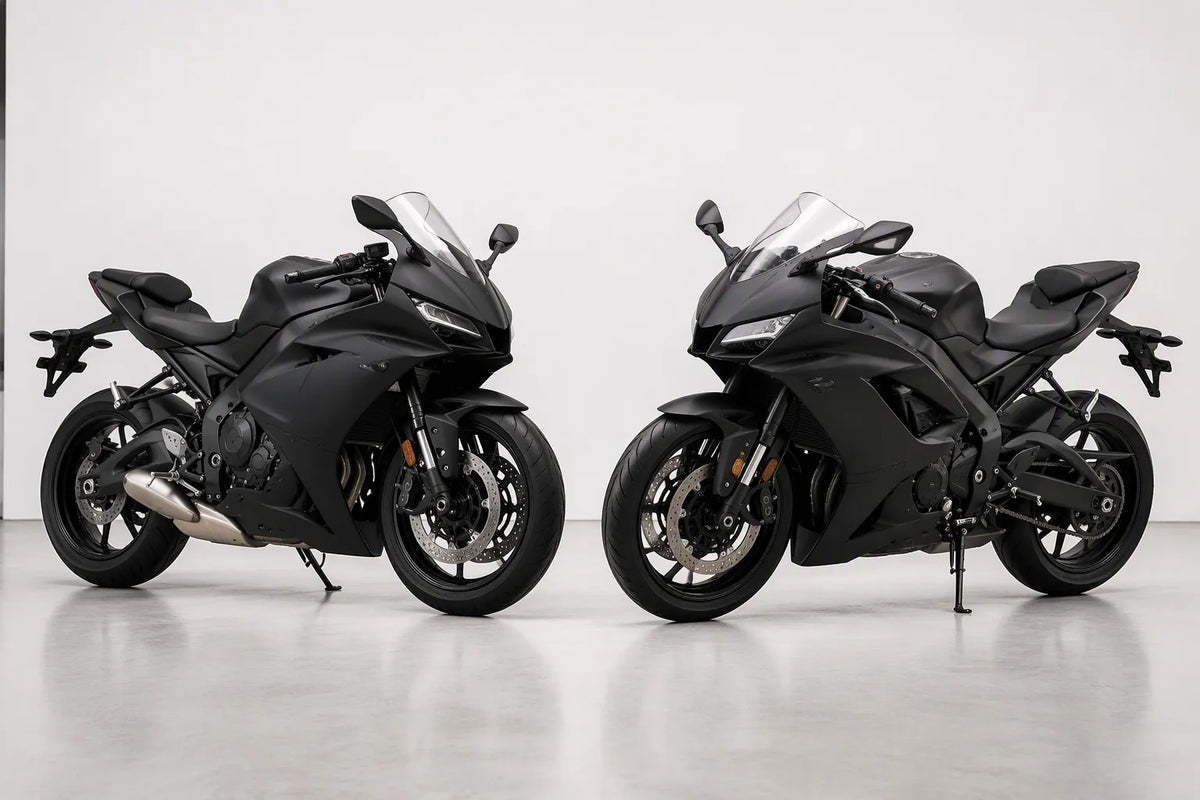
The 2026 Yamaha R7 is not a graphics-only update: Yamaha describes changes to bodywork, lighting and cockpit equipment. For fairing buyers, the important question is what those changes mean for identifying the correct parts—not which paint scheme looks newer.
You will see three areas compared here: fairings and bodywork, lights, and cockpit. Those differences shape how you order parts later.
Two readers matter most. One shops between a 2025 and a 2026 R7. The other owns a 2025 and wonders about 2026 parts.
This is a US-market buying guide, not a road test or a cross-year conversion instruction. We have not measured top speed, mounting-hole positions or panel interchangeability. Appearance comparisons can help you ask better questions, but cannot replace application-specific confirmation.
Key Takeaways
Confirm the model year and market before ordering; a registration date alone is not enough.
Separate a change in panel shape from a change in color or graphics.
Use official model information as a starting point, then check the exact part application.
A fairing kit does not upgrade a motorcycle’s electronic equipment.
Do not infer aerodynamic performance from an illustration or a listing photo.
Consider riding position separately from cosmetic panel selection.
Cross-year panel conversion has no verified evidence; stick to your year.
A year-correct custom finish can change the look without assuming a cross-year conversion.
Yamaha R7 2025 vs 2026 Fairings: Scope and Sources
Before you compare Yamaha fairing options, separate the identity of the motorcycle from the appearance of the listing. Keep a small record with model year, market, current bodywork and the exact panels you want to replace. This becomes the reference for every supplier inquiry.
US Model Years and First Registration
Model year versus registration date
A model year is not the same as a registration date. Yamaha assigns a model year to a machine at the factory. A dealer or owner registers that machine later. So a 2025 yamaha r7 might sell in 2026 and get registered in 2026. That does not make it a 2026 model.
Confirm the model year using the motorcycle’s identification documents and an authorized dealer if anything conflicts. Record the model designation as well as the year. A previous owner may have changed graphics or panels, so the visible color should not override the vehicle’s identity.
US market versus other regions
Yamaha sells the r7 in many markets. The US version may differ from other regions in lighting, emissions equipment, and trim. A 2026 yamaha r7 sold in Europe might carry parts that a US model does not. So when you read a review from another country, treat it as a regional data point, not a universal fact.
For this comparison, the focus stays on US-market machines. That keeps the bodywork and electronics discussion grounded in one verifiable spec set.
Verified Sources Behind This Comparison
Yamaha Motorsports 2025 R7 features page
Use Yamaha’s US 2025 R7 features page for the older model’s equipment baseline. An official features page explains the complete motorcycle; it is not a replacement-panel compatibility chart. Keep that distinction in mind when translating a feature description into a shopping decision.
Yamaha Motorsports 2026 R7 features page
Use Yamaha’s US 2026 R7 features page for the newer model. Check the year displayed on the page when revisiting it, since a current-model URL can change over time. The comparison below records the relevant information reviewed for this article.
The table deliberately leaves out acceleration claims, resale predictions and unverified bolt patterns. Those would need different evidence. A detailed-looking specification list should not make an unsupported compatibility claim appear more credible.
Compact Fact Comparison: 2025 vs 2026
Bodywork, lights, and cockpit at a glance
Feature |
2025 r7 |
2026 r7 |
|---|---|---|
Front fairing |
Ultra-slim R-Series design |
Compact new front fairing |
Side panels |
Standard R-Series panels |
Contoured side panels; new winglets |
Lighting |
Refer to year-specific assembly |
Redesigned with LED mirror signals |
Display |
LCD |
5-inch TFT |
Quick shifter |
Optional upshift |
Third-generation up/down QSS |
Electronics and ergonomics at a glance
Yamaha lists a six-axis IMU and a 5-inch TFT for 2026. It also describes a reshaped tank, higher and closer handlebars, and a lower seat. These are complete-bike changes, not components that should be assumed to arrive in a bodywork order.
Matching an engine-family name is not a shortcut to matching body panels. A buyer needs evidence about the specific panel and its surrounding assemblies. Keep engine specifications in the motorcycle comparison and panel application in the parts comparison; do not treat one as a substitute for the other.
The price you actually pay depends on the motorcycle or kit offered, its condition, included components and the seller’s terms. Compare itemized quotes rather than assuming that every newer-year option is better value. No price or performance premium is established by this guide.
This table gives you a quick reference. The next sections dig into each area.

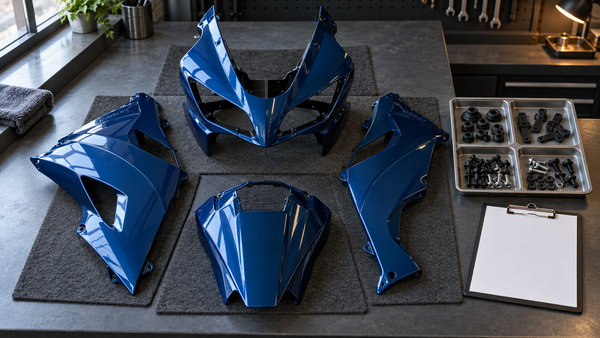
Compare model documentation before discussing a bodywork order. AI-generated concept, not an exact Yamaha model or fitment reference.
Front and Side Bodywork: Real Changes, Not Paint
A useful visual comparison begins with the outline rather than the livery. Look at the upper cowl, side-panel edges and the relationship between adjacent parts. Similar colors can hide shape differences; very different colors can make similar shapes look unrelated.
New Front Fairing and Winglets on the 2026 Yamaha R7
Compact front fairing shape
When looking at a front-fairing listing, ask for a front view and an oblique view of the actual part. Include the light opening, screen edge and interfaces with neighboring panels in the photographs. Avoid judging the whole assembly from a close crop of attractive paintwork.
A photograph does not establish drag, downforce or high-speed stability. Nor does a sharper-looking nose prove a measured performance gain. Keep the discussion focused on identification and buying scope unless a reliable test directly measures the performance being claimed.
Contoured side panels and winglets
Yamaha’s current US description includes winglets. This article does not assign them a downforce figure, claim that they sit flush, or infer a mounting arrangement. Ask which surrounding pieces a listing includes rather than assuming every visible feature in a motorcycle photograph comes in the box.
If a supplier uses a complete-bike photograph, request a separate image of the items actually supplied. A styling feature may be shown in the main photograph without being part of the order. An itemized list resolves that ambiguity more effectively than marketing terms such as “full” or “complete”.
2025 R-Series Bodywork Recap
Ultra-slim R-Series fairing design
For an existing 2025 owner, start with clear photographs of the motorcycle as it stands. Capture both sides, the nose and the tail. If its history is uncertain, note previous repairs or non-original pieces instead of presenting the current assembly as a guaranteed factory reference.
Keep a second set of close-ups for panel joins and any identification marks accessible without unnecessary dismantling. These help a seller understand the part you are describing. They do not replace a parts lookup, but can reveal when two people are discussing different pieces.
What similar names do not establish
The R7 name is useful for finding a category, not for accepting every year range listed within it. Treat a broad “R7” label as an invitation to investigate further. It is not a promise that all generations use the same bodywork.
A seller’s SKU is also not necessarily a Yamaha part number. Ask what each identifier means and which application it refers to. Our guide to part numbers versus seller SKUs explains this distinction before you compare quotes.
How to Tell Bodywork Change From Paint-Only
Panel shape and mounting points
Trace the boundary of the part in the listing photograph. Does the photo show one removable panel or a group of assembled pieces? Ask for an explanation when a painted boundary and a physical seam are easy to confuse. A graphic line alone does not define a separate component.
No exact bolt-pattern or cross-year compatibility evidence has been verified for this guide. Do not assume a swap works in either direction. Ask for documented application evidence for your exact machine, not a reply based only on a similar silhouette.
If your goal is a new appearance, explore custom fairing design options with the correct year-specific application as a separate requirement. A design brief and a fitment confirmation answer different questions; make sure your order has both.
When the difference is only graphics or color
A cosmetic reference describes the finish you want: its colors, graphic layout and gloss or matte appearance. A parts reference identifies the physical item needed. Keep those references separate even if a single photograph inspired the project.
For example, a buyer might like the contrast of a newer paint scheme while retaining the existing motorcycle’s body shape. Explain that as a styling request, not a request to supply a different generation’s panels. Ask the seller what can be achieved on the verified application.
Compare a complete design proposal with a single-panel replacement before deciding. A one-panel order needs attention to the surrounding finish; a complete set needs attention to every included piece. Neither approach guarantees an exact color match from screen photographs.
Before approving artwork, identify which lines cross panel seams and which areas must remain free of graphics. Ask for views of both sides rather than judging only the most attractive angle. Written approval should describe appearance without silently changing the agreed model application.

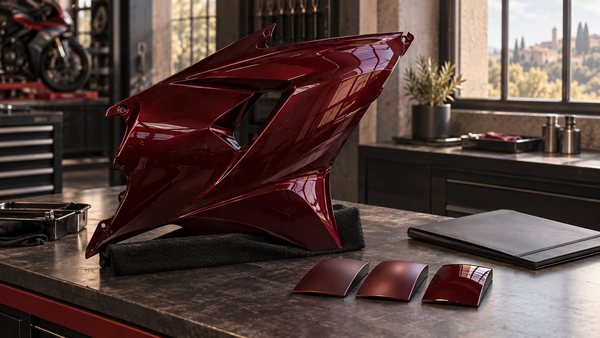
Inspect shape separately from color and graphics. AI-generated concept, not an exact Yamaha model or fitment reference.
Lights and Cockpit on the 2026 Yamaha R7
Lights, mirrors and instruments sit close to bodywork, so a seller’s complete-bike image can blur the boundary between panels and equipment. Look at these areas as separate assemblies when checking an order. Do not assume a visible accessory is included.
Redesigned Lighting and Mirror Signals
Updated front lighting design
For a nose-panel inquiry, show the light opening and its surrounding trim clearly. Ask whether the quoted item is a bare painted panel, a trim assembly or something supplied with additional parts. Record the answer in the order rather than relying on the thumbnail.
LED signals integrated into the mirrors
For mirror-related areas, ask whether mirrors, signal units, covers and associated fittings are included or excluded. A listing can depict these parts together while selling only one of them. Do not improvise electrical changes to make an uncertain purchase appear compatible.
TFT Display and Six-Axis IMU
5-inch TFT versus the 2025 LCD
A dashboard photograph can help identify the motorcycle being advertised, but it does not prove the fit of a loose panel. Keep the display comparison in the complete-bike discussion. For a replacement cowl, ask about the actual panel and adjacent trim instead.
Rider aids are separate equipment
A supplier inquiry should distinguish these questions:
Which exterior pieces are supplied?
Which existing components must be retained?
Which items are explicitly excluded?
What application evidence supports the order?
Who should resolve a mismatch before installation?
Do not buy bodywork expecting it to add rider aids or change electronic behavior. Questions about electrical equipment belong with the relevant service documentation and a qualified professional. This article is not an electronics retrofit guide.
Why Cockpit Updates Are Not Fairing-Kit Items
Electronics are whole-bike features
A fairing kit cannot add a TFT, IMU or rider-aid system merely by changing the exterior panels. Full-motorcycle updates are not proof that an aftermarket kit includes those systems. Ask the supplier to describe the bodywork order without borrowing claims from a complete motorcycle advertisement.
What a fairing kit does and does not include
Rather than assuming a universal kit specification, ask whether your specific order includes:
Each named painted panel and unpainted trim piece.
A windshield or only the surrounding bodywork.
Any tank cover, pad or other optional accessory.
Required heat protection, if applicable to the supplied parts.
Application-correct hardware, or an explicit list of hardware to source separately.
An inclusion checklist is a question set, not a promise about NiceFairings stock or any particular kit. To prepare useful photographs for an inquiry, use the replacement-fairing identification photo guide.
Tank, Ergonomics, and the Generation-Change Picture
The area where the tank, seat and body panels meet deserves its own review. It is easy to describe all of this as “the tank area,” but that phrase can refer to different components. Label the exact item in your inquiry.
Changed Tank Shape and Rider Triangle
Tank shape and ergonomics updates
A tank shape, tank cover and decorative pad are not interchangeable descriptions. State whether you are asking about a cosmetic cover or another assembly. Photographs should include enough of the surrounding motorcycle for the seller to identify the boundary of the requested part.
Do not interpret the newer styling as proof of a more aggressive riding posture. If comfort is part of a whole-bike purchase, assess the actual motorcycle with appropriate dealer assistance. A fairing photograph cannot tell you how the controls and seat suit your body.
Throttle and shifting features remain a separate decision
Electronic throttle or shifting features may matter to someone choosing a complete motorcycle, but they should not be added to the claimed benefits of a painted panel set. Keep a separate list of the riding features you want and the cosmetic changes you want.
This separation also makes a budget easier to understand. A quote for bodywork should cover bodywork and clearly named extras. It should not be compared directly with the purchase price of a different motorcycle as though both deliver the same changes.
What the 2026 Update Really Represents
A generation change, not a color refresh
Read the official year-specific feature summaries alongside the table above. They describe a broader update than a livery change. That is a reason to verify parts carefully, not a reason to claim that an untested conversion is impossible or straightforward.
For an owner, the practical outcome is a clearer project brief: restore the original appearance, create a custom finish on the correct application, or investigate a different complete motorcycle. Those are distinct projects with different evidence and costs.
Why this matters for buyers and owners
Judge a used bike on its actual condition and documentation, and judge a replacement-panel order on its verified scope. A model year alone does not establish the better purchase. Ask what is missing from each quote before comparing the totals.
If a seller cannot identify the parts being supplied, more promotional photographs will not close the information gap. Pause the order and request the missing details. That is more useful than selecting the newest-looking option and hoping the surrounding assemblies match.
Keeping a 2025 R7 and Changing Its Look
Start with a design brief, not a parts list
You can refresh a 2025 R7 without chasing 2026 bodywork. Start with a clear design goal. Decide on a color scheme, a finish, and the panels you want to change. Then match parts to that brief.
Choose a finish based on the result you want, then confirm the actual material and application separately. A printed carbon-look finish is not the same as structural carbon fiber. Do not infer construction from the pattern in a photograph, and do not assume an appearance option proves a particular part is stocked.

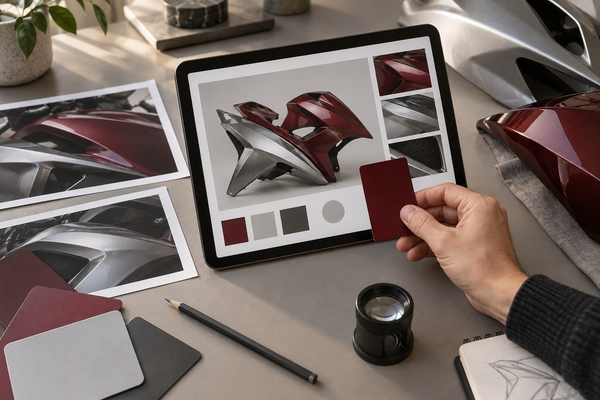
Build a finish brief separately from the fitment specification. AI-generated concept, not an exact Yamaha model or fitment reference.
Why cross-year panel conversion is unproven
We have not verified a 2025-to-2026 panel conversion. Written seller confirmation should be supported by an exact application or parts reference, not simply the phrase “fits R7.” If the project requires altered mounts or electrical changes, obtain qualified application-specific advice before proceeding.
Ordering a Year-Specific Kit for the R7
Ordering is easier when every message refers to the same machine and the same scope. Put the model year, market and intended finish at the top of your inquiry, then attach the relevant photographs. Keep unrelated inspiration images clearly labeled as styling references.
Build an Itemized Scope Before You Order
List every panel and component
Ask the seller for an itemized parts list. Name the nose, side pieces, tail components and trim you need rather than assuming a “full kit” includes your particular missing item. Ask for clarification where the photograph and written list appear to disagree.
Confirm whether the order is genuine Yamaha OEM or an aftermarket product. These are different categories; “OEM-style” does not mean supplied by Yamaha. If you require a genuine replacement, ask an authorized dealer for the correct part lookup.
Confirm what is and is not included
Ask about hardware, decals, finish and any required preparation for the exact order. Do not assume every kit is pre-drilled, every graphic is under clear coat, or every fastener is supplied. Avoid generic substitute fasteners unless their suitability has been confirmed for the application.
Use Photos and Part Numbers as a Checklist
Compare listing photos to your model year
Request actual photos of the supplied items rather than only a complete motorcycle or a rendered design. Compare the listed pieces with your inquiry photographs. Ask about a discrepancy before the order is finalized, especially around openings, edge shapes and adjacent trim.
Retain your model-year confirmation with the order record. If a title, listing and seller message use different years, resolve that conflict first. A later correction can be much harder once a custom finish has been approved or parts have been altered.
Cross-check part numbers against Yamaha sources
Use a Yamaha dealer or appropriate year-specific parts reference to check genuine part numbers where relevant. Do not assume regional differences are irrelevant to the component you need. Explain the market and any known modifications when asking for assistance.
Confirm Application Before You Pay
Ask the seller for year-specific confirmation
Ask: “What evidence confirms this exact item’s application to my model year and market?” You can send that information through the NiceFairings contact page for an inquiry. A request for confirmation is not an assurance of availability or fit.
If an unmodified panel does not align during an application-appropriate preliminary fit check, stop and document the issue. Do not force, drill or cut it to make an uncertain application work.
Document the confirmation for returns and disputes
Save the listing, agreed parts list and written reply. Follow the correct service instructions and supplier terms for any preliminary fit check; seek qualified help if needed. Document a mismatch before modifying the part, and ask the seller how to proceed.

Document the actual component when asking a seller to confirm application. AI-generated concept, not an exact Yamaha model or fitment reference.
The main takeaway is a buying method: use the year comparison to identify questions, then resolve those questions with exact application evidence. A new appearance, a new complete-bike feature and a compatible replacement part are three different claims.
Keep the order’s model identity, component list and finish brief together. This gives both you and the supplier a consistent reference if anything needs clarification later.
Choose a year-correct refresh when appearance is your goal. Evaluate a different motorcycle separately when its complete-bike features are what you want. Do not let a cosmetic order promise the benefits of both.
Illustrations in this article are AI-generated editorial concepts, not photographs of verified Yamaha year-specific parts or products offered for sale. Use the official sources and actual supplier documentation for model identification.