A fairing listing says “CBR650R 2024–2026.” Your bike is a 2025 CBR650R E-Clutch. Is that enough to order? No. The year range puts you in the right conversation, but it does not by itself confirm the factory variant, the right-side bodywork interfaces, the original parts that must stay on the motorcycle, or the contents of a particular kit. Ask the supplier to confirm the exact configuration in writing before approving paint or paying for bodywork.
This guide does not assert that E-Clutch and non-E-Clutch CBR650R fairings are interchangeable or incompatible. We have not performed an on-bike comparison. Honda's description of the E-Clutch drive unit makes the variant worth identifying; it is not a dimensioned fairing-clearance chart. Likewise, a good product photograph can show finish and visible panel shapes, but cannot establish how every hidden tab sits on your motorcycle.
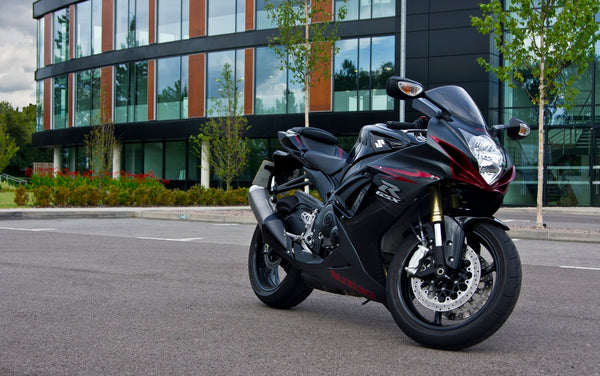
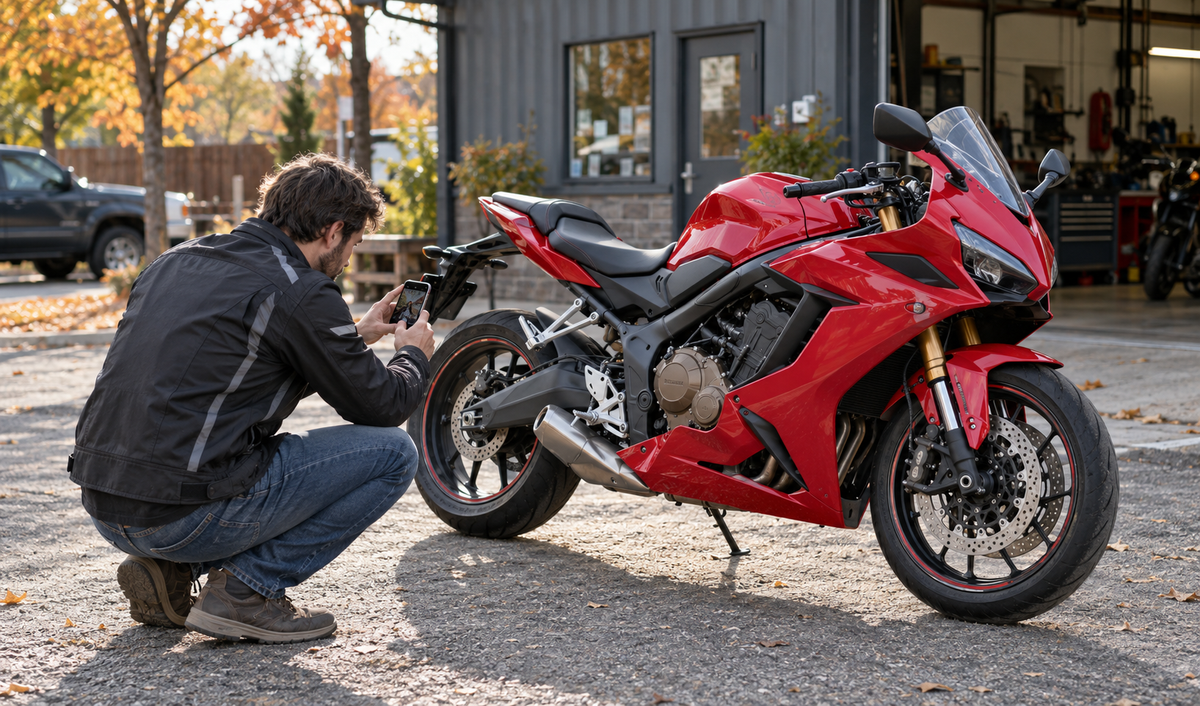
The cover is an AI-generated editorial concept of a rider documenting a sportbike, not a 2024–2026 Honda identification image or NiceFairings fitment test. The in-article black-panel photograph comes from a live NiceFairings product listing; its caption states exactly what it can and cannot show.
The short answer: treat year, variant and kit as three separate checks
First identify the motorcycle's actual model year and original sales market, not its registration date or the year a previous owner wrote in an advertisement. Second identify its factory configuration: Honda introduced E-Clutch on the 2024 CBR650R as a variant, and a bike with that equipment should be named explicitly in the enquiry. Third inspect the specific listing, including its panel set, exclusions and required retained parts. Only then can a supplier answer the right question.
The distinction is practical. A seller may know that its outer shell was designed for a given generation yet lack evidence for an E-Clutch-specific interface or an added accessory. The honest answer may be “we need your photos,” “we have not verified that variant,” or “this component is not included.” None is solved by a generic “2024+” heading. Our part-number versus seller-SKU guide helps keep a factory component reference separate from a shop's design code.
Why 2024 is a real bodywork boundary
Honda's 2024 European model announcement describes redesigned dual LED headlights, updated upper and lower fairings, and a redesigned tail for the CBR650R. That is a stronger reason to separate 2024-on bodywork from an older appearance than a color change or badge. It still does not prove that every panel changed or provide a full cross-year interchangeability table. To answer a specific component question, use the appropriate Honda parts information for the exact year and market, then ask the aftermarket supplier about its own product.
NiceFairings currently presents separate CBR650R product groups for 2019–2020, 2021–2023, and 2024–2026. Those are listing applications, not a universal factory interchange chart. Do not move an older kit into the new generation because a side photo looks close. Nor should you assume that a shared design name proves matching lamps, nose, lower cowl or tail supports.
What E-Clutch changes—and what we cannot conclude from it
Honda explains that its E-Clutch system adds a drive unit and motor control unit with motors and gears. Honda also illustrates projection from the engine side cover. The rider can still operate the clutch lever manually. These are descriptions of the factory system. They do not tell us the clearance of a particular aftermarket panel, the exact position of its tabs, or whether an E-Clutch bike uses every same painted piece as a non-E-Clutch bike in every market.
This is why a right-side photograph matters. The question is not “Does E-Clutch make fairings impossible?” It is “Which exact part of this proposed kit sits near the E-Clutch-equipped motorcycle, and has that combination been verified?” Do not use a ruler placed over a web photograph to invent a universal clearance. Do not remove a factory cover or alter its brackets merely because a seller's marketing image hides them. A Honda dealer or qualified installer can clarify the factory assembly; the seller must clarify its aftermarket kit.
Build a photo packet that answers one purchasing question
Start with a full right-side view and a full left-side view in daylight. Add a front view showing the headlight and nose, then a rear view of the tail and lamps. Take an oriented right-side close-up of the existing side/lower-panel boundary and engine-cover area. If a panel hides the relevant interface, have a qualified person photograph it during proper disassembly; do not dismantle a safety-critical area solely for a speculative online enquiry. Finally, photograph any nonstandard exhaust, protection hardware, turn-signal arrangement or replaced bracket.
Label each image with the bike's exact model year, market and factory variant; put any aftermarket changes on a separate line. A buyer saying “2025 CBR650R E-Clutch, UK-market bike, stock bodywork, aftermarket slip-on” gives a more useful starting point than “2025 Honda.” If there is old crash damage, include the inner mount and stay rather than sending only the scratched outer plastic. Our photo-and-label fairing workflow is a practical format for keeping wide shots and close-ups connected.
Read the real listing without promoting its photograph into proof
The live NiceFairings matte-black 2024–2026 CBR650R kit page identifies a design code, NF-HONDA-CBR650R-2426-A002, and describes a front-view panel layout with two alternate angles. It states an intended 2024–2026 model range and asks buyers to confirm model, year and configuration. At the time of this review, that page does not expressly say “E-Clutch compatible.” Do not turn an omitted variant statement into a yes or a no. Send the exact bike details to NiceFairings and request a documented answer before ordering.

The image is useful: it lets you discuss visible shape, surface finish and which pieces appear in the frame. It is limited: staging a group for a photograph is not a complete packing list, and a front-facing layout does not show the installed right-side clearance. Ask which inner pieces, shields, fasteners, tank-cover elements and trim are included versus retained from the motorcycle. The finished-fairing-photo checklist explains the same separation between appearance approval and mechanical fit.
The five written questions worth sending before checkout
Send one concise message through the NiceFairings contact page or the product enquiry channel, attaching the photo packet and the exact listing URL. Ask: (1) Does this listing explicitly cover my year, original market and CBR650R E-Clutch factory variant? (2) Which outer and inner panels are supplied, and what must be transferred from my motorcycle? (3) Which right-side fairing pieces, brackets or shields are known to need separate verification around the factory E-Clutch equipment? (4) How are nonstandard exhaust or protection parts treated? (5) What inspection is permitted on arrival before any irreversible work, and how should an unresolved fitment issue be reported?
Do not ask the salesperson to approve a measurement they cannot see. A written “not verified” is more valuable than an unqualified promise. Save the response alongside the product link, design code, date and your own photos so the factory, buyer and installer are working from the same configuration. If a dealer identifies a factory part number, do not assume that the NiceFairings SKU is the identical component. The two reference systems serve different purposes.
Think in components, not one giant “fairing kit”
Divide the order into nose/headlight surround, upper side, middle side, lower cowl, front fender, tank cover, tail, inner trim and hardware. That list is a question framework, not a claim that all those pieces are included. The current listing and final order must name the actual contents. A new side panel can look coherent beside an old tank and tail in a render while the physical seam or finish differs. A complete-looking studio image may also omit rubber mounts and shields that the motorcycle needs.
If you replace only one damaged section, record how the existing paint has aged and which edges must visually meet it. If you order a coordinated set, make a retained-parts list for the fuel tank, wheels, windscreen and any piece the kit does not include. Our fairing quote comparison guide is useful for keeping supplied pieces, finishing work and optional items apart; it does not answer the E-Clutch question by itself.
Three examples of what a good answer looks like
Example A: stock 2024 CBR650R E-Clutch, no crash damage. The buyer sends the right-side views, the exact product link and factory-variant identification. The supplier names the supported configuration and panel scope in writing. The installer still performs the applicable pre-fit and clearance checks. The written response is purchase evidence; it is not a substitute for installation inspection.
Example B: 2025 non-E-Clutch CBR650R with a changed exhaust. The E-Clutch question is not applicable, but the lower-cowl/exhaust interface is. A “2024–2026” listing does not certify clearance around an aftermarket exhaust. The buyer sends exhaust identification and underside photos; the seller and qualified installer identify what remains unresolved. Our exhaust-change belly-pan guide covers that separate problem.
Example C: imported bike with 2024 registration and unknown year. The buyer first asks a Honda dealer to establish the correct model year, original market and factory variant. No one should make a bodywork order based on the registration year or a paint scheme. These scenarios are examples of enquiry logic, not reports of customer installations or claims that one variant is accepted or rejected by the product.
Inspect on arrival before altering a panel
When the order arrives, compare the supplied parts with the written panel list, then photograph each face, edge, tab and shipping protection. Keep labels, packaging and order correspondence until the inventory is reconciled. Have a qualified installer use the applicable Honda information and the supplier's instructions for a controlled pre-fit; the shape and hardware of the original bike, not a generated cover photograph, govern the check. Do not drill, trim, heat or force a misaligned part as a way of discovering whether the application was correct.
Any contact with E-Clutch equipment, engine covers, hoses, wiring, exhaust, wheel or controls should stop the installation for diagnosis. A panel that touches one component at rest may behave differently under vibration, steering movement or service access. We are not prescribing a clearance dimension. Record the exact contact point, the installed adjacent parts, the year/variant details and photographs, then contact the supplier before irreversible changes. The panel-gap troubleshooting guide describes why pulling the last hole into alignment can disguise an earlier problem.
Design approval comes after application clarity
Once the variant and kit scope are confirmed, choose the color. Matte black can give the 2024-on shape a restrained look, while a custom scheme can coordinate the new panels with the retained tank and accessories. But a dramatic render is a paint brief, not a proof that the right-side fairing clears factory equipment. Use the NiceFairings custom-design process to state the intended colors, finish and reference views, and keep the configuration question separate in the same correspondence.
Request both sides of a design proof. The E-Clutch question concerns a factory variant on the real motorcycle, not just what the left side looks like. Even after a design is approved, review the final product photos for finish and panel identity only; a photo before shipping cannot replace a professional on-bike inspection. This sequence protects both the quality of the design conversation and the honesty of the fitment conversation.
When to pause the order
Pause if the model year or original market cannot be identified, the listing's named application conflicts with the bike, the supplier cannot address the E-Clutch variant despite it being relevant, an essential retained part is missing, or the kit contents remain unclear. If the motorcycle is modified, the supplier may need more information or may be unable to confirm a particular configuration remotely. That is a reason to clarify or choose a different repair scope, not to convert uncertainty into a guarantee.
The best outcome is not a quick “yes” from a broad model name. It is a traceable answer to one exact motorcycle, one exact kit and the parts that meet between them. Honda establishes what the factory changed and what E-Clutch is; the product listing establishes what the seller offers; your own bike and installer establish the physical condition. Keep all three forms of evidence in their proper roles.
Sources and limits
- Honda 2024 European model announcement: CBR650R styling/bodywork updates and introduction of E-Clutch option.
- Honda E-Clutch technology explanation: drive-unit concept and engine-side projection illustration; not a fairing compatibility statement.
- NiceFairings CBR650R 2024–2026 matte-black listing: live product description and store-owned flat-lay image, checked October 14, 2026. Product text and stock may change.