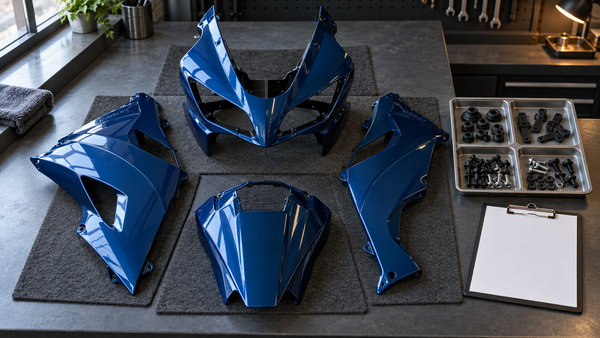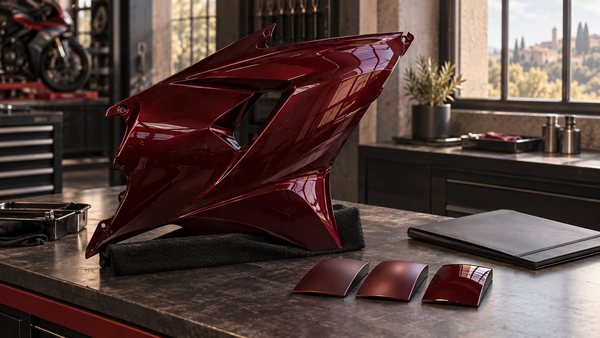
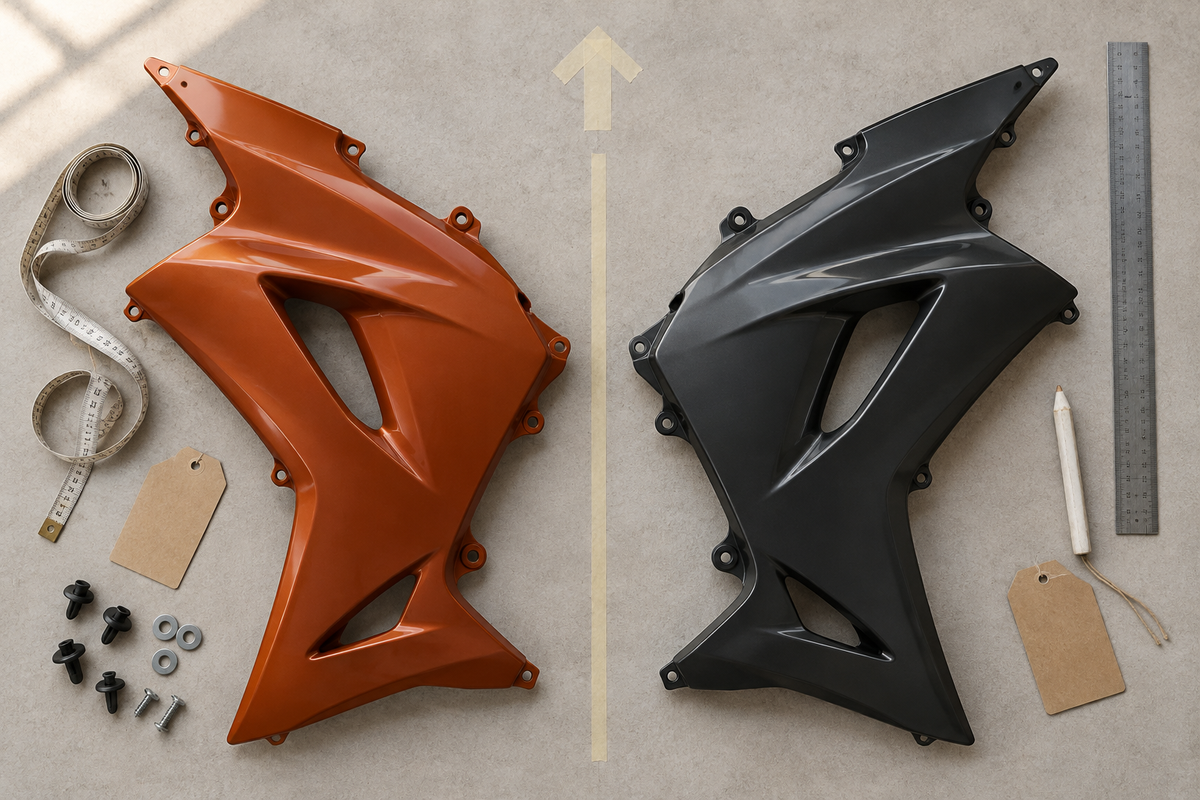
Left and right motorcycle fairing panels are normally identified from the rider’s position, facing forward. Standing in front of the motorcycle reverses your view of those sides. A product photograph can add another layer of confusion: the panel may be rotated, photographed from behind, or shown beside a different variant.
Before ordering a single replacement, connect three things: the side on your motorcycle, the exact panel within that side, and the seller’s orderable item. “The blue piece on the left of the picture” does not establish all three.
This guide focuses on that single-side decision. You will learn how to describe the panel clearly, read a listing without relying on screen direction, and resolve conflicting labels before choosing a variant. It applies to the identification process; it does not establish compatibility between particular motorcycles or turn a photograph into a fitment test.
Key Takeaways
- Use rider left or rider right, facing forward, then confirm the terminology in the model’s documentation and the seller’s listing.
- A side identifies a location, not a complete part. Add the panel name, model year, market and reference where available.
- Photographs support identification, but a reversed or incomplete image cannot confirm which item will arrive.
- Confirm whether the offer is one outer panel, a group of pieces, or a pair. Finish, inner parts and hardware are separate questions.
- If the title, variant and seller’s reply disagree, get the exact order corrected before paying.
Establish Left and Right Before Looking at the Listing
Imagine sitting in the normal riding position and looking toward the front wheel. The side beside your left leg is rider left; the side beside your right leg is rider right. You do not need to sit on or move the motorcycle to apply that reference. Keep the motorcycle secure while observing it.
Now imagine facing the headlight from in front of the motorcycle. Rider left appears on your right. Nothing about the motorcycle’s side has changed; only your viewing direction has changed. This is why two people can point to the same part and give apparently opposite descriptions.

Translate Ambiguous Descriptions Into a Fixed Reference
Use a sentence such as “I need the outer panel on the rider’s left, facing forward.” Add a marked photograph of its location. That wording gives the supplier a fixed point of reference even if your photo shows the bike from the front or at an angle.
Terms such as “near side,” “off side,” “driver side” and “passenger side” can introduce unnecessary ambiguity in an international motorcycle order. LH and RH commonly mean left-hand and right-hand, but confirm the listing’s meaning when it is unclear. Do not interpret an unfamiliar abbreviation by guessing.
Avoid using the exhaust, chain, brake components or graphics as your only side marker. Their arrangement is not a universal naming system, and the motorcycle or image may have been modified. A distinctive feature can help explain a photograph after the motorcycle has been identified; it should not replace the rider-facing-forward reference.
Confirm the Side in the Relevant Documentation
Check the owner’s documentation, an appropriate parts catalog, or the manufacturer’s dealer information for your actual motorcycle. Use the wording from that source when asking about an OEM part. For aftermarket bodywork, ask the supplier to map its own panel name and item reference to the location you mean.
The goal is agreement between your location description and the item being offered. A seller using a different label can still resolve the question by identifying the exact piece in writing and on a clear image. An unexplained conflict should remain an open question.
Identify Which Panel on That Side You Need
“Left fairing” may describe a large outer cowl in one listing and a collection of upper, middle, lower or inner pieces in another. The side alone cannot tell you where one panel ends and its neighboring panel begins. Before selecting a replacement, locate the physical boundaries of the piece you want.
Use a wider photograph to show its position on the motorcycle, followed by a closer image of the whole visible panel. Mark a copy of the wide photograph rather than drawing over the original. Keep the unmarked original as well. If the part is already removed, photograph the complete outer face and accessible inner face while supporting it on a clean, suitable surface.

Do not remove bodywork solely to follow an article’s photo suggestion if you lack the appropriate instructions or experience. Use accessible views first and ask the supplier what additional evidence is necessary. Our guide to photographing a fairing for identification help develops the photo-record process in more detail.
Separate the Painted Shell From What Sits Behind It
An outer panel and a hidden duct, trim piece or support may occupy the same general area. Seeing both in an assembled-bike photo does not mean that both belong to the listing. Ask the seller to identify the supplied pieces individually rather than assuming everything within the photo’s outline is included.
For example, a request for a left outer cowl should state whether you are also asking about its inner trim, mesh, mounting items or adjoining lower panel. If you need only the shell, say so. If you do not know the proper name of an additional piece, describe its location and mark it separately as a question.
A drawing’s numbered callout usually helps you find an entry in that drawing’s parts list. It is not automatically the orderable part number. Record the source and the complete reference shown for the relevant item. Our explanation of part numbers, seller SKUs and molded markings can help when several different codes appear in the same conversation.
Read the Product Page Without Trusting Screen Direction
A loose panel can be placed in almost any orientation for a photograph. Viewing its inner face changes what the outline looks like, while a close crop can hide the features that establish its position. A mirrored image is another possible source of error. Do not flip a product image yourself and treat the result as evidence that the opposite-side part exists or is included.
Instead, inspect the title, description, selected variant, item reference and images together. Check whether the image changes when you select a side. A static image is not necessarily wrong, but it means you need another clear way to confirm which variant the selection represents. When browsing the NiceFairings fairing-kit catalog, use the motorcycle and year information to narrow the search, then verify the exact listing before treating any photograph as side-specific evidence.
| What you see | What it establishes | What to confirm |
|---|---|---|
| A panel on the left of a photograph | Its position in that image | Which side of the motorcycle it fits |
| A title containing “LH” or “RH” | The seller’s stated label | The label’s meaning and exact selected item |
| Both sides shown together | The photograph contains two sides | Whether the price covers one side or the pair |
| An OEM diagram reference | A route to a catalog entry | Exact model, year, market and full part reference |
| A color or design option | A stated finish selection | The panel scope and any color-matching limits |
Handle Contradictions Before Choosing a Variant
Suppose the page title says “right,” the option selector says “left,” and the image looks like the part on your bike. That is not a reason to decide that the image must be correct. Save the page details and ask which physical item is attached to the selected variant. The answer should identify both the side and the item reference.
A useful response might identify the highlighted panel as rider left, give its seller reference, and explain that the main photograph is a shared illustration. If the actual order still carries an inconsistent label, ask for a corrected listing or a clearly documented order description. Do not resolve the conflict by adding an easily missed note to an otherwise wrong selection.
Similarly, do not assume that a “pair” supplies every part visible on both sides of an assembled motorcycle. A pair may refer to two particular pieces. Ask for the names and quantity included, then compare that answer with your own marked photographs.
Match the Side to the Motorcycle and the Finish
Correctly naming rider left does not confirm model-year compatibility. Give the manufacturer, exact model designation, model year and original market where known. If the motorcycle has replacement or modified bodywork, describe that separately from the motorcycle’s original identity. A first-registration year should not be silently substituted for model year.
Manufacturer resources can provide a starting point. Yamaha’s European parts-catalog guidance describes using model searches and technical drawings to identify parts. Yamaha’s US parts lookup states that its catalog concerns models sold in the United States and advises reconfirming model, model year and part numbers with an authorized dealer. Use the resource appropriate to your motorcycle’s market.

An OEM catalog describes the manufacturer’s parts system. It does not automatically validate a third-party kit, an altered motorcycle or a seller’s SKU. Ask an aftermarket supplier to confirm the intended application of its own item against the motorcycle details and photographs you provided.
Confirm the Appearance of the Single Replacement
A correctly identified side can still create an unexpected visual result. A single new panel may sit beside older paint, an existing custom finish or graphics that cross panel seams. Do not use matching color names or similar screen colors as a promise of a seamless match.
Ask whether the quoted item uses the supplier’s standard design, reproduces a documented previous order, or requires a separate custom request. The NiceFairings custom fairings page explains the store’s design-confirmation route; availability and matching still need confirmation for the exact motorcycle and order. Where graphics meet neighboring pieces, identify those meeting points and provide clear reference photographs. Ask what can be confirmed from the references and what remains uncertain.
Keep appearance and fitment as two separate decisions. Approving a graphic layout does not approve mounting geometry. Conversely, confirming the panel’s intended application does not establish that its paint will match another supplier’s finish. If buying just one side is not offered, request the available scope rather than assuming a complete kit can be split.
Send One Clear Request and Check the Saved Order
Bring the details into one message so the seller can answer a defined question. Avoid sending a sequence of cropped images followed by “this one” or “the other side.” Number the photos and explain what each one shows.
Example request: I need the outer middle fairing panel on the rider’s left, facing forward, for my [make, exact model, model year, market]. Photo 1 shows its location; photo 2 shows the whole panel. My current bodywork is [original / replaced / uncertain]. I am considering [listing URL and selected variant]. Please confirm the supplied panel, side, item reference, quantity, finish and any separate inner pieces or hardware. Please also confirm whether this panel is available individually.
Replace the bracketed fields with actual information; leave unknown facts explicitly unknown. If you have a previous order reference or documented part number, include it with its source. Review the NiceFairings ordering FAQ for common process questions, then use the NiceFairings contact page to ask about a particular listing rather than treating this general guide as confirmation that a single panel is available.

Make the Final Comparison Before Payment
Check that the selected variant or quote records the agreed side, exact piece and quantity. Review the finish separately. Save the relevant listing and the supplier’s clarification together so you can tell which answer relates to which item. If the final quote changes the scope from one panel to a set, resolve that difference before proceeding.
When the order arrives, compare the received item and labels with that record. Keep a suspected wrong-side or wrong-item panel unmodified while asking the supplier to review the discrepancy. A mismatch should not be addressed by forcing, drilling or heating a part to make it resemble the intended item. Installation and condition assessment require the appropriate product and motorcycle instructions. For the store’s current workflow, consult the NiceFairings production and shipping overview together with the terms attached to your actual order.
If your question expands from one panel to everything required for the job, use the fairing-kit contents checklist to separate supplied, reused and separately purchased pieces. For the single-side order, keep the core record simple: motorcycle identity, rider side, panel identity, order reference and agreed finish.
Frequently Asked Questions
Is the left fairing on my left when I face the headlight?
No. Under the usual rider-facing-forward convention, rider left appears on your right when you stand in front and face the motorcycle. Confirm the manufacturer’s and seller’s terminology, and describe the location as “rider left, facing forward.”
Can I identify the side from a detached panel photograph alone?
Sometimes a knowledgeable supplier can identify a panel from adequate photographs, but screen position alone is insufficient. Provide the motorcycle details, a location image if available, and the complete panel view. Ask for an explicit item and side confirmation.
Does a listing showing two panels include both?
Not necessarily. Read the selected variant, quantity and description. Shared product images can illustrate options or a larger set. Ask what the quoted price actually supplies if the scope is unclear.
Will an opposite-side panel have the same shape in reverse?
Do not assume it will. Use the actual side-specific documentation and product information. Mirroring an image creates an edited picture, not evidence of the opposite panel’s geometry or fitment.
Can I order one panel to match an existing full kit?
Ask the original supplier with the previous order reference and current photographs. Individual availability, design reproduction and color matching need confirmation for that order. A shared color name is not a guarantee of a match.