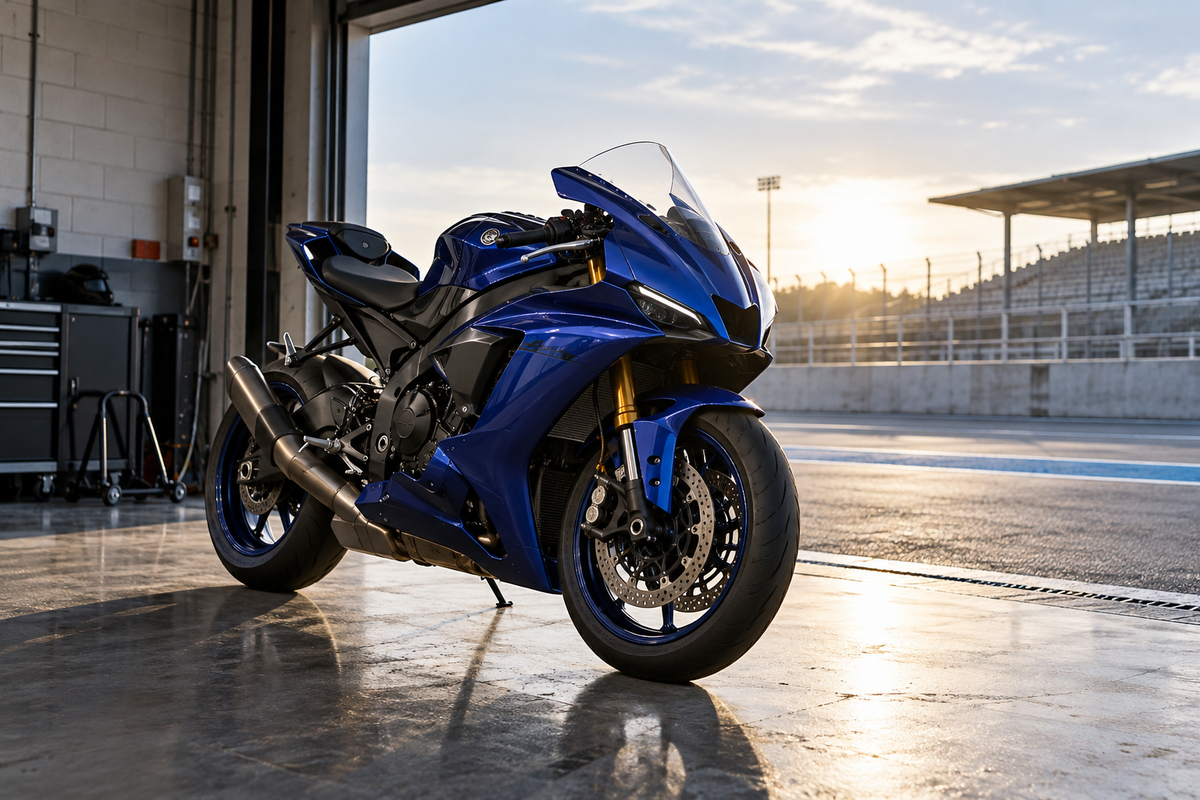
Images are editorial illustrations, not exact model-year, fitment, or paint-color evidence.
What changes besides paint? Start with the parts list. The US 2025 Yamaha R1 feature page describes full LED lighting, while Yamaha presents the European R1 RACE as a track-focused complete motorcycle without road-going components. These examples illustrate different applications, not compatibility between aftermarket kits. Choosing street or track fairings means checking lighting provisions, mounting parts, tail layout, and your exact motorcycle—not just its paint.
Key Takeaways
Street-oriented kits may retain factory lighting and mirror provisions; verify each opening and mounting arrangement for the exact product.
Material alone does not establish fitment, crash behavior, road suitability, or event approval.
Some track tails use a solo-seat layout. Verify the seat support, lighting provisions, and retained parts individually.
Check the lower-pan design, service access, exhaust clearance, and any organizer-specific fluid-containment requirements.
Ram-air duct openings must match your exact R1 model year. Never assume one year fits another.
The word “complete” has no universal contents list. Confirm panels, brackets, fasteners, and reused parts in writing.
Read the current rules for your specific event before selecting bodywork; a seller cannot guarantee acceptance at every organizer.
Yamaha R1 Street Fairings vs Track Fairings: Material Differences
You see two sets of fairings next to each other. One set came off a street bike. The other set is from a track machine. They look alike in shape. They feel different in your hands. The material tells part of the story. It does not tell the whole story.
Material Alone Does Not Define the Application
The US road model and European R1 RACE are useful reminders to check the market and application, even when the R1 name is shared. Do not infer the material of every factory panel from those examples. Ask the seller to identify the construction of the actual replacement kit and how it is intended to mount.
ABS is a thermoplastic, while fiberglass bodywork is a composite whose behavior depends on the reinforcement and resin system. Thickness, design, manufacturing quality, mounting, and damage history all matter. A material name is not a promise that a panel will bend rather than crack, survive a crash, or be economical to repair. Have damaged bodywork assessed before deciding whether repair is appropriate.
You cannot assume that ABS means street legal. You cannot assume that fiberglass means race approved. Those labels come from the whole motorcycle and from event rules. A fairings kit made of ABS may work on a track bike. A fiberglass kit may sit on a show bike. The material is one factor among many.
For dedicated track bodywork, compare the documented application, panel replacement availability, and service access of the specific products. Manufacturer documentation and actual kit photographs are more useful than a brand list or broad assumptions about fiberglass.
Use the following checklist to compare the documented products rather than treating material properties as guarantees.
- Construction: ask for the material and manufacturing specification.
- Mounting: confirm brackets, supports, and fasteners.
- Damage and repair: request product-specific guidance rather than generic material claims.
- Application: check exact-year fitment and relevant event requirements separately.
These checks do not prove that a kit fits your R1. They identify the evidence to request before you choose. Your exact motorcycle and intended use remain the starting point.

Bodywork application and paint style are separate choices; AI concept, not exact Yamaha fitment.
Race-Replica Paint Is Not Track Construction
A shiny paint job with sponsor decals can make any fairing look fast. That look does not change how the panel was built. Race-replica paint is a style choice. It copies the look of a racing motorcycle. It does not add structural strength. It does not create mounting points for track use. It does not remove the need for lighting provisions on a street bike.
You may find aftermarket fairings with a race-replica finish. These panels may use ABS or fiberglass. The paint tells you nothing about the construction method. A fiberglass panel with race graphics may still lack the mounting hardware for a track kit. An ABS panel with a replica scheme may still include cutouts for headlights and mirrors.
Quality comes from the mold, the layup, and the fitment. Quality does not come from the color or the decals. Ask the seller about the material and the manufacturing process. Ask for photos of the actual panels. Do not let a racing look take the place of real information.
Some dedicated bodywork is offered unpainted or in a preparatory finish. That alone does not show whether it is better or worse than a painted kit. Confirm what finishing work remains, whether a trial fit is required by the seller, and which return conditions apply before painting or altering anything.
You must separate appearance from purpose. A motorcycle fairings kit serves a role. That role depends on your bike, your events, and your local rules. The paint scheme is the last thing to consider. The material and the mounting package come first.
When you shop for Yamaha R1 street fairings vs track fairings, start with the documented application. The NiceFairings Yamaha collection is a starting point for reviewing listed replacement bodywork. It is not a promise that a listing is race-approved or suitable for a track conversion. Compare the contents and ask for written confirmation of your exact use case.
Lighting, Mirrors, and Tail Layout Across Fairings
The front and rear of your Yamaha R1 tell you a lot about which fairings you need. Street fairings keep openings for lights and mirrors. Track fairings often remove those openings or cover them with block-off plates. You must verify every cutout and mount before you buy.
Headlight and Mirror Provisions
A street-oriented replacement upper should be checked against the original headlight assembly, surrounding trim, mirror arrangement, and any separate brackets. A visible opening is not the same as an included support or threaded mount. Keeping the original equipment functional requires the appropriate components; a fairing alone does not establish road compliance.
Some closed-course uppers omit headlight openings; other products offer separate block-off pieces. Mirror provisions also vary. Confirm the actual configuration and whether the original assemblies are retained. Do not assume a weight saving or a reversible street conversion from a product photograph.
Do not assume that every track kit blocks all openings. Do not assume that every street fairing includes every cutout. The exact provisions depend on the model year, the market, and the specific product. A European R1 RACE uses track bodywork with no lights from the factory. That complete motorcycle is not the same as an aftermarket race fairing kit. You must ask the seller for photos of the actual panels. Ask for a list of openings and mounts. Check whether the kit retains the factory headlight assembly or requires a race upper with no cutout.
The appearance of a fairing can fool you. A painted street panel and a painted track panel may look identical in a photo. The difference sits in the openings you cannot see from the front. Quality control at the mold stage determines whether those cutouts line up with your motorcycle's mounting points. Always request close-up images of the headlight area and mirror mounts.

Lighting and mirror provisions require product-specific checks; AI road-bike concept, not a model-year photograph.
Tail Section and Seat Pan Fitment
For a street-oriented tail, check compatibility with the retained tail light, plate-support arrangement, seat lock, passenger seat or cowl, and supporting pieces. These parts are not automatically included with painted outer panels. Their presence also does not, by itself, establish that the whole motorcycle meets local requirements.
Some track-oriented tails use a solo design and may require a separate seat pad, seat pan, support, or mounting kit. Lighting and plate provisions vary. Confirm the complete tail assembly and what it reuses before assuming that the outer shell is all you need.
You must verify the seat pan fitment for any kit you consider. Does the kit reuse the factory seat pan? Does it include a new pan? Does it require subframe modifications? The answers change from one product to the next. A kit that fits a 2020 R1 may not fit a 2025 model. A kit built for the European market may not match US lighting requirements.
Event organizers set their own technical requirements. Check the current documentation for the event and riding group you plan to enter, including any lighting, mounting, and bodywork requirements. Ask the organizer if the wording is unclear. Do not drill panels or disable equipment based on general advice in a buying guide.
Lower Pan, Ducts, and Mounting Package
The bottom of your Yamaha R1 hides big differences between fairing types. The lower pan, ram-air ducts, and mounting hardware change how panels attach and what they cover. You must check each of these elements before you buy any replacement fairing kit.
Belly Pan and Ram-Air Duct Differences
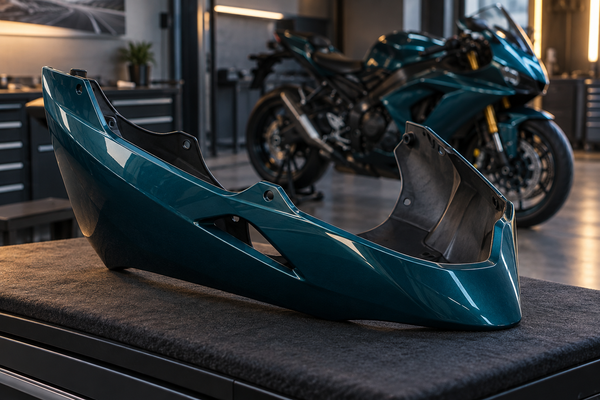
A track-oriented lower may be designed with fluid containment in mind, but the details and event acceptance must be verified. Do not define street versus track bodywork solely by whether the oil filter or drain plug is covered. Service access, drains, exhaust clearance, and the way the lower separates are product-specific questions.
Ram-air duct openings must match your exact R1 model year. The ducts send air to the airbox. A mismatch in size or shape can cause fitment problems. You cannot assume that ducts from one model year fit another. The US 2025 R1 and the European R1 RACE use different bodywork packages. These complete motorcycles show how makers pair ducts with specific uses. They do not prove that aftermarket fairings swap across years or markets.
Ask the seller for underside photographs and documentation of service access, exhaust clearance, and any claimed containment design. Confirm whether ram-air ducts and their supports are included or retained. A seller’s fitment answer and an organizer’s technical acceptance answer are separate checks.

Confirm the lower shell and hardware separately; AI illustration, not an actual package or containment specification.
Retaining Factory Parts and Mounting Hardware
Track kits may need different brackets or quick-release fasteners. Others reuse some factory mounting parts. Confirm each interface with the fairing stay, subframe, ducts, and retained equipment. Do not assume that a “quality” kit necessarily reuses every factory component.
Do not assume that any kit includes every bracket you need. Some products supply all mounting hardware. Others require you to move parts from your original fairings. A complete motorcycle fairings package should list every included item. Check for bolts, clips, rubber grommets, and bracket assemblies.
The look of a mounted panel tells you nothing about the hardware underneath. Quality comes from proper fitment and complete mounting packages. Ask for a written parts list. Confirm whether the kit keeps your OEM subframe and airbox. Verify that the fasteners match your motorcycle's mounting points.
For a detailed guide on what to check, see the NiceFairings blog on motorcycle fairing kit contents verification at fairing kit contents checklist. This resource helps you build a checklist before you commit to any aftermarket purchase.
Never cut or drill panels based on guesswork. Never modify your subframe without manufacturer guidance. Verify all kit documentation first. Ask the seller for written confirmation of fitment, hardware, and retained factory parts. Those steps protect your investment and your motorcycle.
Three Scenarios for Street Fairings vs Track Bodywork
Your riding habits decide which bodywork makes sense. A rider who never leaves public roads has different needs than a rider who spends weekends at a closed course. You should match the panels to your actual use, not to a look you saw online. The three scenarios below cover most Yamaha R1 owners. Read the one that fits you, then verify the details with your seller and your event organizer.
Street-Only Riders and Practical Street Fairings
You ride your R1 on public roads every week. Start with model-specific replacement bodywork documented to retain the equipment and mounting layout you need. Check the upper, sides, tail, and inner pieces as a package. Original-equipment or aftermarket panels still need to be evaluated against your exact motorcycle, particularly if previous owners changed supports or accessories.
Material alone does not make a panel street legal. A fiberglass panel may have lighting provisions, but openings alone do not provide all necessary supports. An ABS panel can lack them if the maker built it for closed-course use. You must check the actual cutouts on the product you buy. Ask the seller for photos of the headlight area, the mirror mounts, and the tail. Ask whether the kit reuses your factory headlight and tail light assemblies. Get the answer in writing.
The appearance of a fairing tells you little about its provisions. A glossy panel with a race-style graphic may still have every street cutout. A plain panel may have none. Focus on the openings and the mounting points. Those details are part of verifying the intended road-oriented setup; they are not a compliance guarantee.
You should also confirm the model year fitment. Yamaha changed bodywork across R1 generations. A set that fits one year may not fit another. The US 2025 R1 road model is a complete motorcycle with a full lighting package. That fact does not prove any aftermarket fairings fit your bike. Treat the factory machine as an example of how a street application looks, not as a guarantee about any kit.
Occasional Track Days vs Dedicated Track Bikes
You ride on the street most of the year and visit a track occasionally. Before buying a second bodywork set, ask the organizer what is required for your motorcycle and riding group. Some events accommodate road-oriented machines, but preparation rules differ. This guide does not provide instructions to remove, tape over, or disable equipment.
Do not assume a universal material rule across all track days and races. Requirements vary by organizer, class, and event. Ask which bodywork and preparation requirements apply to you, and obtain clarification before purchasing a kit that may not be accepted.
For a dedicated track motorcycle, compare access for servicing, individual replacement panels, the mounting system, seat arrangement, and the event’s technical requirements. Ask the manufacturer how damaged panels should be assessed and repaired. Do not assume that fiberglass automatically makes crash damage simple or inexpensive to repair.
Weight and crash behavior depend on the specific product, the layup, and the hardware. Do not pick a material because a forum post promised a number. Ask the seller for the actual panel weights and the mounting package. Compare those figures across the products you consider.
For any scenario, check the event rules and kit documentation before deciding. An occasional track-day rider may find that the existing road-oriented bodywork is acceptable under the relevant rules. A dedicated track build may need a different package. Neither outcome can be established by the material name or a general street-versus-track label.
Quality shows up in fitment, hardware, and documentation. It does not show up in a paint scheme. Ask every seller the same questions about openings, mounting points, and included parts. Compare the answers. That process beats any assumption about material or brand.

Match bodywork decisions to the event and riding use; AI illustration, not event-approval evidence.
Kit Scope and Written Confirmation for Motorcycle Fairings
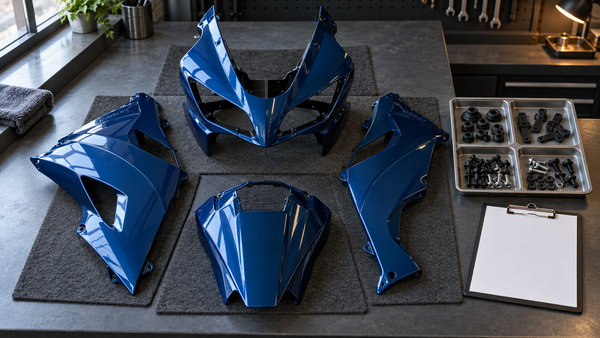
Once you narrow the intended application, check exactly what is in the box. A kit labeled “full” or “complete” may contain only outer panels. Treat the seller’s itemized list as the scope of supply, and account separately for hardware, lights, inner ducts, and retained supports.
What a Complete Kit Should Include
A full fairings kit for your Yamaha R1 needs panels you can see. Look for the front upper, side panels, tail, and belly pan. Each panel must match your bike's model year. Check whether mounting hardware and fasteners are supplied or must be sourced separately. Some kits give you all the screws and bolts. Others expect you to reuse parts from your old motorcycle.
A separately sold fastener kit is not the same as a bodywork kit. A bag of visible bolts may still omit hidden brackets, rubber pieces, clips, or model-specific supports. Compare the bodywork supplier’s list with the mounting requirements, rather than assuming that either package supplies everything.
Not every kit gives you the same scope. Some keep factory parts. Others make you buy the headlight assembly or turn signals on your own. You must ask the seller these questions before you buy. Does the aftermarket fairings set include brackets for the ram-air ducts? Does it give you the belly pan mount? Does it include the solo tail seat foam or the lock mechanism?
The suitability of a replacement kit depends partly on whether its documented scope matches your project. A panel-only package is not automatically poor quality, but missing information can create unexpected purchases. Separate included items, reusable parts, and additional components before comparing total project cost.
Write down your own checklist. Mark each needed component as supplied, reused, purchased separately, or still unconfirmed. Ask the seller to resolve the unconfirmed items before payment. A kit labeled for your year may still rely on parts that are absent or damaged on your motorcycle.
Verifying Documentation Before Purchase
You need written proof of what the kit holds. A product listing online is not enough. You must ask the seller for a document that lists the part count, material, paint finish, and fitment details. Get this proof in writing before you place an order.
Start with the part list. Ask the seller to name each panel that is included. Ask whether the kit keeps your factory headlight assembly or gives you a block-off plate. Ask about the tail section. Does it include a solo tail or does it reuse your stock seat pan? Does it have a cutout for a tail light or license plate mount?
Next, make sure of the material. The seller should say whether the panels are ABS or fiberglass. The material changes how you treat the panels. Write it down.
Then make sure of the paint finish. Some kits come in primer. Others come in a finished color. Ask about the process used for the paint. A race-replica look does not change how the panel was built. Do not let a flashy finish take the place of real checking.
Check the year and model fitment. The seller must state which R1 years the kit works with. The US 2025 R1 road model and the European R1 RACE are separate complete motorcycles. They do not prove fitment for any aftermarket kit. You must match the kit to your exact motorcycle.
Finally, make sure of the return policy. You need to know what happens if the panels do not fit. Ask for this in writing before you buy.
A great resource for your pre-purchase checklist is the NiceFairings blog on motorcycle fairing kit contents verification: fairing kit contents checklist. Use it as a guide to build your own questions.
Without written proof, you risk buying a kit that does not fit your motorcycle. You risk missing parts that you must buy on your own. You risk a return that takes weeks to process. Protect your investment. Get the documentation.
The aftermarket industry offers many choices. Clear documentation reduces uncertainty but does not guarantee a trouble-free fit. Keep the approved parts list and correspondence, inspect the delivered items, and follow the seller’s verification and return conditions before painting or modifying the panels.
The key difference between Yamaha R1 street fairings and track bodywork is the documented application and package, not just paint. Check lighting and mirror provisions, tail support, lower-pan configuration, ducts, mounting parts, and exact-year fitment. Material alone does not guarantee suitability. If a NiceFairings listing leaves a point unclear, ask our team for written clarification before ordering.