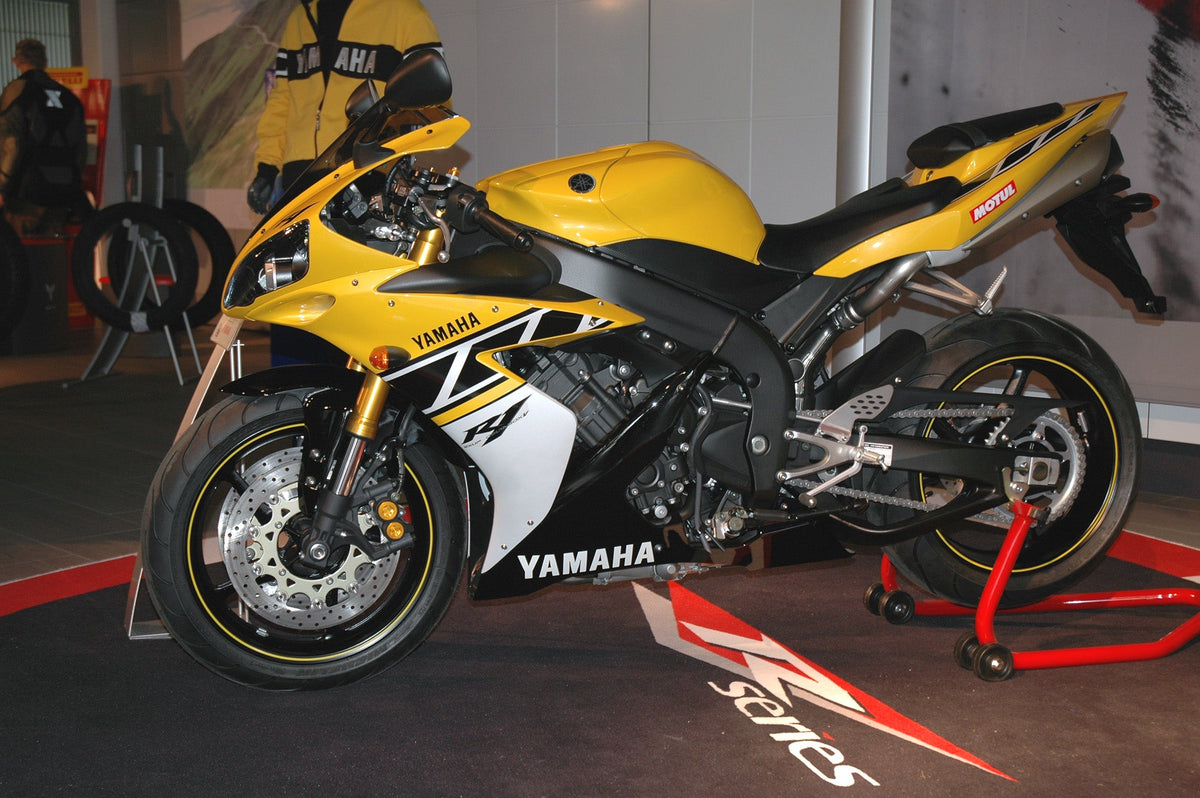
Cover: No machine-readable author provided. P Stalder~commonswiki assumed (based on copyright claims)., Wikimedia Commons · CC BY-SA 3.0. Display size may vary; photograph unchanged. Reference motorcycle, not a NiceFairings supplied-kit example.
“Yamaha anniversary fairings” can describe quite different visual references. Yellow-and-black speed blocks appear on documented company-anniversary R1 editions; the white-and-red World GP 60th design commemorates Yamaha’s Grand Prix racing history. Contemporary Racing Blue is a separate styling direction, not an anniversary specification. Before choosing a custom design, identify the exact motorcycle, model year and market behind the reference you like.
This distinction matters even when you are only borrowing the look. A yellow side graphic, a white-red speed-block band and a blue factory-style layout lead to different choices about the nose, badges and retained tank. A named reference gives the designer a clearer starting point than “the anniversary colors.”
Yamaha Anniversary Fairings: Timeline
A company anniversary and a racing anniversary count from different starting points. Model-year dates can also follow the actual anniversary year. The examples below distinguish those dates; they are not a complete list of Yamaha special editions or every market’s offerings.
2006 and 2016: Company Milestones in Yellow and Black
Yamaha’s 2005 announcement for the 2006 European YZF-R1 includes a Yamaha Motor 50th Anniversary model in a nostalgic yellow “Inter color” scheme. That is a specific period reference, not a universal name for every yellow R-series bike.
Yamaha Europe’s R1 limited-edition history identifies both the 2006 company 50th Anniversary R1 and the 2016 company 60th Anniversary R1 with yellow-black speed-block liveries. The years on those road models should not be confused with the founding-anniversary years themselves. Similar color families also do not make the two motorcycles’ body panels interchangeable.

2021–2022: World GP 60th in White and Red
Yamaha’s March 2021 racing announcement dates its World Grand Prix entry to 1961 and marks 2021 as the 60th anniversary. The commemorative YZR-M1 belonged to that racing celebration. Keep that event date separate from the subsequent road-bike model year.
The Yamaha Australia announcement for 2022 lists R1, R7 and R3 World GP 60th Anniversary models. Their visual reference uses white bodywork, red speed blocks and a yellow front race-plate motif. This is a different commemorative story from the yellow-black company editions.
The named models are those in that Australian announcement. Check the source for the reference bike’s own market. If you apply a World GP-inspired layout to a different model, describe it as an adaptation; a photograph of an R1 does not establish that an equivalent factory R6 edition existed.

Graphic Language
Once the reference is identified, look at what gives it character. Which color occupies the largest area? Where does the block band begin and end? Which small accent makes the nose distinctive? These observations make a design request more precise without pretending a screen image is a paint formula.
Yellow and Black Speed Blocks
In the yellow-black examples, a strong yellow field is interrupted by dark blocks and lighter separating areas. The speed-block rhythm is more important than covering every free surface with another logo. Compare the selected reference’s actual nose, side and tail: do not assume their stripe shapes are identical across model years.
For a reference-inspired project, start by describing those proportions and then agree the actual color and sheen separately. Black graphics need not mean a matte black finish. If historical accuracy is the objective, use the exact edition’s documentation and discuss the limits of the proposed reproduction; a generic “bright yellow” request is not an original finish specification.
White and Red with Yellow Nose Motif, and Contemporary Racing Blue
The white-red World GP reference changes the balance: white provides the main field, red carries the speed-block band, and the yellow nose motif creates a smaller focal area. Keeping that hierarchy visible can be more coherent than making every panel an equally loud red-and-yellow feature. That is a design interpretation, not a claim that one custom layout is an official factory scheme.
Contemporary blue is a different choice. Yamaha’s Australian 2022 release describes the standard R3’s Team Yamaha Blue with matt-blue and cyan accents. It does not give a universal blue formula for every R3, R6 or R1. Do not equate Racing Blue, Icon Blue, Team Yamaha Blue and a code such as DPBMC without checking the exact model and market documentation.
A blue photograph can establish the appearance you enjoy, but not the paint formulation needed to match an existing tank. If your main goal is a repair rather than a different look, our R3 replacement-panel color comparison addresses that separate decision.

Reference-Inspired or Adapted
Choose the purpose of the project before asking for a layout. The same inspiration photograph can support three different requests, and the supplier should know which you mean.
Three Intent Routes for a Build
Follow one identified reference. Choose the model, edition, model year and market you want the appearance to recall. Keep its main colors, graphic rhythm and badge choices together rather than combining unrelated references by accident. Ask what the proposed panels can reproduce and what will differ. This is a design target, not a promise of exact OEM restoration.
Adapt the heritage language. A rider may want the white-red speed-block idea on a motorcycle with different vents and panel breaks. Identify which elements should survive the adaptation—for example the broad white field, red band and small yellow nose accent—and which can change. Ask for a layout on the actual intended panel shapes, not a borrowed rendering of another model.
Choose a contemporary blue direction. If blue is the main attraction, an anniversary badge need not be part of the design. Name the blue reference and the contrasting areas you like, then plan them around the surfaces that stay on your bike. This route can stand on its own without a historical-edition claim.
What Custom Panels Do Not Claim
Custom graphics do not change a motorcycle’s factory identity. A yellow-black kit on a standard bike does not establish that it was built as a 50th Anniversary model. Keep the motorcycle’s original identification separate from the appearance you have chosen, including when describing a finished build to a later buyer.
Agree the intended result and any limitations before production. Differences in graphic placement, finish or emblem size are not automatically acceptable merely because a project is custom. Compare the proposal with the agreed reference and resolve discrepancies. Likewise, no fixed millimeter allowance can be inferred from a photograph or from the words “aftermarket fairings.”
For graphics that cross separate panels, the guide to seams and viewing angles explains how to compare equivalent views. Here, the task is to choose the reference first; seam review cannot resolve a brief that mixes two different editions without saying so.
Yamaha Anniversary Fairings Reference Card
Source, Model, Year, Market, and Design Intent
Use one primary reference and add the other views needed to understand it. Record the source URL and what it actually documents. A front photo can clarify the nose but may not show the side-band design. Avoid filling the unseen side by mirroring a picture without checking the real layout.
Write the reference identity separately from your own bike: for example, “reference: 2006 European R1 50th Anniversary; recipient motorcycle: [my exact model/year/market].” If they differ, make the adaptation explicit. This keeps a styling choice from being mistaken for a parts-compatibility claim.
Record the dominant color, secondary graphic color and small accents, then list the finish and emblem choices separately. Identify whether anniversary wording should be kept, omitted or replaced by an original graphic. Do not use an edition name as a substitute for those decisions.
Retained Pieces and Itemized Order
List the painted and visible pieces that will actually remain on your motorcycle, including any retained tank surface, wheels or trim. A retained blue tank may call for a different transition than the yellow tank in an inspiration photo. Decide that relationship deliberately; do not assume an outer-fairing order includes a fuel tank, tank cover or refinishing work.
Historical photographs show a complete motorcycle, not a fairing-package inventory. Gold-colored wheels or forks visible on a reference bike should not be inferred as supplied kit contents. Ask for the actual itemized order rather than budgeting from everything visible in the photo.
Use the supplier’s confirmed panel list, with individual pieces identified where needed. A generic six-piece checklist can omit inner pieces or divide a motorcycle differently from the offered set. Mark what is supplied, reused, separately needed or still unconfirmed. No cover removal or installation is necessary to choose a styling reference.
A concise request can read: “I want a [reference-inspired/adapted] design using [documented edition, year, market and source]. My motorcycle is [exact identity]. Keep [visual elements], change [elements], and coordinate with [retained surfaces]. Please show the layout for the proposed panel set, identify the included pieces and finish, and explain any limits before production.”
Start with Yamaha fairing options, then use the custom fairing enquiry to discuss the selected reference and actual motorcycle. Confirm feasibility and order scope before approval. A clear historical reference gives the design character; a clear parts list makes the request usable.
FAQ
What is the difference between a company anniversary and a World GP anniversary?
A company anniversary marks Yamaha Motor milestones. The 2006 R1 and 2016 R1 use yellow-black speed blocks for the 50th and 60th years. A World GP anniversary marks racing history. The 2022 R1, R7, and R3 WorldGP60 use white and red for 60 years of Grand Prix racing.
Does a yellow and black fairing kit make my bike a real 50th anniversary model?
No. Custom panels are a visual layer. They do not change your bike's VIN, production records, or official status. You can build a faithful tribute, but you should never describe it as a genuine factory special edition.
Which reference should I pick for a WorldGP60 build?
Start with one official Yamaha photo of the real bike. Note the model, year, and market. The 2022 WorldGP60 scheme uses white bodywork, red speed blocks, and a yellow front race-plate motif. The Australian release lists the R1, R7, and R3, so check your own market.
Are the special wheels and forks in anniversary photos part of the kit?
Do not infer wheels, forks or other equipment from a whole-bike inspiration photo. Request an itemized list for the actual order, including any tank-area covers and pieces to be reused. The supplied scope depends on the listing, not the historical photograph.


