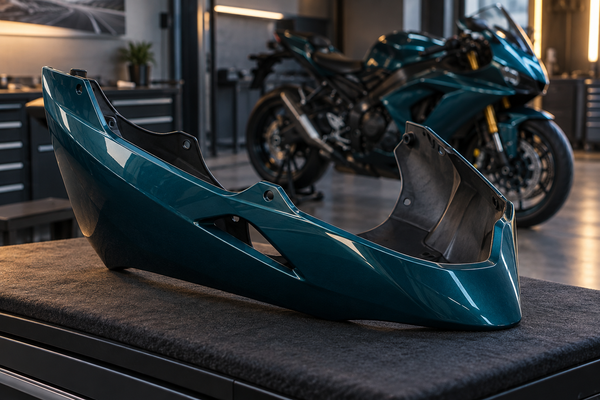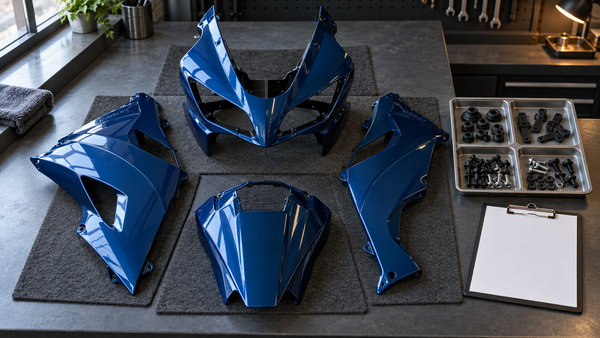
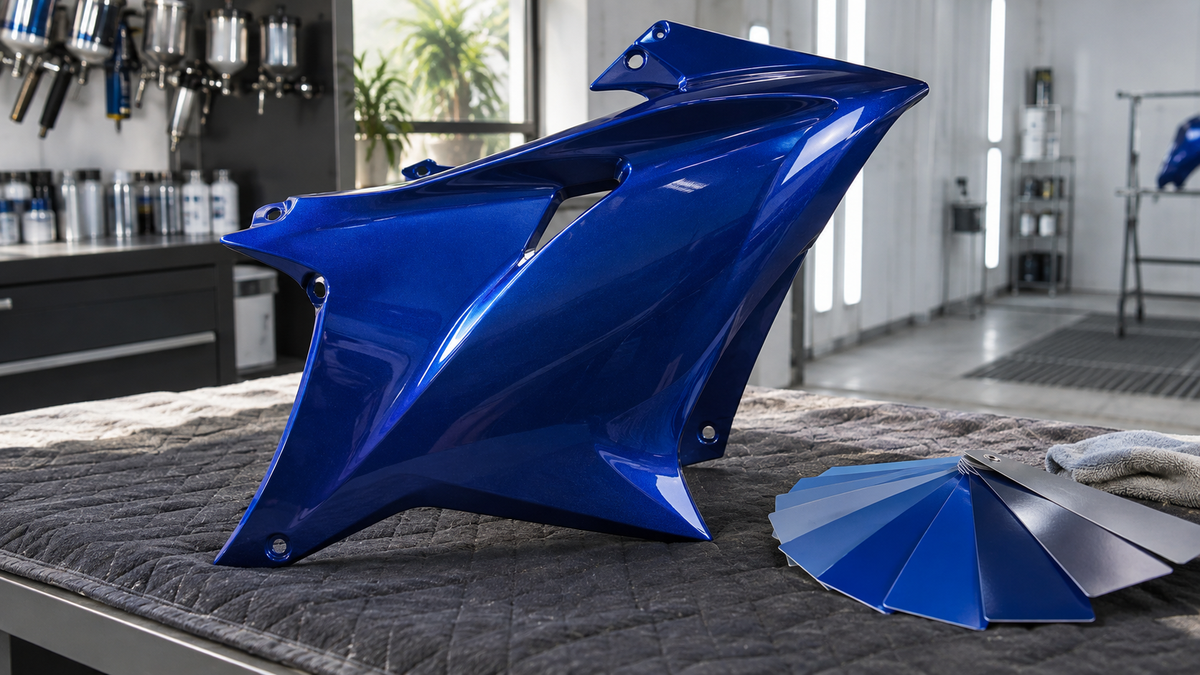
You drop your YZF-R3 in a parking lot and damage a side panel. After checking that the motorcycle is safe and the damage has been professionally assessed where needed, your next concern may be appearance: will the replacement match? Yamaha R3 replacement fairing panel color matching involves more than selecting a blue, black or white listing. New paint can look different beside the panels you retain. You have three routes: an OEM replacement, professional refinishing, or a coordinated fairing kit. This guide compares their practical trade-offs without assuming that any route guarantees an invisible repair.
Key Takeaways
A paint code does not guarantee a perfect color match.
Sun exposure, care and earlier refinishing can affect the appearance of existing paint.
An exact-application OEM panel offers a factory replacement route, but color and installation still need checking.
Professional refinishing can be assessed against your current paint rather than a screen image alone.
A coordinated kit offers a new design across its included panels; inspect their consistency and identify retained parts.
Always confirm your exact model year and market before ordering.
Ask if decals are included or sold separately.
Check the return policy in case the color looks wrong.
The Core Challenge of Yamaha R3 Replacement Fairing Panel Color Matching
The paint code is a starting point, not proof of an exact visual match. An earlier refinish, the condition of adjacent panels and the particular finish can complicate the comparison. Before ordering, separate two questions: is this the correct physical panel, and is its appearance acceptable beside the bodywork that will remain? A satisfactory answer to one does not answer the other.
Paint Fade and UV Exposure
Do not decide from the bike's age alone. A regularly garaged motorcycle and one exposed to the weather may present differently, and previous owners may have changed individual panels. There is no useful universal rule that every R3 changes shade after two years, or that one paint color always ages faster than another. Examine the actual finish and ask about its history.
List every visible painted piece you plan to retain, including relevant tank-area covers, the tail and neighboring fairing sections. Do not assume that the metal fuel tank is the largest exposed painted part or that a kit replaces every cover around it. The exact model and the seller's itemized package determine which surfaces remain in the finished design.
Lighting, Angle, and the Limits of Photos
Lighting changes the comparison. For a professional reference, PPG's color-identification procedure calls for evaluating color with suitable sunlight or color-matching lighting and checking whether the area has been refinished. A single garage photograph does not represent all viewing conditions.
Viewing angle also matters, particularly with effect finishes. Compare the same area from more than one angle rather than judging only a straight-on photograph. Ask a refinisher how they will evaluate the sample against the retained bodywork. Photos can document a concern, but they are not a substitute for agreeing on an acceptable match in person when close matching matters.
When you shop for r3 fairings online, understand that product images are references, not guarantees. The seller's camera and lighting differ from your driveway. The color on your screen may not match the delivered item. Always verify with the supplier. Ask about return policies. Request confirmation that the r3 fairings fit your model year and market.
A physical comparison under appropriate lighting is more useful than screen color alone. Until the actual parts can be compared, uncertainty remains. Use the supplier's written specification and acceptance process alongside the visual check; a photo that looks convincing should not override an incorrect part number or unclear model-year application.

Verify Before You Buy: Model Year, Market, and Part Numbers
Before ordering replacement bodywork, confirm your exact motorcycle, model year, market and existing configuration. A familiar color name does not establish the same paint, decals or physical application across years. Do not infer interchangeability from photographs or from two listings sharing the words YZF-R3. Compare the relevant parts information and obtain application confirmation for the exact item.
Confirming Model Year and Market Specifics
Record the full VIN and the model details from the motorcycle's documentation. Ask an authorized dealer to confirm the model-year and market application rather than relying on a generic VIN-decoding shortcut. Registration year and model year are not always interchangeable, and the documentation does not establish whether a previous owner has repainted or converted the bodywork.
Market matters. Yamaha's US parts catalog is explicitly for US-market models and asks buyers to reconfirm the model, year and part numbers with a dealer. Use information for your own market rather than assuming a US listing covers an imported motorcycle.
You should also note your bike's current condition. If a previous owner repainted any panels, the factory color code no longer tells the full story. You need to assess the actual paint on your fuel tank and remaining bodywork. This assessment guides your choice between new r3 fairings and a professional refinish.
For a 2025 R3, or any other year, ask for an explicit application statement. A phrase such as 'R3 style' identifies an appearance, not necessarily a part that fits your motorcycle. Keep the seller's confirmation with your order and disclose any non-original brackets, lights or existing bodywork that could affect installation.
Decals vs. Painted Panels: What's Included?
Check the itemized listing for the painted panel, decals, emblems and other pieces that complete the appearance. They may be separate items or included assemblies; do not assume either arrangement. Ask whether graphics arrive installed, loose for application, or excluded. Confirm the exact left or right side and the visible finish of the part you are ordering.
If a diagram lists a decal separately, ask whether it is needed and available for your selected replacement. Do not automatically add every nearby item in a parts diagram. A written list avoids paying twice for included components and helps identify what must be sourced before work begins.
For an aftermarket kit, confirm the supplied graphic layout and whether application is included. Decide whether you want continuity with the original scheme or an intentional new design. A color name alone does not describe stripe placement, logo treatment, finish or the way the graphics meet neighboring panels. Ask for the actual design specification, not an unrelated example.
Forum photographs can help you form questions, but they are not an ordering specification. Cross-check suggested numbers against the appropriate catalog and supplier. If a number has been superseded or an older item is unavailable, ask what replacement is actually offered and whether its appearance differs. Do not assume a substitute is identical.
A VIN helps a dealer identify the motorcycle's original specification, not the current color of a repainted panel. Combine that lookup with a physical inspection and any paint records the previous owner has. Keep the original configuration and present appearance separate in your notes so neither a dealer nor a painter is asked to guarantee a match from incomplete information.

Route One: The Genuine OEM Panel for a Yamaha R3 Fairing Replacement
A genuine replacement is worth considering when you want to retain the factory appearance and the exact part is available. Confirm the complete part number, its applicable finish and the package contents. An OEM label does not remove the need to inspect existing mounts for damage or compare a new painted surface with retained bodywork.
The Benefits of Factory Precision
The OEM route gives you a defined factory part to investigate. Verify the side, model application and finish with the dealer before comparing prices with other R3 fairing options. A product photo or an informal description is not enough to distinguish nearby versions.
Use this verification checklist instead of assuming universal manufacturing tolerances. Neither an OEM nor aftermarket description proves a numerical fit tolerance for the item in front of you.
Aspect |
OEM Panels |
Premium Aftermarket Fairings |
|---|---|---|
Application evidence |
Dealer-confirmed part number for the exact motorcycle |
Supplier-confirmed application for the exact kit or panel |
Finish and included parts |
Confirm paint specification, decals and assembly contents |
Confirm material, finish, graphics and itemized contents |
Before installation, compare the replacement with the removed part and check the mounting arrangement according to the relevant instructions. If an attachment does not align, stop and investigate the part identity, assembly order and existing supports. Do not pull a panel into place with bolts, drill it, or trim it merely because an online description promised a direct fit.
Installation effort depends on access, the assembly being replaced and the condition of the motorcycle. Plan tools and replacement fasteners from the applicable instructions, not from a general claim that OEM work needs no special tools. Damage beneath a cosmetic panel can change the scope; a qualified mechanic should assess concerns before appearance becomes the priority.
The Hidden Cost of 'New' Paint
New paint can contrast with retained paint, but that is a possibility rather than an inevitable result. Inspect the neighboring parts before ordering and discuss what happens if the supplied finish is noticeably different. Do not assume that every older panel is faded, or that every newly supplied panel will look brighter.
Compare written quotes for the same scope. Include decals, needed hardware, shipping and installation where applicable. A single OEM panel, a repaired and refinished panel, and an entire kit are different purchases, so a universal cheapest-to-most-expensive ranking would be misleading. Choose based on the pieces you actually need and the finish you can accept.
If you choose an OEM replacement, confirm the part number and whether the quoted assembly includes the painted panel, decals and any required attachments. Keep those answers with your order. Do not assume the word 'assembly' includes every component shown nearby in the diagram.
For a 2025 r3 fairings purchase, check the parts fiche for your exact model year. The 2025 r3 fairings may use different color suffixes than earlier years. Your dealer can confirm the right part for your bike.
The trade-off is a defined factory replacement specification versus the uncertainty of how it will look beside retained paint. Inspect both fit and appearance. If keeping the original scheme matters more than changing the whole motorcycle's look, start by checking the exact OEM replacement before committing to a larger project.
Route Two: Professional Refinishing for a Custom Match
Professional refinishing offers another route, provided the panel is suitable for repair or reuse. Have cracks, mounting damage and the underlying motorcycle assessed first; paint cannot make an unsafe or unsuitable panel serviceable. A refinisher can then explain preparation, repair limits and the realistic appearance they can achieve against the retained bodywork.
The Art of Blending and Color Matching
Color formulation and blending are related but different tasks. Formulation selects or adjusts the paint mixture; blending concerns how the finish transitions into an agreed repair area. Ask the shop which surrounding surfaces would be involved and what preparation is required. Do not assume that repainting only one isolated panel will make its edge disappear beside every neighboring finish.
A spray-out sample provides a practical checkpoint before the final work. PPG explains using spray-out cards to evaluate a blendable match, including viewing the dried finish from different angles. Let the refinisher follow the paint system's procedure rather than improvising a tint or clear-coat recipe.
Ask whether the shop needs the motorcycle, a removable reference panel, or both. Give them access to the actual adjacent finish when possible, not just a phone photograph. Agree how the comparison will be made, what surfaces are included and when you will review the result. This is especially important if the motorcycle already has custom paint.
The painter's experience matters, but an invisible result should not be promised in advance. Ask for relevant examples and a clear explanation of limitations. Discuss what happens if the sample is not acceptable before the full repair proceeds. A realistic agreement about color, gloss and repair scope is more useful than a general guarantee of perfection.

Downtime, Cost, and the Customization Opportunity
Obtain a written estimate that separates panel preparation, any approved repair, paint, graphics and installation. Ask when the bike or reference part is needed, the expected completion window and any curing or care restrictions. Do not assume the job takes a fixed number of days or that it always costs more than a replacement panel.
Compare the quote against the other routes using the same end result. A price for spraying a loose panel is not equivalent to a price including removal, repairs, decals and refitting. Ask what could change the estimate after inspection. Keep a reserve for genuinely identified additional work rather than treating a rough online price as a final budget.
This route opens a customization door. While the painter works on your panel, you can request changes. A matte clear coat changes the entire character of your yzf-r3. A slightly darker shade of your factory color gives a subtle custom look. You might add a racing stripe or accent color that the factory never offered.
For a custom finish, keep the approved color information, sample and refinisher's records where available. A later repair may require matching that actual finish rather than using a factory color code alone. Ask the shop what documentation it can supply for future reference.
Consider your long-term plans without assuming that one finish guarantees resale value. Buyers have different preferences, and documentation of the work may matter more than a broad 'custom versus factory' claim. Keep invoices, the paint formula when available, design approvals and care instructions so a later repair or sale is easier to explain.
Refinishing is worth assessing when the panel is suitable for continued use and you want to retain the existing scheme. Ask about the proposed repair area and neighboring surfaces. It can avoid replacing otherwise serviceable panels, but the decision still depends on repairability, the quoted scope and the finish the shop can realistically achieve.
Route Three: The Coordinated R3 Fairings Kit
A coordinated kit is worth considering when several panels need replacement or you want a different design. Start with its itemized contents. 'Full kit' does not automatically mean every visible body part, tank-area cover, decal, light or fastener is included. Compare the supplied pieces with what you intend to retain before judging the overall value.
The Appeal of a Complete Set
The appeal is a planned design across several new panels, not a guarantee that every delivered piece will match perfectly. Inspect color, gloss and graphic alignment across the set before altering or installing anything. If the design is custom, keep the approved specification and identify which retained panels it was intended to coordinate with.
A kit can support a coordinated appearance change. You might choose a different color arrangement, gloss level or graphic treatment from the existing bodywork. Discuss the custom fairing design options against the actual supplied panels and retained pieces before approving an order.
Installing a kit involves more components than replacing one isolated panel, but the actual work depends on its contents and the motorcycle. Follow model-specific instructions, check the underlying supports and arrange professional help if necessary. Do not assume an afternoon is enough or that the advertised mounting pattern eliminates all fit checks.
Plan for Retained Tank-Area Panels
Identify the tank-area panels and every other painted piece outside the kit. Their appearance remains part of the finished motorcycle. A seller may supply a matching cover for a particular application, but that needs explicit verification. Do not assume a universal cover slips over the tank or that the kit replaces all the existing surfaces you see.
Possible design approaches include coordinating with retained paint, selecting an intentional contrast, or having suitable retained panels professionally refinished. Confirm feasibility and costs first. Any work involving removal or refinishing of fuel-system components requires appropriate professional handling; this color-selection guide is not an instruction to remove or paint a fuel tank.
A full kit does not always include tank treatment, decals, hardware, or lights. You must check what your chosen aftermarket motorcycle fairings package includes before you order.
Ask the seller to identify precisely which tank-area pieces are supplied and which stay on the motorcycle. Have them explain the intended visual relationship rather than just saying that the kit is blue or factory-inspired. A marked-up reference image or itemized order can help prevent assumptions about an optional cover or decal.
For a 2025 r3 fairings buy, make sure the kit fits your exact model year and market. The mounting points can differ between years. The graphic layout should line up with your bike's original design if you want a factory look. Custom fit fairings need exact confirmation of your yzf-r3's details.
This route suits a planned appearance change or a repair involving multiple panels. Compare the complete supplied set, retained pieces and required installation work before ordering. Inspect the actual delivered finish as a set. A coherent design is the goal; replacing more panels is not by itself proof that every visual mismatch has been solved.
Compare the kit against a single replacement and a refinishing quote for your actual situation. A low per-piece figure is not necessarily a saving when most of those pieces are unnecessary. Conversely, several separate replacements can change the calculation. Include the required extras and installation, then decide which complete scope is useful to you.

Making the Final Call: Supplier Questions and the Decision Matrix
You now understand the three paths for your yamaha r3 replacement fairing panel color matching challenge. Each route serves a different purpose. Your decision depends on your bike's condition, your budget, and your tolerance for imperfection. This section helps you compare the options side by side and ask the right questions before you spend money.
Comparing the Three Routes
This table compares what you need to verify, not fixed prices or guaranteed outcomes. Obtain current written quotes for equivalent scope before choosing. Availability, existing damage, graphics and installation requirements can change the result for your particular motorcycle.
Route |
Quote scope |
Color Accuracy |
Installation Effort |
|---|---|---|---|
OEM Panel |
Exact panel, finish, decals and fitting |
Compare new finish against retained paint |
Verify application and existing mounts |
Professional Refinish |
Preparation, assessed repair, paint and refitting |
Agree a sample and achievable match |
Confirm shop access and completion window |
Included panels, optional pieces and fitting |
Inspect the set and retained panels together |
Plan work around actual kit contents |
The OEM route can keep the project limited to a particular replacement assembly. Verify what is supplied and what additional items are needed. Its attraction is not a promise that it is always cheaper or quicker; it is the ability to investigate a defined factory part for the motorcycle's original specification.
Professional refinishing focuses on the existing appearance and an agreed repair area. It makes sense to obtain an assessment when a sound panel can be retained and close color continuity is important. The quote should explain the achievable match, any repair limits and the time the motorcycle or reference parts will be unavailable.
A kit addresses a broader set of panels or a different design. Before buying it to avoid a small color discrepancy, consider whether that larger scope is actually wanted. Include retained covers in the decision, inspect every supplied panel on arrival and resolve any mismatch through the seller's process before modifications affect your options.
Critical Questions for Any Supplier
Before you order anything, ask direct questions. A reputable supplier expects these inquiries. Their answers reveal whether they understand your yzf-r3's specific needs.
"Can you confirm this part fits my exact model year and market?"
Provide the exact model, year, market and relevant modifications. Ask which part number or listing variant the confirmation covers and whether any additional brackets or pieces are required. A reply saying only 'R3 compatible' leaves too much unresolved. Keep written confirmation with the order, and ask an authorized dealer about uncertain original-part applications.
"Is the decal included or sold separately?"
Ask whether each decal is included, pre-applied, supplied separately or excluded. Confirm its layout and finish, particularly when a stripe continues onto an original adjacent panel. Do not assume that OEM means decals excluded or aftermarket means decals included. Both the contents and the installation arrangement need checking for the actual order.
"What is your return policy if the color is visibly wrong?"
Color matching involves inherent uncertainty. Lighting conditions, screen calibration, and paint fade all affect perception. A supplier who stands behind their product offers a reasonable return policy. Ask about restocking fees and who pays return shipping. Get the policy in writing. This protection matters when you cannot inspect the part in person before purchase.
"Does your kit include tank treatment, decals, hardware, and lights?"
Request an itemized package list rather than relying on the phrase 'complete kit'. Identify painted pieces, tank-area covers, graphics, hardware and lighting individually. Mark what is included, what must be reused and what requires a separate purchase. This is also a useful way to compare two quotes that initially appear similar.
"Can you show me photos of this color on an actual yzf-r3?"
Product images serve as references, not guarantees. Ask for real customer photos if available. These images show how the color looks in natural conditions. Remember that screen calibration affects what you see. Use photos as a starting point, not final proof.
Matching Your Rider Profile to the Right Route
Your personal priorities determine the best choice. Consider which profile matches your situation.
The Perfectionist: Choose Professional Refinishing
If small color differences would bother you, start with a professional assessment and sample comparison. Explain the level of continuity you want, including gloss and graphics. Accept that some finishes or existing conditions may limit the result. Choose refinishing only after the shop has explained those limits and you have agreed on scope and acceptance.
The Pragmatist: Investigate an Exact OEM Replacement
If the original appearance is still satisfactory and only one area needs replacement, ask a dealer about the exact OEM panel. Judge the current finish rather than assuming a motorcycle under two years old cannot have changed. Confirm availability, decals and mounting requirements, then compare the full quote against an assessed refinishing option.
The Customizer: Plan a Kit Around Retained Panels
If you want a different look, evaluate a coordinated kit and decide how the retained painted parts will work with it. A deliberate contrast may be preferable to trying to imitate an existing shade. Confirm the actual included parts and budget for any agreed professional refinishing or installation. Approve the design details before a custom order proceeds.
Appearance and fitment are separate decisions. A beautiful finish does not prove physical compatibility, while a correctly identified part does not promise a perfect color match. Verify both. The best route is the one that meets your actual repair scope and design priorities with documented application, realistic finish expectations and a clear way to resolve problems.
Take time to inspect your bike in suitable light and record which panels will remain. Gather exact part information and comparable quotes. If the underlying damage is uncertain, arrange a mechanical assessment first. That preparation helps you choose an appearance route without treating a cosmetic repair as proof that the whole motorcycle is ready to ride.
Your choice involves a trade-off: investigate the original replacement specification, have the current finish professionally assessed, or plan a coordinated kit around the pieces you retain. None automatically guarantees perfect fit, an invisible match or the lowest final bill.
Verification matters most. Confirm the exact part number, model year, and whether decals sell separately. This step prevents costly mistakes.
Compare the actual retained paint, not a color name on a screen. Decide what level of difference you would accept and discuss it before buying a finished panel or approving a refinishing job.
Contact the appropriate dealer, seller or refinisher with the exact application and your appearance goals. Obtain confirmation of availability, scope and acceptance terms for the specific item or work, rather than relying on a generic promise.
FAQ
Why does my Yamaha R3 paint code not guarantee a perfect color match?
The code identifies a starting specification, not a measurement of your current finish. Existing wear, previous refinishing and variation in appearance can affect the comparison. Check the new part against the painted surfaces you will retain and discuss the limits of matching before placing the order.
Can I match a new panel to my faded tank without professional help?
You can document the difference and compare physical samples under suitable lighting, but a photograph or an eye check does not create a guaranteed paint formula. A refinisher can assess options and sample the finish. Ask what match is realistically achievable and which adjacent parts are needed for reference.
What questions should I ask before ordering aftermarket fairings?
Ask the seller to confirm your exact model year and market. Ask if decals come with the part or separate. Ask about their return policy if the color looks wrong. Ask what the kit includes beyond the plastic panels. Get answers in writing before you pay.
Does a full fairing kit include tank treatment, decals, and hardware?
Not necessarily. The wording 'full kit' is not an itemized package specification. Confirm painted panels, tank-area covers, decals, hardware and lights individually, including what must be reused or bought separately. Do not assume that everything visible on the motorcycle is part of the order.
How can I tell if my R3's paint has faded noticeably?
Review the paint history and inspect the same painted area under suitable lighting. A hidden surface on a different component may have had a different finish originally, so that comparison alone does not prove fading. If the difference matters to a repair, ask a refinisher to assess the actual adjacent surfaces.
What should I do if the replacement panel color looks wrong when it arrives?
Do not install the panel. Contact the seller right away with photos of the part next to your bike in natural light. Give them your order number and the details you got about model year and color. Ask about their return or exchange process before you change the part in any way.
Should I replace all panels at once to avoid color mismatch issues?
Not automatically. A kit may provide a coordinated new design, but its included panels and the pieces you retain still need to be considered together. Inspect the delivered set before altering it. Replacing serviceable panels only to avoid a minor mismatch may expand the project unnecessarily; compare the alternatives first.
Can a professional painter match paint on a bike with custom or refinished panels?
A refinisher can assess a custom finish, but not every appearance can be reproduced invisibly. Provide previous paint records and access to the actual reference surface when available. Ask for a sample, discuss limitations and agree on the repair area before approving the complete job.