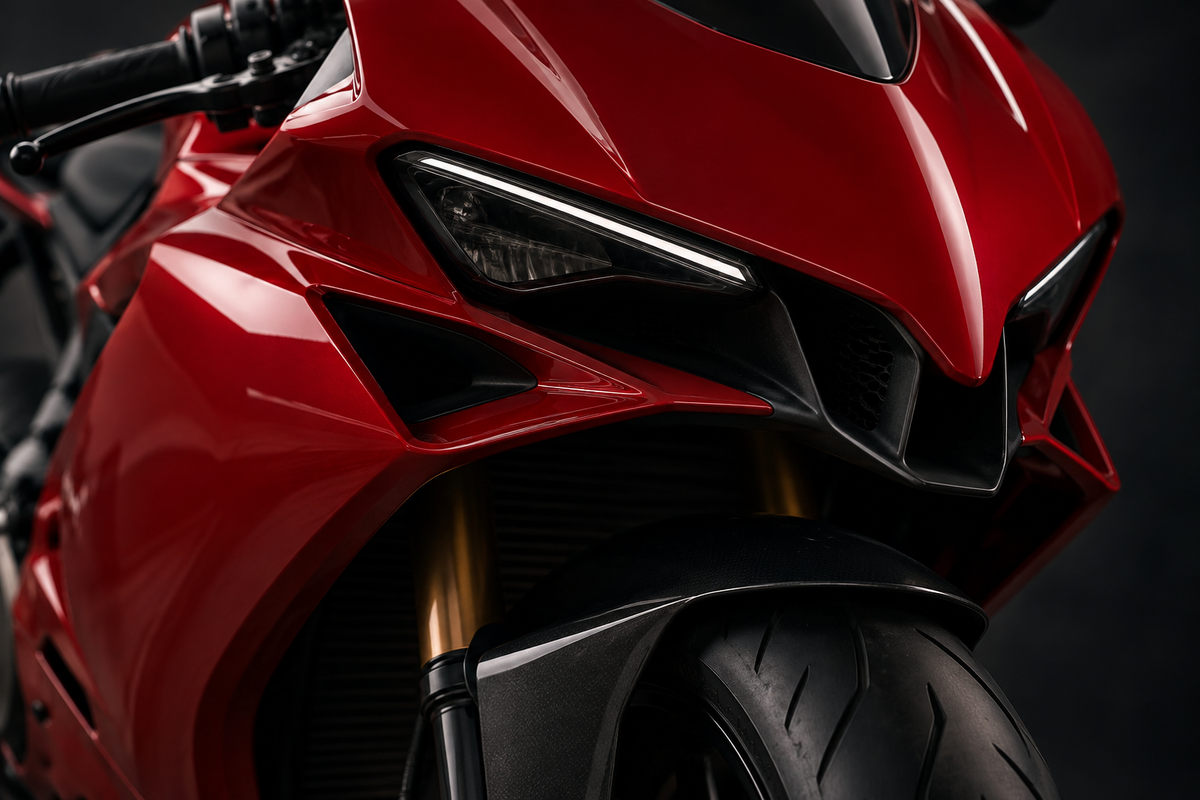
Ducati Panigale V4 replacement fairings can change your motorcycle’s appearance, but appearance alone cannot tell you how the replacement configuration behaves aerodynamically. A matte finish, custom paint scheme or wing-shaped feature is not evidence of a particular downforce or cooling result. Equally, missing test data does not prove that a panel has no aerodynamic effect. This guide separates three purchasing questions: what the panels look like, whether the complete installation suits your motorcycle, and what evidence supports any performance claim. An OEM claim for a specified factory motorcycle does not automatically carry over to an aftermarket kit.
Key Takeaways
-
Factory aerodynamic figures refer to a defined motorcycle configuration and test context, not automatically to every visually similar replacement panel.
-
Aftermarket bodywork can affect airflow. Without relevant evidence, the direction and size of that effect remain unverified.
-
Ask sellers for material details, fitment confirmation, and aerodynamics test data before buying.
-
Separate your styling goal from performance claims, and have the complete replacement configuration assessed for its intended use.
OEM Aerodynamic Engineering
Winglets and Wind-Tunnel Testing
Ducati’s 2025 Panigale V4 introduction describes integrated aerodynamic design, including the fairing, front wings and cooling-related shapes. That is a description of a particular factory motorcycle, not a certification of other bodywork. When comparing a replacement listing, first identify which factory generation and configuration a quoted claim describes. Then ask whether the seller is citing that OEM statement merely as background or providing evidence for the replacement setup itself.
A useful test report identifies what was tested. Ask about the motorcycle, bodywork version, winglets, relevant retained parts and test conditions. Wind-tunnel measurements and computational fluid dynamics, or CFD, can help support a defined claim, but a colorful airflow graphic alone is not a complete report. Check the baseline used for comparison and whether the result actually concerns the product you intend to buy. You cannot infer a replacement panel’s drag or downforce simply by borrowing the factory motorcycle’s published figures.

Materials, Ducts, and Cooling Integration
Cooling-related bodywork deserves its own check. Identify the ducts, openings, shields and adjoining components relevant to the exact model year and variant. A picture of an exterior opening may not show its internal path or connections. Ask which components are retained, replaced or supplied separately. This article does not establish universal duct angles, clearances or temperature limits; use applicable manufacturer instructions and qualified installation advice for the actual motorcycle.
An aftermarket part may preserve a relevant interface, change it or require additional components. None of those possibilities should be decided from its paint scheme. Ask for clear inside and outside views, an installation document and an explanation of the intended interfaces. Matching external appearance does not establish equivalent cooling behavior, but lack of a test report does not prove worse cooling either. Treat an unresolved compatibility or performance question as unresolved. Do not block openings, improvise missing duct connections or conduct high-speed experiments to settle it yourself.
Ducati Panigale V4 Replacement Fairings: Typical Offerings
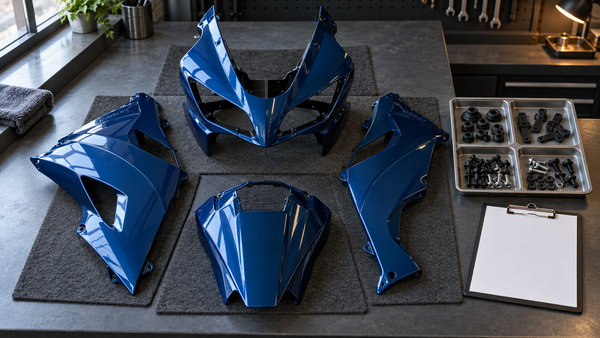
Replacement listings may offer individual panels or sets, painted finishes, unpainted bodywork and different base materials. There is no universal Panigale V4 kit inventory. A photograph might show a front fairing, sides, tail or fender without establishing that every pictured item is included. Winglets, internal ducts and hardware need separate confirmation. Start with the stated application and actual contents, then compare the styling options. A supplier’s fitment claim is information to verify for your setup, not a guarantee inferred from the word Panigale.
Appearance and Function: Materials and Design
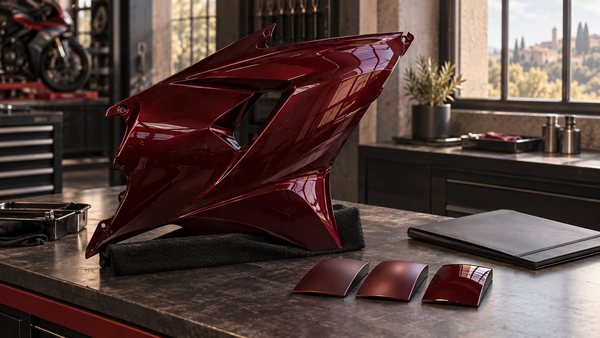
A replacement panel’s base material and its finish are separate specifications. A listing may describe ABS plastic, fiberglass-reinforced material, carbon-fiber composite or a carbon-look finish; confirm which description applies to the exact product. ABS here refers to a plastic material, not a brand endorsement. A visible weave pattern does not prove carbon-fiber construction. Ask what the substrate is and whether the pictured finish belongs to the selected option. Material choice alone does not establish weight, impact behavior, heat suitability or aerodynamic performance for a completed panel.
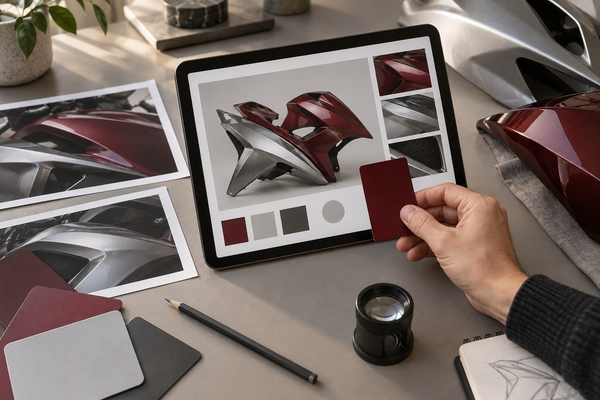
Design details also differ between listings. Some resemble the factory exterior; others visibly change openings, surfaces or projecting features. Similarity is useful for discussing appearance, not for establishing aerodynamic equivalence. Ask whether the geometry and mounting arrangement are intended for your exact application and what instructions support that statement. Keep an unresolved performance claim separate from a documented color or finish choice. A style-led purchase still requires a suitable, securely installed complete assembly.

Aero Testing and Validation: What Evidence Exists?
Every buyer faces a key question. Does the replacement kit have any aerodynamic validation? The answer depends on the seller. Some suppliers share test data for their panels. Others give no aerodynamic documents at all. You should not think that a winglet shape on an aftermarket panel gives the same effect as the factory part. The OEM claim belongs to the complete motorcycle. That claim does not carry over to a separate kit. Any performance claim for a replacement package needs proof for that exact setup.
Ask for the evidence behind the specific claim: for example a relevant wind-tunnel report, CFD analysis with its assumptions, or a properly documented comparison. Check the exact bodywork configuration, baseline, conditions and limitations. A test on another setup may provide background, but it does not automatically validate yours. Missing evidence means the advertised benefit is unverified; it does not mean the part is aerodynamically inactive. A custom paint choice can be evaluated on its own merits without treating it as a performance upgrade.
Performance and Safety Considerations
Aerodynamic Differences from OEM
A replacement panel can look close to the original in a product image while leaving important questions unanswered. Which ducts, wings, brackets and adjacent components form the installed package? Does the report or application statement cover that combination? Small visible differences are a reason to ask for clarification, not enough information to calculate a performance change. Likewise, identical-looking surfaces do not prove identical results. Separate what the listing documents from what you are inferring, and have unresolved technical questions checked before ordering or riding.
You should not assume the factory downforce or drag figures apply to your new panels. Those numbers belong to the complete motorcycle. They do not transfer to a separate kit. A seller may claim the winglets add stability. That claim needs evidence for your exact setup. Ask for wind-tunnel data or CFD reports that cover your model year and variant. Without that proof, treat the aero claim as unproven. The visual match does not prove a working match.
Secure fit and correct installation matter for both road and track use. Neither setting makes loose hardware, unsupported projecting parts or uncertain clearances acceptable. Have the installer follow the applicable instructions and inspect the completed assembly. Aesthetic panel-gap preferences are different from safety-critical mounting and clearance requirements. If there is unexplained movement, interference or a missing required component, resolve it before riding rather than using speed to test whether it is acceptable.

When Replacement Fairings Are Appropriate
Ducati Panigale V4 replacement fairings can serve several goals: replacing damaged cosmetic panels, changing a paint scheme or preparing a separately specified bodywork set for an intended use. Those goals do not establish suitability on their own. Identify the application, included parts, mounting requirements and any road or event restrictions before choosing a kit. For a broader purchasing checklist, see the fairing kit contents guide.
If preserving a known factory configuration is your priority, discuss the appropriate genuine replacement parts and installation with a qualified Ducati dealer or specialist. Do not keep damaged OEM bodywork simply because it is original. An aftermarket setup with relevant documentation can be assessed on that evidence; one without it should not be sold to yourself as a proven equivalent. The correct decision depends on the actual damage, product, supporting information and intended use, not a universal rule that OEM is functional and aftermarket is only decorative.
For track use, check the specific organizer’s current requirements and the complete bodywork application; a material label does not establish compliance or repairability in every situation. For road use, confirm the required equipment and suitable installation for your motorcycle and location. This is a purchasing guide, not a homologation or technical inspection. A painted ABS option and a fiberglass option should each be assessed using their actual specification rather than assumed performance tradeoffs.
Buyer’s Guide: Evidence vs. Hype
Photos vs. Documented Material
An actual product photo can help you review visible shape, color and finish, subject to lighting and display differences. A stock photograph, render or AI illustration might only communicate a concept. Neither category proves the unseen substrate, strength, weight or fitment. Ask which images show the actual offered item and request other views where an important interface is hidden. The illustrations in this guide are clearly labeled editorial concepts, not photographs or tests of Panigale V4 products.
A written material specification is more specific than a surface impression, but check who issued it and which product it covers. A raw-material data sheet does not automatically certify a finished panel, its thickness everywhere or its installed behavior. Request the available product-specific details and note what remains unknown. The table below distinguishes useful evidence from conclusions it does not establish by itself.
|
Evidence Type |
What It Shows |
What It Cannot Show |
|---|---|---|
|
Product photo |
Visible appearance, if the actual item is shown |
Base material, strength, fitment |
|
Material spec sheet |
Stated specification for the identified item |
Aero performance, fitment |
|
Fitment list |
Supplier-stated application |
Aero performance, material |
|
Aero report |
Reported setup, method and result |
Untested configurations or conditions |

Key Questions to Ask Before Ordering
Begin with the exact model year, variant and current configuration. Do not assume that the V4, V4 S and SP2 names either guarantee or rule out shared parts; obtain a product-specific application statement. Tell the supplier about relevant changes such as bodywork conversions or a non-standard exhaust. A change may affect the questions an installer needs to check, but this guide does not provide an interchangeability chart or clearance specification.
Next, check the listed contents against what you keep. Does the kit include the front fairing, side panels, tail, and fender? Does it include winglet pieces or duct covers? You may need to reuse your OEM ducts, winglets, or fasteners. Ask for a full hardware list. Confirm whether the kit uses stock mounting points or needs new brackets.
Finally, ask about any aerodynamic claim in the listing. Request evidence relevant to the setup and distinguish a measured result from a styling description. The NiceFairings FAQ and custom-order guidance explain general ordering matters; neither should be treated as aerodynamic certification. Keep the supplier’s technical answers with the exact listing and order details.
Before ordering, keep a written checklist of model year, variant, current setup, listed contents, reused components and unresolved questions. Record the source and date of each technical statement. Specific answers help you evaluate the offer; a missing answer means you need clarification, not that every other claim is necessarily false. If you cannot establish a suitable configuration, pause the purchase and seek qualified guidance instead of filling the gap with assumptions.
A good buying decision separates appearance, application and evidence. You can choose a new visual style while still asking detailed questions about materials, mounting, retained components and any performance promises. Do not borrow an OEM claim for an unverified replacement setup, and do not assume an untested product has zero aerodynamic effect. Keep the approved configuration and supporting information together, then arrange a supported pre-fit review before final installation. A clear specification is more useful than either promotional certainty or blanket dismissal.
FAQ
Do replacement fairings give you the same downforce as the stock panels?
Not necessarily; similarity alone cannot establish equality or a particular difference. Factory figures apply to the stated configuration. Ask for relevant evidence covering the proposed replacement setup and its comparison baseline. If none is available, the claimed equivalence remains unverified.
Can you reuse factory winglets and cooling ducts with an aftermarket kit?
That depends on the kit. Some require transferring OEM parts. Others include their own. Ask the seller whether your stock winglets and ducts will fit the new panels before you place an order.
What proof should you ask for when a seller claims aerodynamic performance?
Ask for a relevant report, its tested configuration, comparison baseline, conditions and limitations. A wind-tunnel measurement or CFD image without context is insufficient. Missing evidence leaves the performance claim unverified; it does not demonstrate that the panel has no aerodynamic effect.
Does a carbon-look surface mean the panel is real carbon fiber?
No. A printed pattern or hydro-dipped finish can copy the weave without using carbon-fiber material. Read the material specification on the product page or ask the seller what the panel is actually made of.
Can replacement fairings change how your bike manages engine heat?
Changes to bodywork and duct interfaces can affect airflow, but a photograph cannot quantify the cooling result or establish its direction. Confirm the required ducts and interfaces for the actual application, follow appropriate instructions and have unresolved concerns assessed by a qualified installer. Do not substitute a styling comparison for a cooling assessment.