A replacement lower fairing can look exactly right in a product photograph and still leave the most important ordering question unanswered: what is happening behind it on your actual motorcycle? On the 2020–2024 Ducati Panigale V2, the under-engine exhaust, the lower bodywork and the pieces retained from the original assembly need to be considered together. A standard road bike, a bike with a different silencer and a bike with a complete racing exhaust should not automatically receive the same answer about lower panels or heat protection.
This guide is a way to assemble a useful pre-order evidence packet. It is not a clearance specification, an installation procedure or a claim that any aftermarket panel duplicates Ducati's thermal design. The evidence packet helps a supplier say what its kit includes and identify what it cannot confirm. A technician and the exact Ducati or exhaust-maker instructions still have to resolve the mechanical and thermal installation.
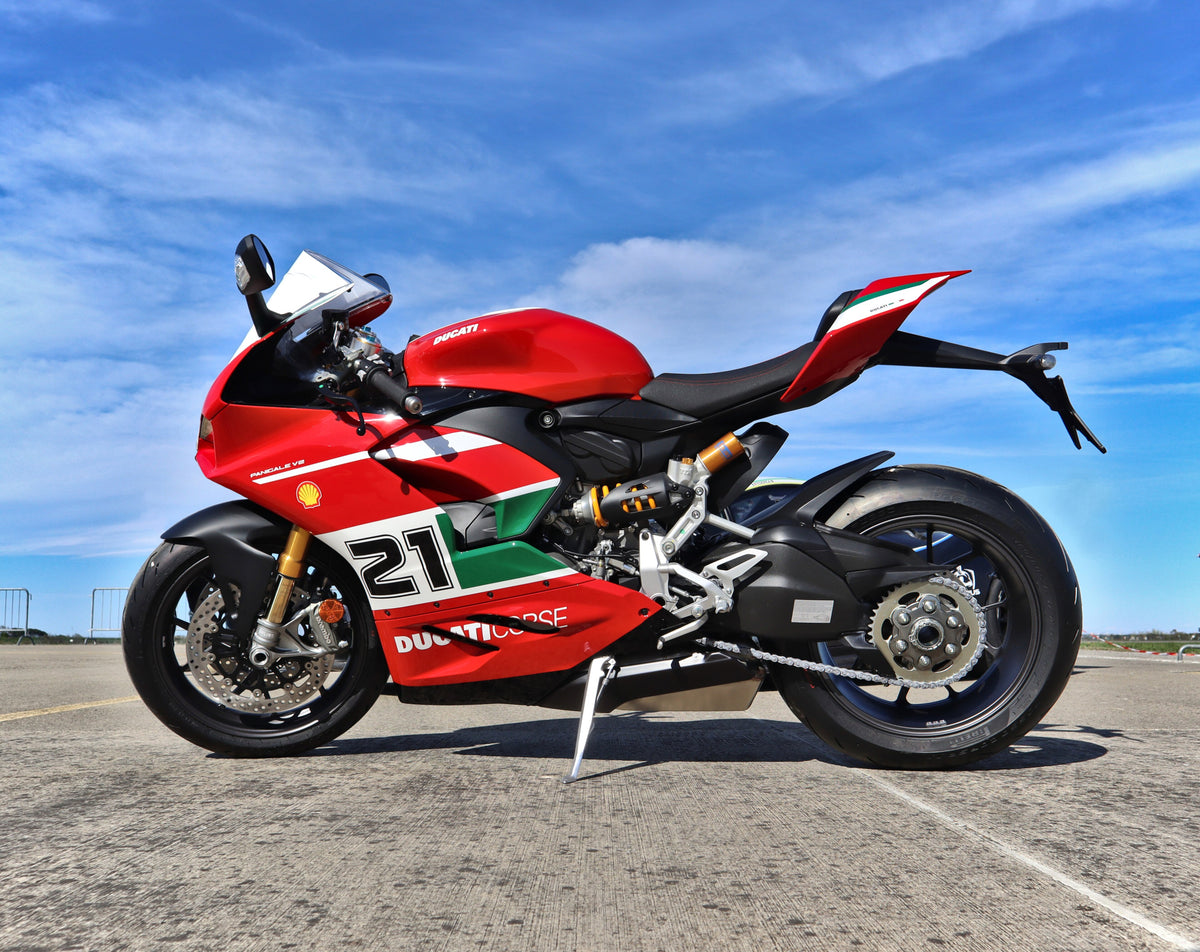
The cover image is a real 2023 Panigale V2 Bayliss 20th Anniversary photographed from the side. It shows exterior bodywork and the general lower-bodywork region, not the inner face of the fairing or the presence, condition or position of heat protection. It is not a NiceFairings product or a fitment test.
Begin with the right generation, not just the V2 name
Ducati describes the original Panigale V2's fairing as a dual-layer arrangement. Its 2020 model description describes an under-engine silencer ending in a compact right-side outlet; the MY24 model description also describes the fairing underside in relation to the under-engine silencer. Those are descriptions of the motorcycle's design, not proof that every aftermarket panel has the same internal components or clearances.
The name alone is especially unhelpful across the 2025 boundary. Ducati describes the new Panigale V2 generation with twin silencers under the seat. This article concerns the 2020–2024 layout. It should not be used to order bodywork or reason about heat for a 2025-or-newer bike merely because both say Panigale V2.
Even inside the 2020–2024 range, confirm the exact year and version on the bike, not only a registration date, seller title or remembered purchase year. Ask whether the exhaust and bodywork are still the original arrangement. If the motorcycle has been repaired, raced or converted, the visible fairing may not be a reliable record of what should be underneath it. Photographs and exact part references become more valuable than a broad year-range label.
Why the lower half cannot be judged from its paint
A painted outer shell tells you its color and shape. It does not tell you which original inner panels, insulating pieces, brackets, spacers or heat-reflective components the installer is expected to retain. It does not tell you how close an altered exhaust runs to the inner surface. Even two visually similar red lower cowls can be supplied as different assemblies.
There is a useful documented example. Ducati's instructions for a specific racing exhaust kit refer to a separate lower-half-fairing kit and identify heat-reflective and sound-deadening pieces in that configuration. The lesson is not that every V2 owner needs that kit, or that its instructions can be copied onto another exhaust. The lesson is that Ducati treats the combination of exhaust and lower bodywork as a defined configuration with named components. A generic instruction to “just add foil tape” skips the very question the parts list is answering.
The same distinction applies to a supplier's promise. “ABS fairings” identifies a broad plastic family, not a validated temperature limit for a particular installation. “Includes all fairings” may describe painted exterior panels without describing the liner, clips or reflective material. A livery mockup proves the artwork can be placed on a drawing; it cannot approve the clearance inside the real motorcycle.
Make two inventories before asking for a price
Inventory one is the visible and removable bodywork. Name the left and right lower halves separately, then the side and upper panels, inner/secondary pieces, front and rear trim, fasteners and any belly-pan or closing piece. Photograph both sides of the complete motorcycle and each lower fairing's exterior. If a panel is already safely removed, photograph its inner face and all pieces attached to it before anything is peeled off. Do not remove a hot panel or disturb wiring, hoses or exhaust components for the sake of a photo.
Inventory two is what the replacement may depend on: the exhaust maker and exact system or part number if known; the outlet arrangement; retained guards and heat-reflective pieces; sound-deadening panels; brackets, spacers, grommets and clips; and any recent repair or conversion. Mark each item original, changed, missing, or unknown. “Unknown” is a useful fact. A guess recorded as an OEM component is not.
Use this compact packet when asking a supplier or installer for help:
| Evidence to provide | What it can clarify | What it cannot prove alone |
|---|---|---|
| Year, version, market and bike identification | Which model-specific parts information to consult | That an existing converted front or lower assembly is stock |
| Left and right full-bike photographs | The visible layout and likely areas to inspect | Internal clearance, liner condition or exhaust identity |
| Exact exhaust maker, system reference and installation documents | The configuration the exhaust maker actually specifies | That a different fairing kit duplicates the approved assembly |
| Both lower panels, outside and safely accessible inside | Existing attached pieces, damage and mounting points | Future heat performance after changing parts |
| List of retained and missing hardware | What a quote must include or transfer | That an improvised substitute is suitable |
The packet should be factual, not exhaustive for its own sake. One sharp, well-lit image of an inner lower panel is more informative than six atmospheric photographs of the red paint. A wide view should include enough of the motorcycle to orient the close-up. If a panel is still installed, say so. Never present an exterior photo as if it documents the hidden heat treatment.
Keep a copy of the packet with the eventual order confirmation. When the panels arrive, it gives the installer a baseline for comparing what was promised with what is actually in the box. If the original lower fairing has already been thrown away, note that too: the missing reference may change what a technician must obtain separately. This is especially important when a previous owner performed the exhaust conversion and left no parts list or installation paperwork.
Separate three possible purchase questions
First, are you replacing only damaged painted exterior pieces on an otherwise unmodified road motorcycle? In that case, ask the supplier exactly which left/right lower shells the quote includes and what original items must transfer. The term “replacement fairings” is too broad to establish the contents. Ask the installer to inspect the old panel and its attached pieces rather than discarding them before the new shell is checked.
Second, has the exhaust been modified? A slip-on, a full system and a race installation are not interchangeable categories for ordering advice. Give the supplier the actual exhaust reference and ask whether its product has been checked against that configuration. If no one can verify it, the answer should be “fitment/thermal compatibility unconfirmed,” not an implied yes. Take the exhaust-maker's applicable instructions to a qualified technician before approving assembly.
Third, are you changing both the exhaust and the bodywork? Treat that as a system-level project. The exhaust instructions may identify a specific matching lower assembly or heat treatment. The proposed fairing supplier should state what it supplies, but the technician must determine how the exact assemblies work together. Do not buy a painted shell first and hope the clearances, liners and fasteners can be made to fit after delivery.
The NiceFairings Panigale V2 collection is currently an inquiry route, not a displayed list of confirmed ready-to-buy V2 kits. That is a reason to send the packet and request a written application response, not to assume a kit is in stock. For broader road-versus-track quote scope, see our Panigale V2 quote guide; this article deals specifically with the lower-panel and heat-hardware question.
If the old panel shows heat damage, preserve the clues
Discoloration, blistering, a softened edge or a changed smell should be recorded before a replacement is ordered. Note which side and which face of the panel is affected. Put a ruler or familiar object near the damage for scale, without placing anything on a hot exhaust. Photograph the corresponding exhaust route and any visible missing or displaced guards. Record when the mark appeared relative to a recent exhaust, bodywork or service change.
Avoid jumping to a single cause. A mark near the outlet does not by itself prove defective plastic, an overheated engine or an incorrect product. A missing retained piece, shifted mounting point, different exhaust route or previously repaired panel may all need inspection. Conversely, a clean outer surface does not prove the inner face and nearby wiring are safe. The point of the photos is to make the next inspection more focused, not to replace it.
If there is melting, smoke, fuel odor, visible contact with an exhaust component, damaged wiring or a concern about a hose, stop riding and have the bike assessed. This is not a cosmetic issue to solve with a sticker or a color-matched replacement. Only resume use after the relevant fault and installation are evaluated by a competent professional using the correct manufacturer information.
Read a quote for exclusions, not just inclusions
A useful quote names the exact panels, the intended bike year/version, the finish and the hardware or accessories included. It should also state what is not supplied: original fasteners to transfer, inner pieces, heat-reflective material, exhaust-specific lower halves or installation labor. If the seller has not inspected your modified bike, its quote should not silently become a thermal guarantee.
Ask five direct questions. Which left and right lower panels are in the package? Are the inner/secondary pieces supplied or assumed to be retained? Is any insulation or heat-reflective material supplied, and if so, which exact material and placement instructions accompany it? Which original brackets, clips and spacers must be moved over? What exhaust configurations have actually been checked for this product, and what remains unverified? Request the answers in writing before paint is approved.
The NiceFairings contact page is the practical route if the collection does not show a confirmed application. Include the packet in one inquiry rather than a sequence of isolated photos. The FAQ can answer general ordering questions, while the final application and included-parts answer must be specific to the quoted item. If a custom visual design is wanted, the custom-fairings page helps start that discussion; artwork approval and mechanical approval should be two separate decisions.
Do not confuse a production estimate with proof of fitment. The production and shipping information describes process timing, but a painted made-to-order item is the wrong place to discover that the lower-cowl assumptions were never resolved. Clarify the configuration before the production clock starts.
A short email that gets a more useful answer
Here is a request a rider can adapt: “I have a [year and version] Panigale V2 in [market]. The exhaust is [maker and exact part, or unknown]. The current lower panels are [original, replaced, or unknown]. Attached are full left/right views, close-ups of both lower panels, and inner-face photos where safely available. The attached list identifies retained and missing liners, guards, brackets and fasteners. Please identify the exact panels and accessories included in the proposed kit, the original pieces you expect us to transfer, and whether you have confirmed the application with this exhaust. Please mark any heat-clearance or installation question you cannot confirm.”
That wording does not demand an impossible blanket warranty. It asks the seller to define its product and its evidence. If the answer is incomplete, pause the order and seek the relevant Ducati or exhaust-maker instructions. A careful “we cannot confirm” is better than a confident but untestable claim.
Keep the photograph and the evidence in their proper roles
The photograph below the headline is an illustration of the 2020–2024 Panigale V2's exterior, specifically a Bayliss edition shown at a 2023 event. It is not a comparison between original and replacement fairings. It does not show an installed NiceFairings kit, an approved racing exhaust or a known heat liner. A licensed real photo is valuable because it lets the reader see the whole motorcycle without synthetic details; it is still limited by what the camera actually captured.
Photo credit: Terragio67, Wikimedia Commons, CC BY-SA 4.0. Original image 4374 × 3471 pixels; a 3840 × 3047-pixel source rendition was used for web delivery. No editorial elements were added to the image.
The right ordering sequence is simple: identify the bike and exhaust; inventory visible and retained parts; get a precise panel-and-hardware quote; resolve unknown mechanical and thermal questions with the proper instructions and installer; only then approve the finish. That sequence makes a custom fairing order more useful and makes an unsafe assumption easier to catch before it becomes a painted part on the workshop floor.