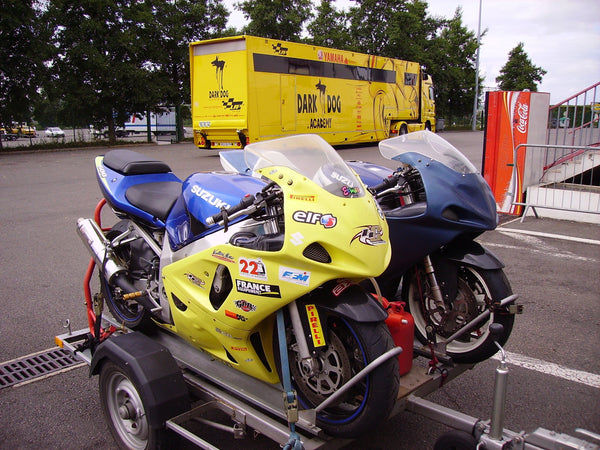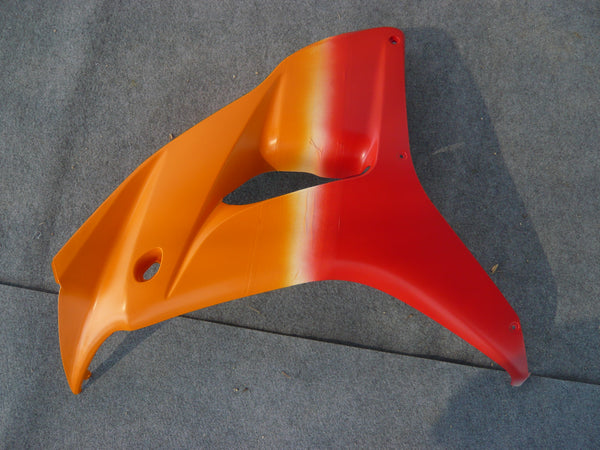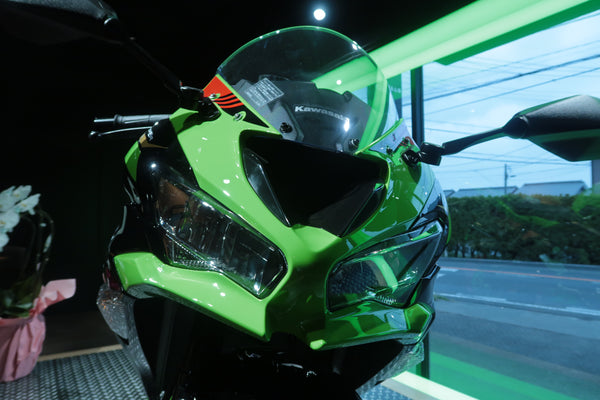

Cover disclosure: AI-generated editorial concept. It is not a real seller, customer motorcycle, NiceFairings product, accident record or mechanical inspection.
If your sportbike wears replacement fairings, a buyer will reasonably ask why. A clear answer is more useful than either hiding the change or presenting fresh paint as proof that the motorcycle is sound. Build a small bodywork history packet: identify which panels changed, when and why they changed to the best of your knowledge, show the available records, and separate what you know from what a mechanic still needs to assess.
This guide is for a seller preparing a listing and a viewing. It does not tell a buyer that replacement fairings prove a crash, or that original panels prove a clean history. For a buyer-side walkaround, use the existing used-sportbike fairing inspection guide. The task here is different: help a seller present the change honestly without overselling the cosmetics or making a diagnosis they cannot support. Check the disclosure rules and required sale documents in your own location; this article is not legal advice.
The five-part packet
Keep the packet short enough to share before a viewing but detailed enough to answer the first serious questions:
- Identity and scope: exact motorcycle details and a list of original, replaced and refinished visible parts.
- Timeline: when the change occurred, who arranged it and the reason as far as records show.
- Evidence: dated invoices, before photographs, work orders, product references and pictures of removed parts, if available.
- Current condition: consistent photographs of the assembled bike and accessible attachments, including ordinary wear.
- Open questions: anything you cannot verify, plus any professional inspection still needed.
Do not turn a missing receipt into a dramatic suspicion or into an invented certainty. “The panels were on the bike when I bought it; prior reason unknown” is a useful, honest statement. “Never crashed” is a much broader claim that a bodywork receipt or tidy paint cannot prove.
First separate the motorcycle from its paint
Start with the registration or ownership documents and the motorcycle's actual identification. Record model, model year, market or variant when known, and current modifications relevant to bodywork. Photograph the motorcycle from both sides, front and rear in diffuse light. Keep the originals of those files rather than sending only filtered social-media versions.
Then inventory the bodywork, not the whole vehicle in one sentence. A fuel tank, tank cover, nose, side panels, lower fairing, tail, front fender, screen, mirror covers and inner trims may have different histories. A “new fairing kit” does not automatically mean all of those items were supplied or changed. The fairing kit contents checklist helps separate the listed painted pieces from retained hardware and inner components.
Use a simple status for each item: original to your knowledge, replaced, refinished, repaired, or unknown. Those categories describe what you can document; they are not judgments of quality. If you do not know whether an inner trim is original, leave it unknown. The packet is credible because it marks its limits.
| Area | Status to record | Supporting item | Unresolved detail |
|---|---|---|---|
| Upper cowl and screen | Original, replaced, refinished or unknown | Invoice or dated before/after views | Retained brackets and hardware |
| Left and right sides | Record each side separately | Product reference and both side views | Whether adjacent pieces were also changed |
| Lower fairing | Record separately from side panels | Inside/outside views | Heat shield or exhaust-related work |
| Tail and seat cowl | Identify exact pieces | Receipt and removed-part photos | Retained lighting or plate equipment |
| Tank or tank cover | State what remained on the bike | Neutral-light photos | Color matching or prior refinish |
This worksheet does not prove the condition of the frame, steering, brakes or suspension. It tells the next person what the seller knows about the visible bodywork and where a professional inspection should begin.
Make a timeline without filling gaps by guesswork
Put the events you can document in date order: purchase of the motorcycle, any known incident or color-change decision, purchase of panels, painting or graphics, installation, mechanical repair, and the present listing. Record the source for each date. A receipt date proves an item was purchased; it does not prove the part was installed that day or that all related mechanical work was complete.
If another owner made the change, say which portion of the story came from that owner and which portion you verified. “Previous owner said the fairings were changed for a color project” is not the same as “I changed them for color.” If you later find a contradictory invoice or photograph, correct the timeline rather than selecting the version that sounds best in the listing.
Some sellers retain the removed panels. Photograph them as a separate set, with their condition visible, and state whether they are included. Old panels can explain a cosmetic decision but are not proof of a complete accident history. If storing them until sale, the removed-fairing storage guide helps avoid adding scratches or losing hardware while the bike is advertised.
Photograph the evidence, not just the glamour angle
Begin with four level overviews: front, rear, left and right. Then add front-three-quarter views and matching close-ups of both sides. Photograph panel seams, accessible fasteners and inner edges at a distance that includes a recognizable neighboring feature. A close-up of one anonymous black tab is hard to place later.
Use neutral or diffuse daylight where possible. Strong warm light can hide color differences; heavy editing can make wear look smaller than it is. Show scratches, touched-up areas and imperfect gaps alongside clean areas. A seller who only posts a dramatic low-angle shot invites the buyer to ask for basic documentation later. The fairing identification photo guide offers a consistent set of angles for communicating panel identity.
Do not remove a structural or safety-related part merely to create a better listing image. If an inner area is inaccessible without work you cannot perform safely, mark it “not photographed.” If the buyer needs more information, arrange a qualified pre-purchase inspection with the required permission and access.
Give files plain names such as left-mid-panel-inside-01 and keep the unedited originals. Do not name a file crash-proof or frame-perfect: those labels claim more than the image shows. A useful caption says what is visible, where, and when the photo was taken.
Sort your records by what they can actually establish
Not all records answer the same question. A product invoice can identify supplier, date, price and perhaps the ordered finish. An installation invoice can identify work billed. A before photograph can show the old appearance. A finished photograph can show visible finish at one time. None of these alone certifies roadworthiness or proves that a prior owner never dropped the motorcycle.
| Record | Useful for | Cannot prove by itself |
|---|---|---|
| Fairing order or product page | Stated panel scope and supplier | Actual installation or hidden condition |
| Paint or graphics work order | Requested finish and work billed | Exact color match under every light |
| Dated pre-swap photos | Visible condition at that date | Condition of hidden supports or chassis |
| Installer's itemized invoice | Work that was charged and documented | Quality of every unseen interface today |
| Professional inspection report | What that inspector checked at that time | Future condition or issues outside its scope |
| Removed original panels | Physical condition of those parts | A complete history of the motorcycle |
Keep a private copy of full receipts. Before sharing documents publicly, consider whether they expose your address, payment details or another person's information. Redact sensitive fields only on the shareable copy; keep the original available for an appropriate in-person verification. Do not alter dates, descriptions or findings.
Write a listing paragraph that survives follow-up questions
A good description names the change, the known reason, the date or ownership stage, the records and the unknowns. It should be easy for a buyer to compare with the photographs and inspect further. Avoid broad labels such as “OEM quality,” “never touched,” “perfect fit” or “crash-free” unless you have a precise and supportable basis for the specific claim.
Here is a hypothetical wording example, not a statement about any actual NiceFairings customer motorcycle:
“The left and right painted side fairings, upper cowl and tail cover were replaced during my ownership in 2025 for a color change. I have the panel order and installation invoice, plus dated photographs of the bike before the swap. The tank, screen and inner trims were retained to the best of my knowledge. The original side panels are available to inspect and are included. I have not disassembled the front stay for this listing; buyers are welcome to arrange an independent inspection.”
If the panels followed an incident, the wording should describe the known event and documented repairs accurately. A color-change example is not a template for disguising accident work. If the work predates your ownership, change the verbs and say so. Precision reduces the need for defensive claims.
Answer three difficult questions without pretending to know more
“Why were the fairings replaced?” State the known reason and its source. If it was a color change, show the pre-swap appearance and order record. If it followed damage, disclose the event and available repair records. If unknown, say unknown.
“Are the panels OEM?” Identify the actual supplier or part references when documented. “Aftermarket” describes origin, not condition or the reason for installation. The OEM-versus-aftermarket contents guide helps explain why supplied panels and transferred parts should be listed separately. Do not infer origin from paint color alone.
“Does this mean the bike was crashed?” Fairings cannot settle that question. Explain what you know about the replacement and offer the records and an independent inspection. Do not turn an absence of visible damage into proof that no incident occurred.
If a buyer points to a gap, mark it as an observation and ask a qualified inspector to assess its cause. A panel can sit unevenly because of hardware, a bracket, assembly, panel geometry or damage. The panel-gap diagnostic guide can help formulate questions, but it is not a remote verdict on this motorcycle.
Keep cosmetics and mechanical condition in different folders
Replacement fairings can make a bike presentable while unrelated maintenance remains due. Create one folder for the bodywork packet and another for mechanical service, inspection and ownership records. Cross-reference them where the work overlaps, but do not let a new painted kit stand in for tire, brake, steering, cooling or structural evidence.
If a known event also involved a mirror, lever, headlight stay, radiator, engine cover or control, list those items separately. Show the corresponding repair or assessment record. If there is an unresolved safety question, pause the sale process or arrange qualified inspection before encouraging a test ride. A visual guide cannot certify the motorcycle underneath its panels.
Likewise, do not price a replacement set as an automatic resale premium. Buyers evaluate the whole machine, documentation, market and unresolved work. The used-motorcycle replacement-planning guide addresses the owner's future bodywork choices; it does not establish what this sale should be worth.
If you are fitting new panels before selling
Document the reason before ordering. Save photographs of the current bike and every damaged or mismatched piece. Confirm the exact model, year and written product scope. If you explore NiceFairings' catalog, treat a collection as a starting point, not proof of fit or included hardware. Send the exact motorcycle details through the contact page and use the custom fairings page only if a design change is part of the project.
Keep the quote, proof approval if applicable, finished photographs supplied by the seller and installation record. Do not say a complete kit includes a tank, inner cowls, screens, clips or shields unless the specific order lists them. Photograph the installed panels in neutral light after the work and retain the previous set when practical. A later buyer should be able to see what changed, not merely hear that the bike looks fresh.
Do not use a cosmetic replacement to conceal an unresolved support or mechanical issue. If the old panel did not align, determine why before calling the new one a repair. If the bike has changed exhaust, lighting, mirrors or protection hardware, disclose those modifications too; they can matter to bodywork fit and service access.
A final pre-listing review
Read the packet as if you had never seen the motorcycle. Can you identify the bike, the changed panels and the known reason without calling the seller? Are the before and current photos comparable? Do the invoice descriptions agree with the claims? Are missing records and inaccessible areas clearly marked? Is the buyer invited to obtain an independent inspection rather than asked to trust a photograph?
Then remove any sentence that converts a limited observation into a sweeping promise. “No damage visible in the supplied photos” is different from “never damaged.” “Installed by a shop according to the attached invoice” is different from “guaranteed perfect fit.” The strongest packet is not the one with the most confident adjectives; it is the one a careful buyer can verify.
Bottom line
A fairing change should be a documented chapter in the bike's history, not a secret and not a certificate of health. List the exact pieces, show the sequence, share the evidence you have, mark the unknowns and leave mechanical conclusions to an appropriate inspector. That is a more useful service to a serious buyer than either a flawless-looking photo or an unsupported “never dropped” claim.