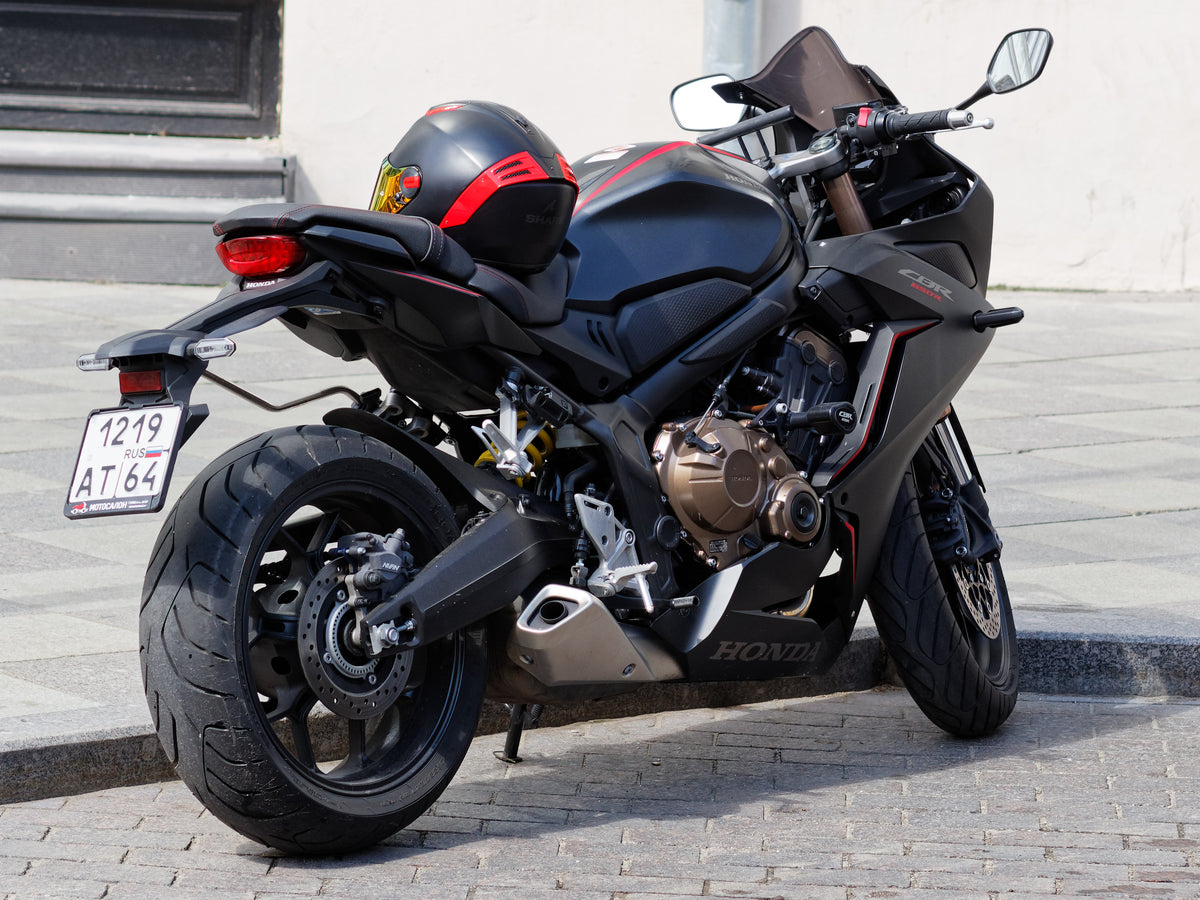
A search for “CBR650R fairings” can make two different shopping decisions look like one. NiceFairings currently has a 2019–2020 kit and separate 2021–2023 bodywork. Honda's 2021 Japan-model announcement also describes a change to the seat cowl and rear fender. The practical answer is not to decide which paint scheme looks best first: identify your exact motorcycle, photograph its tail and neighboring interfaces, then have the seller confirm the listing, pictured components and parts you must retain. A model name or product-image filename alone is not an interchangeability test.

The current 2019–2020 listing shows the design and laid-out panels. Its underlying image filename mentions more years; the product's stated fitment range, not that filename, is the shopping claim to verify.
1. What Honda actually said changed in 2021
Honda's December 2020 announcement for its 2021 Japan-market CB650R and CBR650R identifies a revised seat-cowl and rear-fender appearance, as well as color and graphics updates and a fork change. That makes the tail a useful place to start a photo comparison. It does not give a complete aftermarket-parts interchange chart, establish the same market specification worldwide, or prove that every side and front panel changed. An official design announcement is evidence of a stated factory update, not a substitute for a parts fiche or a physical fit check.
Honda's 2018 introduction of the 2019 CBR650R describes the original fully faired model with extended side fairings, a short rear section and narrow dual LED headlights. That tells us what the launch-era visual architecture emphasized. It still does not let us identify an individual used bike from a front-only social photograph. A prior owner might have changed its tail tidy, seat cover, signals or painted panels. Even a correct factory-year photo can be a poor guide to what is mounted on your particular motorcycle today.
There is a second boundary to keep separate. Honda's 2024 European-lineup announcement describes redesigned dual LED headlights and upper and lower fairings for the 2024 CBR650R. Our existing 2024–2026 E-Clutch verification article covers the later generation and variant question. This article is narrower: it is for an owner trying to choose between currently listed 2019–2020 and 2021–2023 replacement bodywork, with special attention to the rear. Do not use its discussion of the earlier tail to order 2024-on panels.
2. Identify the bike before comparing two product photos
Start with the year and model on reliable ownership or vehicle records, plus the frame/VIN information as appropriate for your market. Ask a Honda dealer or consult the correct market's official parts information if the bike's year is uncertain. Registration year, sale year and factory model year may not always be identical. “It looks like the bike in the listing” is a weak replacement for those records, particularly if its bodywork has been repaired or swapped. Keep the frame identification private; the seller normally needs the exact model/year/market and photographs, not a public post containing the complete number.
Take a left side, right side and straight rear photograph with the entire bike visible. Then photograph the tail from rear three-quarter angles, the joint beneath the seat, the seat-cowl edges, rear-fender/license-plate area, signal mounts and any panel that overlaps the side fairing. Make a second close photograph with the seat or existing loose panel removed only if you can do so safely under the correct service procedure. If you cannot, a technician can document the mounting points. Do not pry a painted part just to obtain a prettier image.
Mark modifications in the message you send the seller: tail tidy, deleted passenger hardware, different signals, aftermarket seat cover, luggage mounts and previous accident repairs. None of these automatically prevents a kit from being used; they are reasons not to assume the stock-photo outcome. A stock shell can still require compatible retained brackets and undamaged mounts. Our fairing-kit contents checklist provides a general way to distinguish photographed pieces from included hardware. Use it alongside the exact CBR650R listing rather than treating it as a model-specific parts diagram.
3. Compare the two live offers without inventing compatibility
The 2019–2020 CBR650R product identifies design NF-HONDA-CBR650R-1920-01A and instructs buyers to refer to its own product photos for pictured panels and included items. The 2021–2023 product identifies NF-HONDA-CBR650R-2123-01B and likewise refers to its own photos. Both current descriptions advise confirmation of motorcycle model, year and configuration. They recommend loose test-fitting before final tightening and contacting the store with photos if significant mismatch appears. Those are product-page statements, not a guarantee that either kit fits a modified motorcycle without work.

A different live 2021–2023 listing. Compare this exact offer's rear and smaller components with the 2019–2020 offer, but do not infer bolt-on interchangeability from similar finishes or a shared-looking image name.
Do not read a filename like “2019_2020_2021_2022_2023” as an authoritative fitment specification. File names often survive asset reuse or batch naming. Read the visible product title, description and option selected at checkout, then ask for a written answer if the year ranges appear inconsistent with a photo or your own parts. Conversely, do not claim the two offers are definitely incompatible solely because their stated ranges differ. The safe conclusion is narrower and more useful: they are advertised as different year ranges, and cross-range installation has not been established by those photos.
The kit images also should not be treated as evidence about the original Honda rear fender, tail bracket, lamp, wiring or every fastener. A laid-out panel set shows visible plastic, not how its backside interfaces with all retained parts. Ask about the exact tail panels, tank cover and smaller trim pieces in the offer you choose. If you want another color, the additional 2021–2023 cowling design is a design alternative within its stated range, not evidence of 2019–2020 fitment.
One detail deserves an extra check: an apparent matching shape in two flatlays can still hide a different attachment arrangement on the reverse. Product photography is usually optimized to show finish and completeness from above, not the exact position of every hidden tab. Ask for reverse-side photographs of the tail components and the matching part names in the kit list if this is the damaged area. If the supplier cannot give a verified cross-year answer, stay within the stated year range rather than treating visual resemblance as a reason to experiment. That is an evidence boundary, not an assertion that no parts can ever be adapted.
4. Run a tail-first comparison that produces an answer
Use three sources side by side: your actual motorcycle photographs, the correct-year Honda parts diagram or dealer identification, and the exact NiceFairings product listing. Make a short row for each piece you care about: upper tail, left and right tail sides, under-seat trim, rear fender/plate assembly, and the hardware that holds or overlaps them. Record existing condition, pictured in offer, seller says supplied or reused, and still unknown. This is more informative than counting panels in a crowded flatlay.
Consider a 2020 bike with a cracked upper tail and intact side bodywork. The question is not “Which 2021 design is prettier?” It is whether the 2019–2020 listing supplies the specifically damaged part and whether the adjacent mount is sound. Replacing a complete painted kit may still be a style decision, but it will not repair a bent motorcycle-side bracket. If only the tail is damaged, ask whether a separately supplied tail piece is possible before assuming a whole set is required.
Now consider a 2022 bike that has a 2019–2020-looking tail because a previous owner changed something. The frame and official parts identification lead the model-year conversation; the photographed installed parts define the current modification question. Send the seller both facts. Do not order an older kit merely because one photograph resembles an older bike. A modified tail can conceal changed retainers or support parts. A knowledgeable installer may need to work out what is present before the seller can give a reliable kit recommendation. The pre-fit checklist is useful once that scope is known, not a way to skip identification.
Finally, if the old bodywork is missing after a crash, there is no intact reference to compare. Request photos of the back of the candidate panels, ask the dealer for the original parts diagram and check mounting points before purchasing. A flatlay cannot tell you whether a missing original support should have been retained. Put the question in writing rather than relying on an assumed “complete” meaning. The alignment troubleshooting guide explains why forcing a panel into position is not a substitute for finding the missing component. Keep accident-related safety assessment separate from bodywork shopping; a new shell should not conceal unresolved damage beneath it.
5. Use photos for paint approval, not for proof of fit
NiceFairings describes a finished-kit photo-confirmation process on these listings. That is valuable for reviewing the visible design, graphics and requested colors before dispatch. It cannot show that a shipped part will align with the mounting points on a motorcycle the photographer has not inspected. Split your approval into two stages: scope and year-range confirmation before production, then appearance confirmation when final photos arrive. Keep the written scope answer with the photos so the person installing the kit knows which original parts were meant to stay on the bike.
When comparing the 2019–2020 patterned kit and the 2021–2023 patterned kit, review the tail graphics on the actual tail pieces, not only the large side panels. A strong graphic on a side fairing may terminate awkwardly when the tail is a different finish. Ask for views of both sides and the rear in the final photo set. If an existing fuel tank or other retained component must match, send daylight photographs under neutral light and discuss shade tolerance in advance. A screen image is not a promise of exact paint match.
At delivery, inventory the physical parts against the agreed list before installation. Photograph any damage or discrepancy immediately. Have the complete set trial-fitted loosely, verify that tabs and fasteners engage without undue stress, and check lights, turn signals, steering and clearance with the motorcycle stationary. If a point does not align, stop and identify the cause before drilling, trimming or riding. The store's own descriptions ask buyers to contact it with photographs when substantial modification appears necessary. That instruction is particularly important when a tail, lamp or license-plate support is involved.
6. A concise question you can actually send to the store
The most productive enquiry names the bike and the unresolved component: “My CBR650R is a [verified model year and market]. Here are left/right/full-rear photos and close-ups of the seat-cowl joint. I am considering this exact 2019–2020 product or this exact 2021–2023 product. Please confirm which listing is intended for my bike, whether the marked tail piece is supplied, what original rear-fender/bracket/hardware parts I must reuse, and whether my noted modifications alter your answer.” Attach the original photographs, not only screenshots with the key edges cropped away.
If the reply is ambiguous, do not replace the question with guesswork. Ask the dealer or qualified installer to identify the original and current parts, then return with that information. A correct year-range selection is necessary, but it is not the entirety of a sound installation. If the seller confirms a kit but cannot confirm a separately damaged rear support, price and source that support independently before approving the order. If the seller asks for more photographs, take the requested angles rather than interpreting the request as a rejection. Specific uncertainty is a useful result: it tells you exactly what must be checked before money or paint work is committed.
For a rider doing a complete color change, the answer may be pleasantly simple: the verified year matches the listed range, the bike is unmodified at the relevant interfaces, the seller itemizes the pictured panels and retained hardware, and an installer sees no damaged mounts. In that case, the remaining decision really is aesthetic. For a rider repairing a bent or incomplete tail, the same product page is only one piece of a larger parts plan. The difference between those buyers is not enthusiasm or budget; it is the evidence available about the motorcycle in front of them.
The result is an order based on your CBR650R, not a generic model-name search. Honda's 2021 tail update tells you where to look; the store's two live year ranges tell you what to ask; the bike and its documentation settle what you actually have. Only after those are reconciled should you spend time deciding whether red graphics, dark patterned bodywork or a custom finish best suits the bike.
Cover photograph: “Moscow, Honda CBR650R July 2025 01.jpg” by Retired electrician, CC0 1.0. It shows a real older-generation-looking CBR650R parked outdoors, not a NiceFairings kit installation or proof of this motorcycle's exact model year. The source image was not retouched.