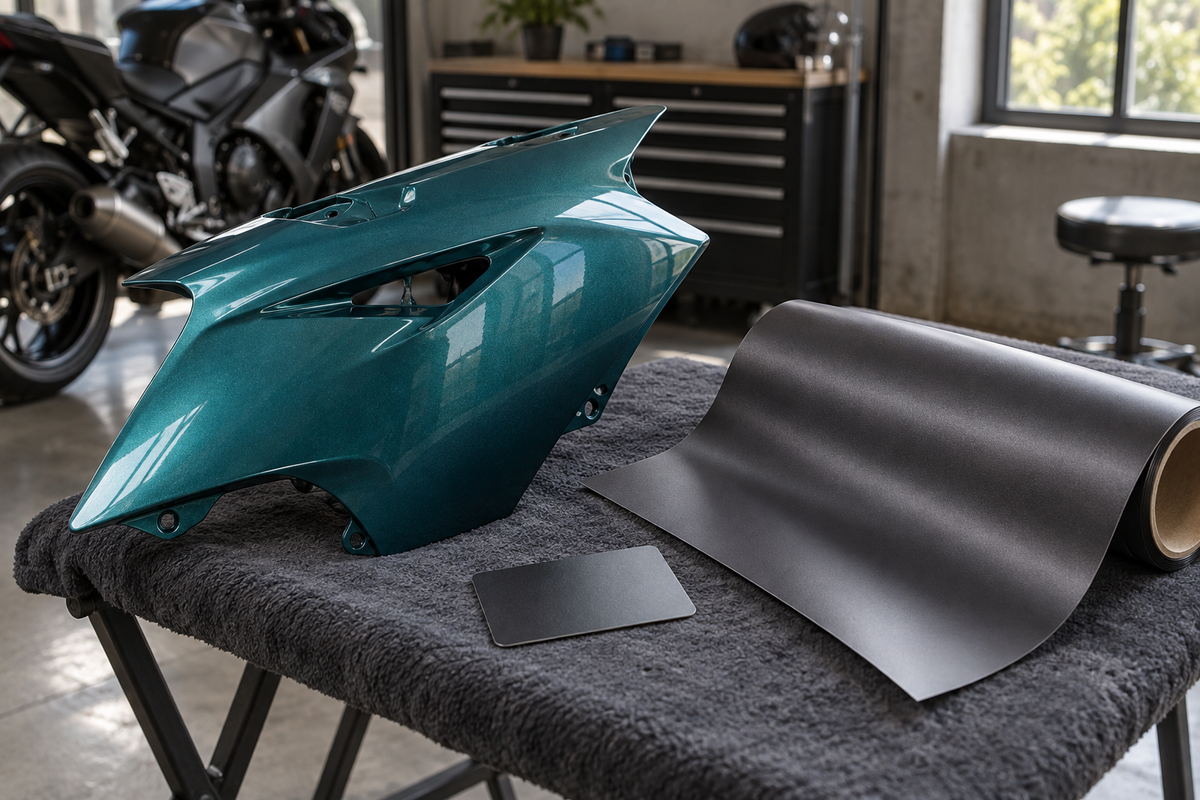
Are you buying a finish change for existing bodywork, or replacing the panels themselves? That distinction comes before comparing vinyl wrap with painted replacement fairings. Wrap is not a structural repair, and new painted panels still need the correct application and installation. Compare the condition of the motorcycle, desired appearance, quoted scope, care and future removal or refinishing considerations. No universal price range or guaranteed return to original paint condition applies to every project.
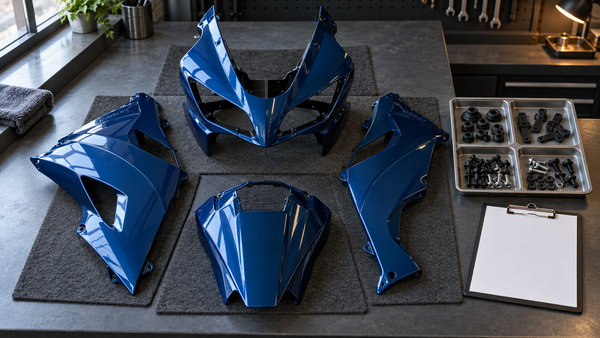
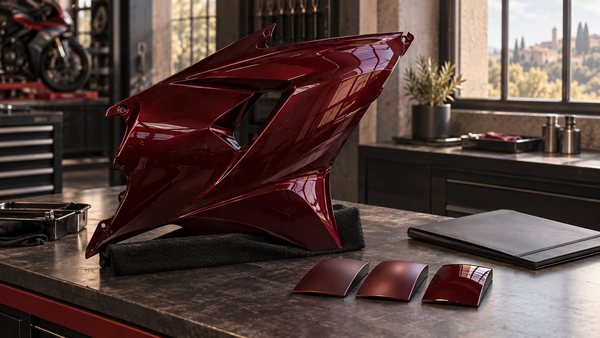
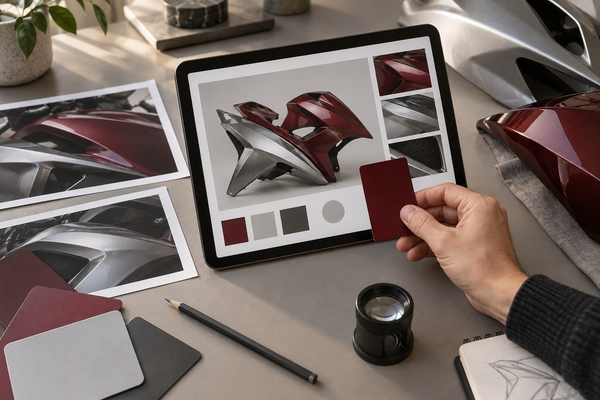
Images are AI-generated editorial illustrations, not photographs of the supplied product or evidence of model-year fitment, dimensions or safe installation. Use actual product documentation and motorcycle records for technical decisions.
Key Takeaways
Decorative wrap changes surface appearance but does not repair cracks, attachments or weak paint.
Replacement panels may be appropriate for missing or damaged bodywork after the actual repair scope is assessed.
Before you buy, always make sure the new panels fit your exact motorcycle model, year, and sub-model.
Compare current itemized quotes for the actual coverage, preparation, components, labor and delivery.
Wrap may offer future appearance changes, but removability and coating risk need assessment; paint also has maintenance and refinishing requirements.
Do not choose a finish from generic track-versus-road heat or protection claims.
Before you make a purchase, ask for written price estimates for all costs: panels, paint, labor, shipping, and import fees.
Professional surface assessment informs a wrap decision but cannot guarantee damage-free removal.
Custom Motorcycle Fairings: Looking at Where You Start
Your first job is to be honest with yourself. Go to your bike and check the bodywork. Are the panels solid? Do they have cracks, missing tabs, or peeling paint? The answer tells you what to do next. A wrap project and a replacement panel project start from very different places. You cannot skip this step.
Wrap: Only for Looks, Not for Fixing
Vinyl wrap changes the color of your motorcycle. It does not change how the bike is built. This point matters more than any other in this guide. Wrap is a film that changes the look. It is not new bodywork. It is not the same as paint protection film. These are three different products with three different jobs.
Wrap cannot fix broken tabs, cracks, or bad paint
Decorative film relies on the underlying panel and coating. It does not repair cracks, restore a mounting tab or provide a structural attachment. Surface defects and weak coatings need appropriate assessment before application. Do not use film to conceal an unresolved bodywork problem or assume a good visual result establishes a sound component.
Have damaged tabs or uncertain panel integrity assessed by a qualified professional. This guide does not establish which fractures can be repaired or prescribe replacement from a photograph. Determine the appropriate underlying work before comparing cosmetic finishes.
Needs a solid panel for the wrap to stick
The installer needs to assess the underlying panel and coating as well as the proposed film. Curves, edges and surface condition can affect the result. A visually appealing film application does not establish structural condition or cure an underlying defect.
When You Need New Panels
Examples of concerns requiring assessment before any cosmetic work include:
Missing sections or extensively damaged bodywork, with repair or replacement to be determined for the actual part.
Multiple cracks or prior repairs whose condition cannot be established by appearance alone.
Suspected heat deformation or a change in shape that needs an identified cause.
Damage near attachment or flexing areas, where the relevant component’s role matters.
Uncertain mounting points or supports that could affect the completed assembly.
Not every scratch requires a new kit, and not every damaged panel has the same repair options. A professional should establish the underlying work and whether the surface is suitable for the proposed finish. Keep that assessment separate from the preference for a color or graphic scheme.
Damaged or missing bodywork needs an assessed repair or replacement scope
A painted replacement kit gives you new bodywork. You change the panels completely. This path makes sense when your current fairings are too hurt to fix. You get a fresh start with new plastic. The new panels come unpainted or pre-painted, depending on the seller.
A painted kit changes panels but still needs proper fit and separate parts
Confirm the exact supplied panels, finish and any separately required pieces. A kit may rely on original supports, trim or hardware. Do not assume small modifications are routine or authorized; resolve unexplained alignment with the supplier and installer before altering parts.
Check Fit Before You Choose a Route
Fit is the most important thing to check for any replacement panel project. A panel that does not fit is useless, no matter how good the paint looks. You must check fit before you order.
Check fit for model, year, and sub-model
Follow these steps to make sure your kit will fit:
Find the exact model and year range of your motorcycle.
See if the mounting holes on the fairing are already drilled.
Check your existing brackets for damage or misalignment before blaming the new kit.
Agree an appropriate pre-fit inspection before irreversible finishing or modification
Do not force, heat or alter parts to resolve unexplained misalignment
Talk to the seller before ordering if your bike has mixed panels or has been in a crash.
Get this info before you buy:
Exact year, make, model, and sub-model of your bike.
The seller's listed fit range for the fairing kit.
What is in the kit: upper, side panels, lower panels, tail, tank cover, fender, windshield, heat shield, bolts, and decals.
Type of material (ABS, fiberglass, carbon, or composite).
Paint status (pre-painted, raw, primer, or custom).
Where it ships from and how long it takes.
Return policy, restocking fee, and custom-order rules.
Whether your bike has been in a crash or has non-OEM brackets.
Approving the finish vs. checking fit are separate steps
These are two different checks. Do not mix them up. Fit check asks: does this panel bolt onto my bike? Finish check asks: does this paint color and quality look good to me? You can like the finish and still have a fit problem. You can have a good fit and still hate the paint. Treat them as separate steps. Get written confirmation for both before you say yes.
For existing film, include a professional removal assessment in the project scope. Record the film identity and coating history where known.

Design and Finish Possibilities for Your Project
Once you know your panels are solid or you order a new set, you can think about the design. The look of your custom motorcycle fairings project depends on this choice. Vinyl wrap and paint give you very different finish options. Your style goals will decide the best road for your motorcycle.
Achievable Custom Motorcycle Fairing Colors with Wrap
Vinyl films offer a range of appearance options. Future removal may be possible under the applicable conditions, but it is not automatically simple or damage-free. Discuss the exact film, surface and intended use with the installer before treating reversibility as a project benefit.
Wide range of finishes: gloss, matte, satin, metallic, color-shift
A gloss finish gives your bike a shiny, reflective look. Metallic films add a sparkling depth. A black matte wrap gives a tough, stealth look that stays popular for a modern style. Satin sits between gloss and matte. Color-shift films change hue depending on the light and angle. This variety lets you make a unique custom design without buying new panels.
Complex contours and edges need installer assessment
Complex curves on a fairing can be hard for the film. Deep recesses and sharp edges can make the wrap lift. A professional installer can check your fairing and tell you if the custom design can be done. Do not skip this step.
Custom Motorcycle Fairing Paint Colors for Permanent Results
Paint offers a different way to specify color, graphics and surface appearance. Discuss the actual coating system and design with the painter or panel supplier. No finish automatically matches a screen image or an exact vision, and a race-inspired scheme does not dictate one universal coating process.
Quote the exact solid, metallic or multi-stage finish scope
Ask the painter to define the quoted finish and its material and labor scope. Solid, metallic, pearl and multi-stage descriptions can cover different systems. Do not assume a fixed layer sequence, factory equivalence or durability from a short label. Samples can support appearance approval while their limits are recorded.
Pearl, candy, and paint-code-matched OEM options
If considering pearl, candy or an OEM-code-inspired match, ask what can be supplied and how it will be compared with existing bodywork. A paint code alone may not match aged, repaired or differently finished neighboring panels. Agree the sample process and any limitations before approving the order.
Matte vs. Gloss: Maintenance Trade-Offs
Your finish choice affects how you care for your motorcycle. Paint care is different between gloss and matte looks.
Gloss: distinguish approved routine care from professional correction
Use care products and methods approved for the actual gloss coating or film. Routine washing is separate from polishing or defect correction. A pH label or generic detailer recommendation does not prove compatibility, and no cleaning method guarantees the absence of marks.
Matte: avoid unapproved gloss-enhancing or abrasive treatments
For matte finishes, avoid unapproved gloss-enhancing products and abrasive treatment. Identify whether the surface is paint, wrap or another film and follow its actual care guidance. If gloss or texture changes, stop and obtain advice; an appearance change is not a diagnosis of permanent damage by itself.

Installation Scope and Labor Requirements
Wrap Application: Surface Prep and Professional Removal
Have the installer assess the actual panels, coating, coverage and access requirements before committing. Do not assume all bodywork, trim or decals must be removed in the same way. Any disassembly and surface preparation should follow the applicable motorcycle, component and film instructions.
The exact coating and film determine suitable preparation. This guide gives no universal alcohol dilution, solvent recipe or cleaning sequence. A chemical method permitted for one film and surface does not authorize its use on another. Ask the installer to clarify compatibility and the product instructions being followed.
Surface defects or contamination need appropriate assessment before application. Do not sand a panel or strip a coating merely to make it look smoother for film. Establish the underlying condition and agreed preparation scope with the relevant professionals.
Complex contours, edges and access affect the installer’s application plan. This is not a heat-shaping tutorial: no temperature, stretching or reassembly method is prescribed. Have the installer determine the appropriate process and limitations for the actual product and bodywork.
Before committing, ask for a written scope covering the proposed finish, panel preparation, separately required work and exclusions. Keep the agreed product and color references with the order.
Working with Unpainted Motorcycle Fairings
When you choose unpainted motorcycle fairings, you add extra steps. A trial fit is essential before any paint work.
Trial fit before irreversible finishing is essential
Arrange product-specific pre-fit assessment before irreversible finishing. The installer should use the relevant procedure and investigate unexplained alignment rather than forcing, heating or drilling a panel into place. Clarify how this inspection fits the supplier’s return conditions. A generic loose-bolt sequence cannot establish the correct installation for every kit.
Agree who will perform the pre-fit assessment, what will be recorded and how the parts will be transferred to the painter. Do not mark, modify or refinish the panels before the scope and relevant terms are understood.
Transport handoffs: supplier → painter → installer
Coordinate the supplier, painter and installer so responsibilities are clear. Record delivery condition, pre-fit assessment, finishing scope and protective transport arrangements. The appropriate sequence depends on the project; a supplier cannot necessarily perform a trial fit on your actual motorcycle. Plan handoffs explicitly rather than assuming that has happened.
Painted Panel Installation Workflow
This installation workflow follows three main stages.
Pre-fit inspection, bolt-on, post-installation review
Record arrival condition and compare the delivered inventory with the order. Raise damage or discrepancies before proceeding, following the supplier’s process. Have relevant application and installation concerns assessed separately from the finish appearance.
Installation must follow the actual motorcycle and product instructions, with appropriately qualified help where needed. This guide does not prescribe a universal bolt order or torque. A visually pleasing gap does not certify correct attachment or clearance.
Have the completed assembly assessed for the required installation checks as well as appearance. A walk-around can identify a visible concern, but it does not establish hidden condition or operating suitability. Record unresolved issues before returning the motorcycle to use.
Read the actual seller terms and transport scope
Before you order, read the seller terms. Know the return policy and shipping rules. Transport scope matters. Painted panels are fragile. Confirm insurance. Verify that the paint matches your approved color. The installation workflow includes verifying correct parts.

Total Project Cost: Beyond the Sticker Price
Itemizing a Complete Project Quote
Start by listing every single cost. Many first-time buyers only check the panel price. That mistake causes surprise costs later on. Your total project cost is more than just the bodywork. You need to plan for each part of the process. The table below shows where your money goes.
Cost Component |
What You Need to Know |
|---|---|
Windscreen |
Check if it comes with a full aftermarket kit |
Heat shield |
Clarify any required thermal components and which are supplied or retained |
Mounting hardware |
Identify included, retained and separately required hardware |
Fairing clips, rubber grommets, well-nuts |
Condition and specification govern reuse; new parts are not automatically appropriate |
Paint / finish (local painter) |
Obtain the actual finish scope and preparation quote |
OEM color matching |
Agree matching expectations, sample process and any quoted extra work |
Custom graphics or airbrushed designs |
Can raise the total a lot because of the labor involved |
Metallic or matte finish premiums |
Confirm the actual film or coating specification and cost |
Decal kits |
A high-quality vinyl set or OEM decal set |
Professional labor |
Make sure the quote covers heat shield reinstall, windscreen mounting, and decal alignment |
Fitment guarantees and return policies |
Ask about these when you confirm your kit quote |
Finish, preparation, panel scope and labor can all affect the total. Ask for the actual breakdown rather than assuming paint always represents most of the cost. A clear quote should distinguish supplied products from services and identify exclusions or assessment-dependent work.
Painted Panels: Known Cost Components
When you order painted panels for your motorcycle, the sticker price is only the start. You need to get the real quote for the panel price, finish work, and fitting labor. A few things change the total cost.
Factor |
Effect on Fitting Labor Cost |
|---|---|
Part type: OEM vs. aftermarket |
Obtain the actual application and installation estimate; category labels alone do not determine labor |
Frame and bracket condition |
Existing support condition may require assessment or additional work |
Number of panels replaced |
Quote the actual number of panels and the surrounding work involved |
Quality of fitment |
Unresolved alignment needs assessment, not assumed modifications |
DIY vs. professional installation |
Use appropriately qualified installation where required; do not choose solely from an apparent labor saving |
Define the desired finish and graphic scope with the supplier or painter. A race-inspired design does not automatically require a particular multi-stage coating process. For a pre-painted NiceFairings order, confirm the selected finish, included panels and relevant application conditions. Appearance approval and installation assessment remain separate.
Confirm transport responsibilities and applicable charges for the actual order and destination. Ask who handles import-related costs where relevant, without assuming every shipment incurs the same fees. A custom finish also does not guarantee higher resale value. Keep financial expectations grounded in the specific project rather than a generic range.
Wrap: Material and Installation Costs
Vinyl wrap gives you a different cost structure. You pay for the film itself and the installer's labor. The material cost depends on your motorcycle type and how many fairing panels you wrap.
Request a current quote for the exact film, coverage, surface condition, design and installation scope. This article uses no verified market-wide wrap-price range. A partial graphic treatment and a full color-change project should not be compared as though their scope were identical.
Where you live plays a big role in the final price.
Local availability and individual workshop rates can affect quotes, but a city name does not establish a fixed pricing hierarchy. Compare relevant experience, agreed scope and terms alongside the total rather than assuming a higher price guarantees a better result.
Ask each installer what is included and what remains conditional on surface assessment. Keep removal, preparation, graphics and reassembly responsibilities explicit so the quotes describe comparable projects.
Wrap gives a different look than paint. The look of a wrap project depends on the prep work and the installer's skill. You pay for expertise, not just materials.
Preparation and workshop availability determine the actual schedule
Your wrap project schedule depends on two things. First, the preparation work. Your fairing needs a clean surface. Any residue or damage adds time. Second, the workshop schedule. Busy shops may have a waiting list. Ask about lead time when you get your quote. A good install takes time. Rushing the job leads to poor results. The total project cost includes this waiting time. Factor that into your planning.
Long-Term Flexibility and Resale Value
Wrap as a Temporary Color Change
Removal suitability and paint damage risk require assessment
A wrap can support future appearance changes, but return to the original condition is not guaranteed. Suitability depends on the specific film, coating, condition, exposure and removal process. Do not treat decorative vinyl as equivalent to paint protection film or assume it prevents all scratching or UV changes. Ask about documented claims and removal limitations.
Assess temporary themes against the actual film and use conditions
An event or seasonal design can be one reason to consider film. The actual product and installation still need to suit the surface and use conditions. Repeated changes involve cost, preparation and removal considerations; they are not a promise of unlimited risk-free experimentation.
Resale effects are uncertain. Buyers may value originality, a particular design or clear condition records differently. Do not use a fresh wrap to hide damage or represent the underlying paint as verified. Disclose relevant work and retain photographs and records rather than assuming film creates a price premium.
Painted Panels as a Permanent Commitment
Repainting requires sanding and reapplication
Changing a painted finish later usually involves a separate refinishing project, with the appropriate preparation determined by the actual coating and condition. Obtain a current professional quote for that scope. No universal per-panel price or sanding sequence is supplied here.
Original paint vs. custom colors impact on resale value
Resale preferences vary by buyer, motorcycle and condition. Originality, repair history, design choice and workmanship may all matter, but this guide does not quantify a gain or loss. Choose the project for an informed purpose and retain honest records instead of treating custom paint as an investment guarantee.
Removal Risks for Poorly Cured Resprays
Wrap removal can damage uncured or weak paint layers
Removal risk depends on the coating and film system as well as condition and process. Weak or insufficiently cured coatings can be vulnerable, but a blog cannot measure their adhesion or predict the outcome. Ask the painter and film installer to assess suitability using the actual product information.
3M support notes vulnerability of non-OEM resprays
3M’s support guidance discusses professional removal and warns that poorly cured non-OEM repaints can be vulnerable. That is not a guarantee for every factory finish or every film. Use the guidance for its stated scope and have the actual coating and proposed product assessed rather than calling one category automatically safe.

Decision Framework for Your Custom Fairing Project
Project Type Scenarios
Sound panels may be candidates for wrap; damaged panels require assessment
Start with appropriate assessment of the existing panels and finish. A sound-looking surface is not proof of integrity or adhesion. Wrap does not restore broken attachments or repair structural damage. If underlying work is required, establish it first; then compare a finish change, refinishing or suitable replacement panels.
Track bike, daily rider, or show bike each favors a different route
Intended use informs the discussion but does not produce a universal answer. Do not assume automotive paint tolerates any exhaust exposure or that decorative vinyl provides PPF-level protection. Ask the relevant suppliers about the actual coating or film, substrate and use conditions, including any special event requirements.
Pre-Order Buyer's Checklist
Verify panel fitment, finish approval, and written quotes
Treat fitment and finish as two separate checks. Fitment confirmation covers your exact bike model, year, and sub-model. It also covers mounting holes, tab locations, and space around the frame, exhaust, and controls. Finish approval covers visual direction, color samples, sheen, and graphic placement. Both approvals must be in writing before you commit. Ask the seller how they handle changes during production. Agree on the limits of digital color samples. A screen never matches a painted panel exactly.
Compare total scope, not just sticker price
Compare complete, current scopes: relevant assessment, preparation, film or panels, finish and graphics, transport, fitting and future removal or refinishing. Record exclusions and uncertainties. Wrap is not automatically reversible without damage, and paint is not automatically factory-equivalent. Choose using the actual project information.
Resources for Professional Guidance
3M official support for wrap removal
Consult 3M’s official support guidance for its stated removal advice. It does not certify every coating or installation.
Consultation with qualified painter for custom finishes
Discuss color direction, substrate, finish system, sample approval and care with a qualified painter. Bring relevant motorcycle and existing-finish records. Ask about consultation or assessment charges rather than assuming the conversation is free or inexpensive. The aim is a clear, realistic scope.
Choose the route that fits the assessed starting condition and the appearance you want. Keep replacement bodywork separate from a surface-only change. Verify the exact application, approve realistic finish expectations and compare written scopes. The process supports an informed decision but does not guarantee resale value or a particular long-term outcome.
The useful comparison is not simply wrap versus paint by price. It is the actual project: what condition exists, which components are needed, what finish is suitable, who performs each stage and what terms apply. Resolve underlying damage first and retain the relevant records. Film removal and future refinishing both have costs and limitations that belong in the decision.
FAQ
Can vinyl wrap fix a cracked fairing or a broken mounting tab?
No. Decorative film is not a structural repair and does not restore a mounting tab. Have the damaged bodywork assessed to determine the appropriate repair or replacement before considering cosmetic film.
How do I know if my current fairings can take a wrap?
Ask a qualified installer to assess the actual surface and film requirements, with coating-supplier or painter input where needed. Appearance alone cannot establish adhesion or panel integrity. Do not flex damaged bodywork or experiment with chemicals to test suitability.
What should I check before ordering painted replacement panels?
Confirm your exact model, year, and sub-model. Verify mounting hole locations and tab positions. Ask what parts the kit includes. Check the seller's return policy and shipping terms. Get fitment and finish approval in writing before you pay.
Does a wrap damage the paint underneath when removed?
Yes, coating damage is possible, particularly with poorly cured repaints. Obtain a professional assessment of the actual panel and film rather than a universal guarantee.
Which option works better for a track bike?
There is no universal finish choice based only on track use. Confirm the actual film or coating specifications, bodywork requirements and use conditions. This guide gives no blanket heat-resistance approval or racing certification.
Can I change my mind after painting my fairings?
You can plan a later appearance change, but the suitable process and cost depend on the actual coating or film and its condition. Obtain a professional assessment and quote rather than assuming a fixed sanding method or damage-free film removal.
What matters most when comparing total project cost?
Look beyond the sticker price. Add surface prep, color work, graphics, shipping, and fitting labor. A low panel price can hide a big project. Compare the full scope side by side before you spend.
Where can I get help with custom paint or wrap removal?
A qualified painter can discuss a painted finish; a wrap installer can scope a film project. Compare those written proposals against the same panels and desired result.