Two sellers can both describe a fairing as “ABS” while using different production methods. That does not make one of them fake ABS. ABS is a family of thermoplastic materials; injection molding and thermoforming are ways of shaping plastic. Genuine ABS sheet can be thermoformed. A beautifully painted panel may also leave the back side, attachment points and installed fit entirely unshown. If a product page says “injection molded ABS,” the buyer needs evidence for the material claim, the process claim and the specific motorcycle fit as separate questions.
This distinction is different from choosing ABS versus fiberglass for street or track. Here the task is to examine a seller's manufacturing language without turning it into an unsupported promise that every panel will drop onto every bike unchanged.
What the two processes actually do
In injection molding, heated plastic is pushed into a closed tool and cooled into a part. In thermoforming, a plastic sheet is heated and formed over or into a tool; vacuum forming is one version. Both can use ABS. Formlabs' manufacturing-process guide and Protolabs' process overview describe the distinction without claiming that one process is always suitable or unsuitable for a motorcycle panel.
The process affects which geometries are practical and how a tool may create ribs, bosses, tabs or an inner face. But a process name alone does not establish the exact resin grade, sheet or molded-wall thickness, dimensional tolerance, mounting-hole location, paint process or result on a repaired motorcycle. A well-made part can still be ordered for the wrong year. An accurately labeled part can still meet a bent bracket. The question is whether the seller can tie the claim to this listing and this application.
Material, process and fit are three separate answers
Imagine a seller sending a photograph of white plastic pellets. The image may show feedstock, but it cannot identify the resin formulation from appearance. A glossy front view of a finished fairing is even less informative about the substrate. A supplier document naming ABS for a particular product is useful material evidence, but it does not say how the panel was shaped or where its holes land. Conversely, a production photograph of a tool or machine may show a process in use without proving that the particular blue kit in your basket came from it. Ask for the connection between the evidence and the selected product.
This is why the phrase “real ABS” needs care. It can mean that the material was correctly identified; it should not be used as shorthand for an injection process, a particular wall thickness, an original-equipment tool, or easy installation. If the seller cannot provide a resin certificate, that is an evidence limit to record, not a reason to invent a laboratory result. If material identity is a non-negotiable buying requirement, request the documentation before committing. A customer planning a one-off cosmetic refresh may reasonably prioritize a precise application and credible finished-part photos, provided the listing's material wording is accurate.
Read the product page as a set of claims
Separate the listing into four columns before buying:
| Claim | Useful supporting evidence | What it does not prove |
|---|---|---|
| “ABS” | Material statement for the exact selected product; supplier documentation if available | Whether the part was injection molded or thermoformed |
| “Injection molded” | Process statement tied to the SKU, plus appropriate back-side and feature photos or supplier production documentation | Exact resin grade, uniform strength, or guaranteed fit |
| “Pre-drilled” | Clear photos of the relevant mounting features on that panel and the named year/model | Alignment to a bent stay, missing grommet or modified lamp |
| “Fits [year/model]” | Written application for the exact option, plus a comparison with the customer's current bike | Every previous repair or accessory configuration |
Some molding features may be visible on the hidden side of a part, but one circular mark or a neat edge is not a laboratory test of process. Paint may obscure features. A seller can supply a description and photographs, while the buyer should still ask whether those images belong to the selected kit. The presence of ribs or a metal insert in one archive photo cannot establish the process of every other panel in the catalog.
What a photograph can establish
An underside picture is valuable because it can show whether a tab exists, whether a mounting boss looks intact, whether an opening is finished, and whether a retained original grommet has a place to sit. Use an overview to locate the feature, then a close-up with a scale or adjacent known part. The photo cannot quantify a tolerance: camera angle, lens distortion and missing reference dimensions can shift apparent positions. A ruler in the frame helps with a simple dimension, but the manufacturer would still need to identify its measurement points and acceptable range.
Look for context. Is the photograph of the left panel when your concern is the right? Is it a bare unpainted shell while the ordered design includes an added trim piece? Does the product page say “representative photo” or show another generation? None of those makes the seller dishonest, but it changes how much the photograph tells you about your order. A good question is: “Can you identify the exact panel, application and option shown here?” Keep a copy of the answer with the listing as it appeared at purchase.

Real NiceFairings workshop archive detail. This one mounting feature does not certify the forming process, resin grade or fit of other panels.
The questions worth sending a seller
Ask: “For this exact listing and paint option, what material and forming process do you state for the painted outer panels? Can you show the back side of the upper, side and lower pieces, including representative tabs, bosses and finished openings? Is a wall-thickness specification available for these parts, and how is it measured? Which year, model and market variant is the listing intended for? Are the photographed installed bikes the same application and panel design as the one offered here?”
A useful answer may say that certain documentation or install photos are unavailable. Keep that as unknown; do not fill it with marketing language. A seller who gives a precise application and a clear item list helps you more than one who says “OEM quality” without naming the interfaces. But even a correct process description does not replace the motorcycle's parts record or an installer's inspection of its supports.
The way to ask is to send a small packet rather than a single “Will it fit?” message. Include the motorcycle's make, model, year, market, side and front photographs, and any known replacement headlight, windscreen, exhaust or support bracket. Add the product URL and selected option. If you only know the registration year, make that explicit: it may not by itself identify a production generation. Ask the seller to reply with the intended application and any known exclusions in writing. A photograph of a different bike does not close an unanswered application question.
Do not assume the seller has measured every possible modification. A previously repaired front stay, aftermarket lights or added sliders may change the installation even when the main shell is the advertised one. A store should describe its offered kit; the owner and installer must describe the actual motorcycle. The year-range listing guide explains how to reconcile those two records without turning catalog labels into a universal interchange chart.
NiceFairings' fairing catalog is a starting point for choosing a specific listing. For example, the CBR600RR F5 2007–2008 painted set states an intended application and warns that injection molding does not mean every panel fits every motorcycle without adjustment. The current page title says ABS plastic, but that title alone is not independent verification of material or process. Save the exact URL and selected design; ask about the forming method, underside and relevant supplied pieces before making a different model-year inference.

Example from the named CBR600RR product listing. The photograph identifies the visible design and pictured pieces; it cannot validate the molding process or fit on a customer's motorcycle.
Keep a claim record that survives a page update
Product descriptions and option menus can change. For a purchase decision, save a dated copy of the exact listing, chosen design and written response to the material, process and application questions. Note whether each statement applies to the whole kit or only the painted outer panels. “Material: ABS,” “process: injection molding,” and “intended motorcycle: CBR600RR F5 2007–2008” are three independent entries. If one is missing, mark it unanswered rather than silently copying an answer from another product. This also makes a later support conversation more efficient: both sides can refer to the same selection and wording. The order-specific parts guide helps record what is supplied separately from what the old bike must contribute.
What a poor fit can—and cannot—tell you
An unexplained gap, a hole that appears displaced or a stressed tab is a problem to investigate. It is not an at-home proof that the plastic is counterfeit ABS or that a particular manufacturing method was used. Possible causes include the wrong application, shipping damage, a deformed original stay, missing rubber hardware, assembly order or a part defect. Do not force a final bolt to “correct” the gap. A qualified installer should locate the first point of conflict and photograph the old and new parts with the motorcycle's mounting structure in view. Our first-conflict guide explains that pause.
The same caution applies to feel. A panel that seems flexible in your hands is not automatically fake ABS; thickness, shape, temperature and the plastic formulation matter. A cracking boss is a real concern, but its cause requires closer examination than a label or color photo. Preserve the part and hardware before cutting, drilling or adding adhesive, and send the supplier an oriented image set.
A practical first-fit investigation
Before the new panels go near the bike, lay them out and compare the major shapes and openings with the original parts you removed. Keep old rubber pieces, spacers and fasteners identified by location. If an original panel is missing, a correct manufacturer parts diagram can help name a mounting component, but the diagram does not prove that the aftermarket kit contains it. Inspect the motorcycle for bent stays or damaged mounting points while those areas are visible.
At the first trial fit, support the panel and align the major mating surfaces by hand. If one bolt starts and the next point will not meet, stop before applying torque. Photograph the entire assembly and the local conflict; note which surrounding pieces are installed and which are not. A tab may be blocked by a misplaced retained component, a fairing piece may be offered in the wrong sequence, or the supplied part may be inaccurate. Those are different diagnoses and different remedies. Cutting a hole or elongating a slot before identifying the cause can remove evidence and create a crack path.
Compare left and right only when they are supposed to mirror each other. On many motorcycles, exhaust routing, air ducts and service access make the two sides structurally different. Neither “one side fits, so the other should too” nor “the panels look different, so one must be fake” is sound. Photograph the old part and the new part in the same orientation, and let the seller or a qualified shop assess the precise interference. Follow the motorcycle's service information for fasteners and installation order; this guide does not supply model-specific torque values.
Use three kinds of photograph for three different questions
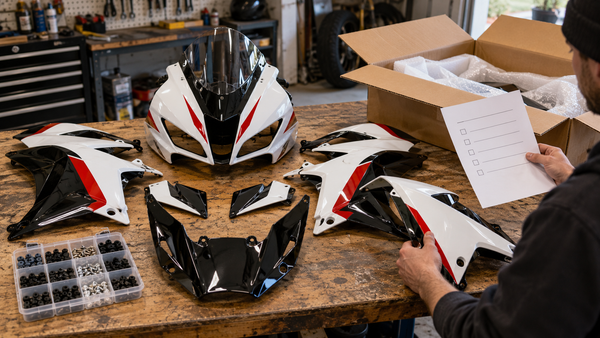
An overall lay-flat photo can show the visible design and major supplied pieces. A back-side close-up can show attachment features, openings and condition. An installed-bike photo can show the exterior appearance and apparent gaps on a particular bike. None of those, alone, is a material certificate, process audit or universal fitment proof. Ask the seller to identify the motorcycle year and kit in any installed example; an anonymous side view is inspiration, not validation.
Three example buying decisions
The process matters to you, but the listing only says ABS. You can ask the seller whether “ABS” refers to the substrate for this exact painted set and which forming method is represented. If the reply cannot establish injection molding, avoid repeating that claim in a review or resale listing. You may still decide the kit meets your cosmetic and budget needs; that is a buying choice, not a technical certification.
The listing states injection molded ABS, but the mounting picture is generic. Save the statement, then request the back of the relevant upper or side panel for your named motorcycle generation. If the seller cannot provide it, record the uncertainty before ordering or plan for a supervised dry fit. “Injection molded” alone does not answer whether a tab matches a bike whose support was replaced after a crash.
The panel arrives and a hole does not meet the support. Do not conclude from that single observation that the material or process label was false. Check the product option, bike variant, transferred hardware and stay alignment. If the mismatch remains, send paired views of the old and new part with the support visible. This evidence gives the supplier a solvable problem rather than an argument about material names.
If you are comparing two painted options, finish may legitimately drive your final choice once the application and part scope are clear. Until then, a sharp color scheme can distract from the two written answers you actually need: what is this selected product claimed to be, and is it intended for this exact motorcycle configuration? Start with the product page, request missing evidence, and record what remains uncertain. That is a stronger buying method than either trusting every “ABS” label or treating every thermoformed ABS part as a fake.
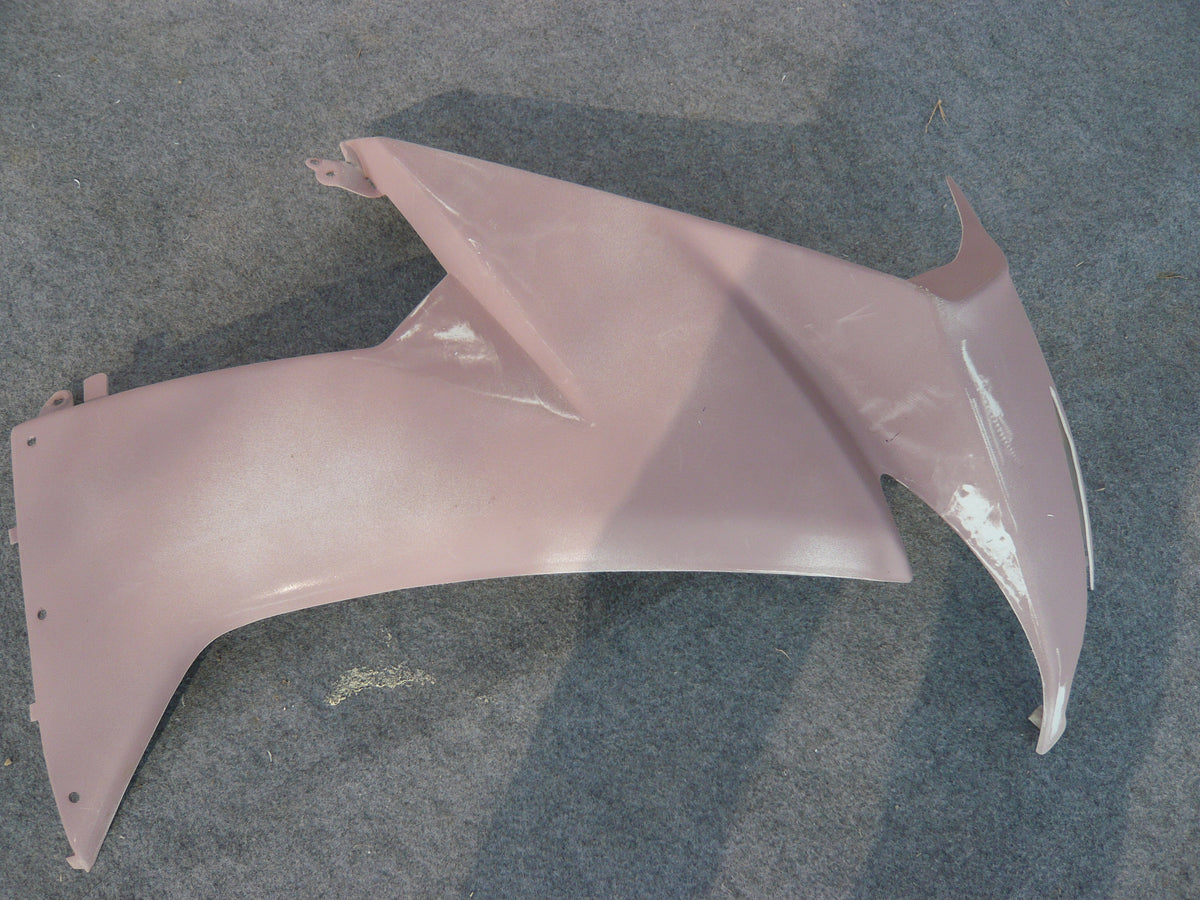
Cover: NiceFairings workshop archive, showing a fairing side panel during surface preparation. Its appearance does not identify the resin or forming process.