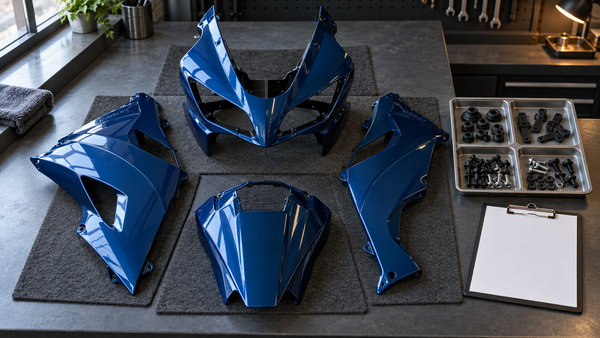

Your riding date is on the calendar. Your motorcycle still has its old fairing. This guide is about that time between today and the road. You will learn to build a motorcycle fairing replacement project timeline backward — from riding date to order day — so every phase has a slot and every risk has a buffer.
This is a planning and logistics guide. It is not an installation how-to, a delivery inspection article, or a race regulations piece. Two clocks control your project: calendar days and business days. Holiday calendars are different by country and carrier. A well-built timeline lowers surprises. It cannot promise a completion date. For first-time motorcycle fairing replacement, that honesty matters.
Key Takeaways
-
Start from your riding date and work backward to build a realistic timeline.
-
Map each quoted business-day estimate onto the relevant calendar, allowing for weekends and applicable holidays.
-
Get the supplier’s current written estimate and confirm which event starts each stage; an estimate is not a delivery promise.
-
Add extra time between each phase to deal with sudden problems.
-
Check the kit promptly on arrival. NiceFairings currently asks buyers to report delivery damage or missing items within seven days; verify the applicable policy.
-
Discuss installer availability early and agree flexible booking or rebooking terms while delivery remains uncertain.
-
Set a decision date a few days before installation to choose whether to move forward.
-
Never skip safety checks to meet a deadline; postpone the ride if the motorcycle is not ready.
Build Your Motorcycle Fairing Replacement Project Timeline
A motorcycle fairing replacement project timeline works backward from your riding date. You start with the day you want to ride. Then you count back through every phase. This method forces you to see the real space between today and the road.
This is a planning guide rather than a mechanical installation procedure. Use it to reserve time for the work and its checks, not to set torque values or decide whether damaged components are safe. A fairing swap has no universal completion time. The actual motorcycle, kit, condition and installer determine what is required. Record their estimate separately from the supplier’s production and shipping windows.
Why Unstructured Planning Fails
The Trap of "I'll Order Soon"
"I'll order soon" feels harmless. The phrase hides a real problem. Soon has no date. Soon has no owner. Soon has no consequence. You tell yourself the order can wait. Then a week passes. Then two. The riding date does not move. The order does.
A replacement project has dependencies. Production may wait for application and design confirmation, shipping follows dispatch, and final installation needs the relevant parts available and checked. Forward planning can work when those dependencies are recorded. Working backward from a riding date adds a useful feasibility check: it shows whether the available time reasonably covers them. Use both views rather than assuming that any one scheduling method prevents delays.
How a Fixed Deadline Changes Priorities
A fixed riding date changes how you make decisions. You stop asking "What would be nice?" You start asking "What must happen first?" The date becomes a filter. Every task either moves you toward the date or away from it.
This shift matters for first-time motorcycle fairing replacement. New buyers often focus on the fun parts. They browse paint schemes. They watch install videos. They forget the boring parts. The boring parts — approval, shipping, customs, scheduling — control the clock.
Calendar Days vs. Business Days
Where Business Days Apply
Calendar days include every date. A business-day estimate follows the relevant supplier or carrier working calendar, which may exclude weekends and local holidays. As a rough illustration only, fifteen to twenty-five working days corresponds to about three to five five-day workweeks before holidays. The actual start day and applicable calendar determine the dates. Ask how the supplier counts the confirmation day rather than treating a week conversion as an exact deadline.
You must convert every quote into calendar days. Otherwise your timeline lies to you. A 25-business-day production window plus a 20-business-day shipping window can consume nine calendar weeks or more. That number surprises many riders.
Which Holiday Calendar Governs
Holiday schedules can affect production, transport or clearance, but not every organization closes on the same dates. Check the origin and destination calendars and the carrier’s published service arrangements. A holiday may affect one stage without stopping all activity. Record the applicable closure or reduced-service period instead of automatically adding the same number of days to every stage.
Ask the supplier which working calendar applies to production and the carrier which service calendar applies to the route. The customs or local delivery stage may follow different arrangements. If an answer is not yet available, label the assumption and retain contingency time. Do not assume your own local public holidays are the only relevant ones.

Your First Backward Pass
Marking the Must-Hold Date
Write the target riding date on paper, but treat safety and readiness as non-negotiable even if the date must move. Working backward, reserve time for final installation and checks, arrival review and issue resolution, shipping, production, and application or design approval. Where tasks can overlap, show the dependency rather than adding every duration twice.
Each block needs a start date and an end date. Leave nothing blank. A blank block becomes a hidden delay.
Placing Rough Phase Blocks
Your first pass will be rough. That is fine. The goal is to see the shape of the project. Use the current NiceFairings estimates as a starting point. The production-shipping page lists 15 to 25 business days for production after fitment and design details are confirmed. It lists an estimated 10 to 20 business days for shipping after dispatch. The combined estimate is 25 to 45 business days.
These are estimates, not guaranteed arrival dates. Pre-approval time, holidays, customs, weather, carrier issues, and remote location can add time. Check the current source before you build your plan. Do not treat any estimate as a promise.
Now place your blocks. If your riding date is eight weeks away, a 25-to-45-business-day estimate may not fit. You have two choices. Adjust the goal. Or postpone. Rushing safety checks is never the answer.
Phase 1 — Scope Your Motorcycle Fairing Replacement
Your motorcycle fairing replacement project starts with scope. Scope means knowing exactly what you are buying and what you already have. This phase influences the work required and the questions you need answered before estimating duration and cost. A clear scope does not determine the supplier’s workload or guarantee a production slot. It gives both parties a defined order against which to provide estimates.
Identify Your Exact Bike and Current Setup
Year, Model, and Trim Details
Establish the exact model year, model, variant and current bodywork configuration. Do not infer compatibility or incompatibility from adjacent years or trim names alone. Use reliable vehicle records and product-specific application confirmation. Provide photographs where requested, and use a private supplier channel for any identifying information genuinely needed. A bodywork conversion or relevant accessory may create additional questions that the basic model name does not resolve.
Do not use new bodywork to conceal an unresolved crash, structural or mechanical concern. Have suspected underlying damage assessed before planning a cosmetic replacement around a riding date. Replacing a panel can address that panel’s condition, but it does not establish that brackets, steering, cooling or other systems are sound. Add any required professional assessment to the scope and timeline.
Current Fairing Condition and Prior Repairs
Document the current panels and any known repairs or changes. An old repair does not automatically alter the fit of a replacement, but associated bracket damage or non-standard parts may require investigation. Tell the supplier and installer what is known and what remains uncertain. Do not bend tabs, remove components or diagnose underlying damage just to complete a planning worksheet.
Consider the replacement cost of your current fairing as well. A bike with old repairs may need extra work to accept new panels. Factor that into your budget and timeline.
Confirm Supplier Application and Item Scope
What the Supplier Needs From You
The supplier asks for specific information. Year, make, model, trim, and current color. They may ask for photos of your current fairings. They need to see the mounting points. They also need your design preferences. If you want custom artwork, include the files or description. If you have questions, check the supplier's FAQ page. That page answers common questions about what to provide.
Ask for the price of the actual scope, including any separate parts, design work, delivery and installation. Do not assume every custom design carries an extra charge or that every full kit costs more than any partial order. A written quote makes it easier to compare options without turning generic pricing assumptions into a schedule decision.
What You Need From the Supplier
The supplier must confirm back to you. They should list every panel in the kit. They should note the hardware, decals, and installation items. They should give you a production timeline estimate. For example, NiceFairings lists production taking 15 to 25 business days after you confirm fitment and design details. Shipping takes an estimated 10 to 20 business days after dispatch. The total estimate is 25 to 45 business days. These are estimates, not guarantees. Check the current production-shipping page for the latest.
Read the actual supplier’s delivery-damage and missing-item reporting instructions before ordering. NiceFairings currently asks buyers to contact it within seven days of delivery and retain packaging and supporting photographs. Do not generalize that period to every seller or every type of claim. Plan a prompt arrival review; a reporting window is not a required waiting period before installation.
Finalize Custom Artwork
What Counts as Approval
Confirm what approval means for your particular order: the application, included parts, design version and any outstanding conditions. Keep the approved reference and the supplier’s acknowledgment together. Ask when the production estimate begins and how revisions affect the order. Later changes may be unavailable once production has started, not simply a matter of adding a predictable number of days. The custom-order guidance explains what information to provide.
Why the Production Clock Waits on You
Where production depends on application and design confirmation, time spent resolving those details sits before the quoted production window. A delayed approval may move the planned start, but the effect on the actual queue is supplier-specific. Answer questions promptly without approving an unresolved design just to save time. Confirm the acknowledged order stage rather than assuming your reply instantly starts manufacturing.
Phase 2 — Production, Shipping, Customs
After confirmation, track the supplier’s acknowledged production window and eventual dispatch. Shipping and customs may overlap within a door-to-door estimate; they are not always three entirely separate durations to add together. Ask what each estimate includes and label the boundaries in your worksheet. You can organize your responses and contingency plan even though you cannot guarantee manufacturing, carrier or clearance timing.
Production Time After Approval
Standard vs. Custom Paint Runs
An existing listing design may reduce the amount of artwork discussion compared with a new brief, but it does not prove that paint is already mixed or that production will be faster. Ask for the estimate for your selected option. A complex custom request may need extra confirmation; another may fit the usual production window. Keep approval time and post-confirmation production time separate, and record the actual answer rather than assuming a fixed standard-versus-custom difference.
Asking for a Realistic Production Window
Ask your supplier one direct question: "How many business days after my approval will production take?" Get the answer in writing. The current NiceFairings production-shipping page says production takes 15 to 25 business days after fitment and design details are confirmed. That range is an estimate. It is not a guaranteed arrival date. Time before approval, holidays, weather, carrier issues, and remote location can all add time. Check the page again before you make your final plan.
Treat every production window as an estimate. A supplier quote is a planning tool, not a promise.

Shipping Time After Dispatch
Carrier Options and Transit Estimates
Dispatch means the kit leaves the factory. Then shipping starts. The same NiceFairings page estimates 10 to 20 business days for shipping after dispatch. The combined estimate is 25 to 45 business days. Again, these are estimates, not guarantees.
Ask which shipping services are actually available for your destination, their current estimates and the charge shown for your order. Do not assume the store offers sea freight, express upgrades or a service you have seen elsewhere. Clarify whether the estimate is door-to-door and whether ordinary customs processing is already included. Record exceptional-delay risk separately without automatically double-counting clearance days.
Tracking Milestones That Matter
Tracking can show dispatch or carrier acceptance, movement through hubs, clearance updates and local delivery progress, but the exact scan labels and visibility vary by carrier. A label-created event does not necessarily mean the parcel is already moving. Missing scans do not conclusively locate a delay. Follow the carrier’s published information and ask the supplier about unexplained gaps rather than inventing a handoff from an absent update.

Customs and Import Processing
Documents You May Need
Ask the supplier and carrier what recipient information, documents or actions are required for your destination and shipment. Requirements vary, so this guide is not a universal import-document checklist. Use the carrier or customs authority’s current instructions and secure channels for requested personal details. Keep accurate order and shipment information available; do not invent values, descriptions or documents to speed clearance.
Why Customs Needs a Contingency Plan
There is no single customs duration that applies to every destination and shipment. Clearance may be included in the carrier’s estimate, and additional inspection or information requests can still cause delay. Ask what the estimate covers. Treat unresolved clearance as a risk to monitor rather than assigning an unsupported fixed number of days to all orders.
Respond promptly to genuine carrier or customs requests using verified channels. Ask for clarification if the request is unclear, and retain the records. Preparation can help avoid preventable delays, but it cannot promise a release date. Keep contingency time appropriate to the route and your commitments.
Phase 3 — Arrival and Installer Scheduling
The kit has arrived. Now the focus moves from shipping to getting ready. This step covers checking the kit, reporting problems, and setting a time with your installer. Each part helps avoid a rushed and messy fairing swap.
Inspect the Kit on Arrival
Photograph the Packaging Before Opening
Before opening, photograph the packaging and any visible damage. Keep the label and order details available for a report without publishing personal information. These images document the condition you observed and can support the supplier’s review; this guide does not decide whether a claim succeeds or fails solely on a particular photograph.
Check Panels, Paint, and Hardware Against the Order
Unpack on a clean, protected surface and compare the received components with the order and packing information. Note visible damage, missing items or discrepancies from the approved design. Count supplied hardware against the agreed list rather than assuming every kit includes bolts. If a problem is found, keep the affected parts and packaging intact and contact the supplier before installing or modifying them.
Report Issues Immediately
The Claim Window
NiceFairings says to contact them within 7 days after delivery. Save all packaging until you finish checking. Don't throw away boxes or foam. A claim without the original packaging is harder to fix. Check the policy page for the latest rules.
What Documentation Speeds a Resolution
Send clear photographs of the issue and packaging, together with the order number, delivery date and a concise description. Keep the original files and correspondence. A complete report can reduce follow-up questions, but it does not guarantee a response time or resolution date. Leave room in the project plan for the actual review outcome.
Schedule Fairing Installation
Installer Availability Lead Times
Discuss availability before the kit arrives. Ask for an estimate based on the motorcycle, proposed kit and known condition, and ask what cannot be assessed until the parts are present. An initial estimate may need revision after inspection. Record the booking terms and the time reserved for resolving issues, not just the hands-on installation slot.
Confirming the Slot Before the Kit Lands
Use a provisional booking or an agreed rebooking process while arrival is uncertain. A carrier estimate is not a guaranteed appointment input. Reserve a supported pre-fit and final checks; the pre-fit checklist helps organize those questions. Do not ride with loose, damaged or incompletely fitted parts, or force a fit to meet the date. Have any proposed modification assessed under the applicable instructions and supplier process.

Phase 4 — Contingency and Decision Gates
A good timeline for a motorcycle fairing swap plans for problems. You can't control how fast production goes, customs, or weather. But you can control how you handle delays. This phase adds buffer time and sets clear decision points.
Build a Buffer Into the Calendar
How Much Buffer Is Realistic
Choose contingency time according to the unresolved risks, estimate ranges and flexibility of your riding and workshop dates. There is no universal few-day buffer that makes every project safe. Avoid counting the same allowance in multiple stages. A hard-to-move commitment needs a realistic fallback, not merely an optimistic extra day added to each row.
The NiceFairings production-shipping page says production takes 15 to 25 business days after you confirm fitment and design. It says shipping takes 10 to 20 business days after the kit leaves. The total is 25 to 45 business days. These are estimates, not guarantees. Things like time before approval, holidays, customs, weather, carrier problems, and faraway places can add days. Check the page again before you set your buffer.
Where Buffer Does the Most Good
Place contingency where a delay would affect the next commitment: before an inflexible installer booking, for example, or between final checks and a planned trip. Ask which stages are most uncertain for this order. Do not automatically make one buffer the largest for every buyer; an unresolved design, a shipping route or workshop availability can dominate different projects.
Set Decision Gates
Gate 1 — Order-by Date
Your order-by date is a planning threshold calculated from the assumptions you have recorded, not the last date on which arrival is guaranteed. Count backward through final work, contingency, shipping, production and pre-confirmation tasks using the appropriate calendars. If the threshold is already past, review the assumptions with the supplier and installer and adjust the goal or postpone rather than relying on luck.
Gate 2 — Ship-by Date
Your ship-by date is the planned dispatch threshold for the remaining schedule. Check the current shipping guidance and ask the supplier for the actual status. A tracking number alone is not proof of carrier acceptance. If dispatch has slipped, recalculate the remaining time and contact the installer before an inflexible booking creates avoidable cost.
Gate 3 — Go/No-Go Date
Your go/no-go date is when you decide to keep going or put it off. Set this date a few days before your installer appointment. At this point, ask yourself three questions. Do you have the kit? Is it in good shape? Is the installer ready? If any answer is no, postpone the ride. Never skip safety checks just to hit a deadline.
Plan B at Each Gate
Reassess Scope Before Ordering
If the timeline is tight, discuss the scope before ordering with the supplier and a qualified installer. A smaller cosmetic project might be an alternative, but it does not automatically shorten lead time or reduce the total quote. Check the actual availability and work required. Do not reduce the scope by leaving necessary components, repairs or safety checks unfinished.
Use Another Motorcycle or Postpone
If the kit won't arrive in time, you have two safe choices. One: ride a different bike that is ready if you have one. Two: push back the ride. Never ride with bodywork that is not finished, loose, or damaged. Never skip a pro check just to hit a date. A good plan for a fairing swap keeps you safe. Change the goal or wait. That is always better than rushing.
A deadline is never a reason to skip safety checks. Postponing is a smart planning choice.
Your Backward-Planning Worksheet
A worksheet turns your motorcycle fairing replacement project timeline into a plan you can see. You can see every phase, every date, and every gap. Paper works. A spreadsheet works too. The format matters less than writing it down.
The Blank Worksheet
Columns to Fill In
Build six columns. Column one lists each phase: scope, artwork approval, production, shipping, customs, arrival inspection, and installation. Column two holds how long that phase takes. Column three shows who confirms that time. Column four marks the start date. Column five marks the end date. Column six leaves room for notes.
Leave most duration cells blank at first. Mark them as supplier-confirmed or installer-confirmed. The only exceptions are the current NiceFairings estimates. The production-shipping page lists 15 to 25 business days for production after fitment and design confirmation. It lists an estimated 10 to 20 business days for shipping after dispatch. The combined estimate is 25 to 45 business days. Label these clearly as estimates, not guarantees. Check the page again before you finalize your plan.
How to Count Backward From the Riding Date
Start with the target ride and reserve the installer-confirmed work and final-check allowance. Above that, allow time for prompt arrival review and possible issue resolution. Do not subtract a seven-day reporting window as if it were a compulsory waiting period or a promised claim-resolution duration. Then account for shipping, any non-overlapping clearance allowance, production and approval on their relevant calendars. Each date remains conditional on its inputs.
When you reach the top, you have your order-by date. Compare it to today. If the order-by date has passed, your timeline does not work. You must adjust the goal or postpone.
A Realistic Hypothetical Example
Assumptions Used
This example is hypothetical. It shows the method, not a promise. Imagine a rider with a riding date roughly four months away. The supplier confirms a production window. The carrier provides a shipping estimate. The installer gives a scheduling lead time. The rider adds buffer days between phases. All durations come from those confirmations, except the labeled site estimates used as placeholders.
The Completed Timeline Walkthrough
The rider fills the worksheet from the bottom up. The installation slot is provisional; arrival review and issue resolution have their own allowance. The site estimates of ten to twenty business days for shipping and fifteen to twenty-five for production are recorded as dated placeholders. The rider asks whether clearance is included in shipping before adding another duration. Artwork and scope confirmation remain supplier-confirmed inputs, not invented one-day or two-day promises.
The rider maps the confirmed inputs and contingency onto a real calendar and checks the result against the target date. If the dates do not fit, the rider revises the plan before committing. The worksheet does not prove that a roughly four-month horizon is sufficient for every order. It makes the assumptions visible so that a supplier update or installer change can be reflected without hiding a missed dependency.
Common Timeline Mistakes to Avoid
Treating Shipping and Customs as One Step
Clarify the boundary of the shipping estimate. It may describe transport to a destination hub or delivery to the buyer; customs processing may be included in a door-to-door estimate. Treating every shipment as dispatch-to-border transport would be misleading. Keep clearance visible as a dependency and risk, but do not add a second allowance for the same normal processing without checking the estimate’s scope.
The NiceFairings production-shipping page estimates 10 to 20 business days for shipping after dispatch. Ask your carrier if that estimate covers customs clearance. If it does, do not add extra days. If it does not, plan for more time. Customs can take hours or days. Officials may ask for more documents. You cannot control that clock.
Record the shipping service, stated coverage and claim process for the actual order. The product price alone does not establish insurance, tracking quality or a customs duration. Your worksheet can show transport and clearance on separate lines for visibility while noting when their time allowances overlap.
Ignoring Installer Schedules
Arrange appropriate experience, equipment and instructions for the work. Workshop availability varies and should be checked directly rather than assumed to be several weeks. Contacting an installer early gives you time to understand the expected scope and booking terms. It also exposes questions that may need an answer before the kit is ordered.
Call potential installers before you place your order. Ask about their current lead time and their cancellation policy. An early talk helps you match the installation date with the expected delivery date. Ask what days they have open around your target.
Installation labor adds to your fairing replacement cost. Ask for a written estimate before you commit. Knowing the total fairing replacement cost helps you set a realistic budget. If no shop has space when you need it, adjust your riding date or find another qualified shop. Do not try installation without proper experience. A poor installation can damage your motorcycle and create safety risks.
Skipping the Go/No-Go Gate
A go/no-go gate is a decision date you set early in the project. It comes a few days before the installation appointment. You choose that date when you create your timeline.
Without this gate, you drift when delays occur. You keep hoping the kit will arrive. You keep hoping the shop will fit you in. You may feel pressure to rush or skip steps. That pressure leads to unsafe shortcuts.
Set the gate on your calendar when you build the timeline. On that day, ask three questions. Do you have the kit? Is it in good condition? Is the installer confirmed and ready? If any answer is no, postpone. Safety matters more than any deadline.
A good go/no-go gate protects your investment in your motorcycle fairing replacement. It also protects your safety on the road. You have already invested time and money into this project. Do not throw that away by rushing at the end.
Begin with your riding date. Count backward through each step. Put extra time between production, shipping, and installation. This keeps your planning under control. This way shows how much time you really have.
Remember that business-day estimates and calendar dates are different. Confirm the relevant working calendars and what the quoted stages include. Time before confirmation, holidays, clearance issues, weather or carrier disruptions can change the plan. Keep the uncertainty visible rather than declaring any one stage universally the least predictable.
Fill out your worksheet now. Keep space for changes. If the schedule does not work, adjust the goal or delay. A good plan manages risk, not just dates. A planned motorcycle project causes less worry. Know your fairing replacement cost early. Check that cost at each decision point. Your budget stays safe when you keep track. Plan ahead so you do not feel stressed.
FAQ
What is the first step in a motorcycle fairing replacement project timeline?
Begin with the target riding date, then identify the scope, dependencies and current supplier and installer estimates. A larger scope does not automatically mean a particular cost or duration. Record the actual inputs, apply the relevant calendars and leave a practical fallback if the dates do not fit.
Why does the calendar versus business day difference matter?
A business-day estimate is counted on a working calendar, not as consecutive dates. Twenty working days is roughly four five-day workweeks before applicable holidays; the exact dates depend on the start and calendar. Ask the supplier or carrier how its estimate is counted.
How long does production take after I approve the design?
The current NiceFairings production-shipping page lists 15 to 25 business days after you confirm fitment and design details. This is an estimate, not a guaranteed arrival date.
When should I contact my installer?
Call a motorcycle shop before you order. Ask about lead times and cancellation policies. Good shops may book weeks ahead. Agree on rebooking terms before committing.
What if customs holds my fairing kit?
Follow the carrier or customs authority’s current instructions for your shipment. Keep the required information available and respond promptly through verified channels. Ask what the shipping estimate already includes, and review your fallback if clearance delays threaten the next commitment.
What do I do if the kit arrives damaged?
Document packaging and visible issues, compare the received parts with the order and contact the supplier promptly. NiceFairings currently requests contact within seven days for delivery damage or missing items. Retain packaging and do not install, modify or discard affected parts while awaiting the supplier’s instructions.
What if my timeline cannot fit the riding date?
Adjust your goal or postpone the ride. Consider the fairing replacement cost when deciding. Never skip safety checks to meet a deadline.