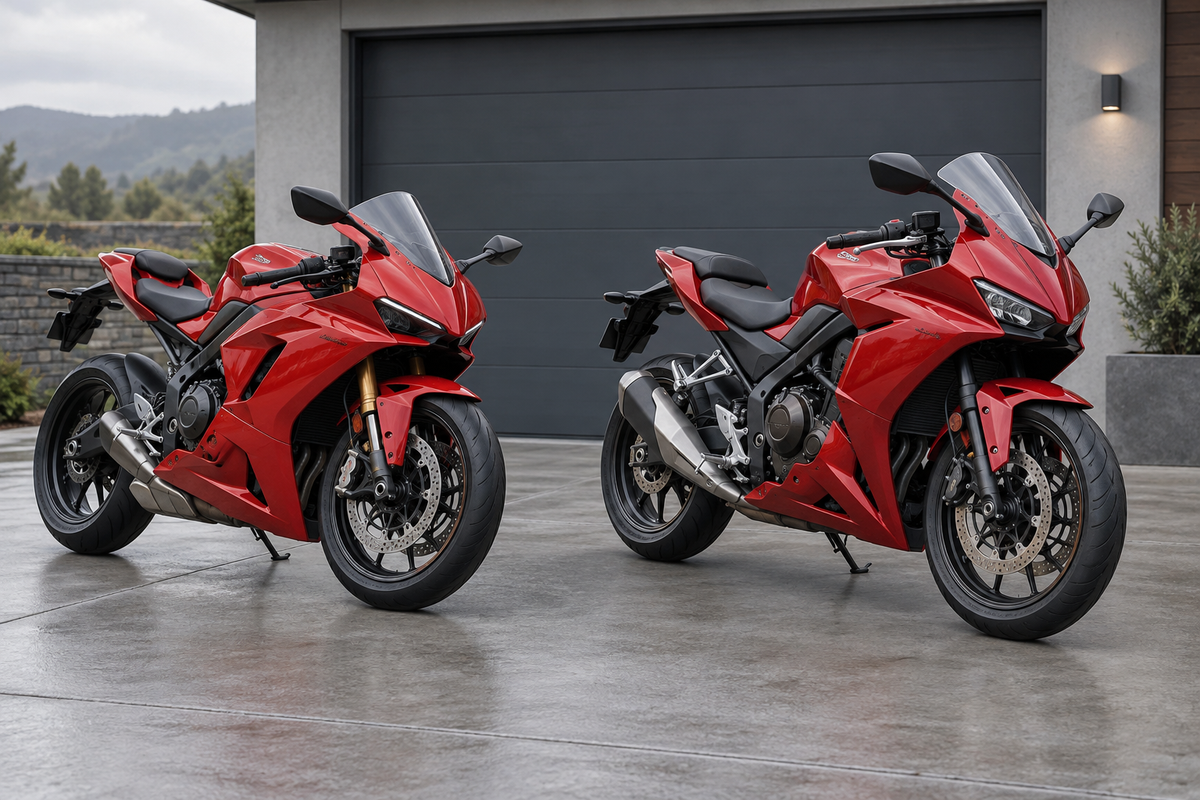
When comparing Honda CBR600RR vs CBR650R fairings, treat them as separate model applications rather than a presumed direct swap. Similar CBR lettering and paint schemes do not prove fit. This guide helps US and European buyers document the exact motorcycle, check the proposed product and ask clearer bodywork-ordering questions. It is not a conversion tutorial or a universal panel-interchangeability chart. Verify the exact year, original market, current configuration and individual component references before comparing appearance or price.
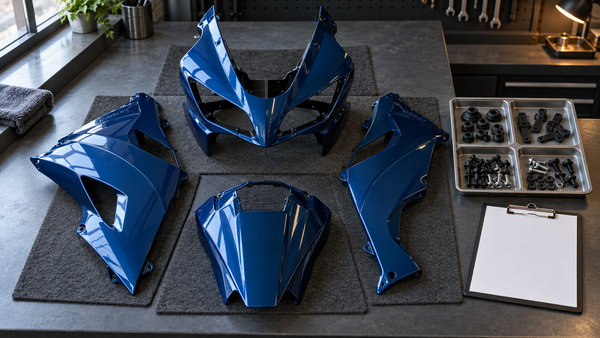
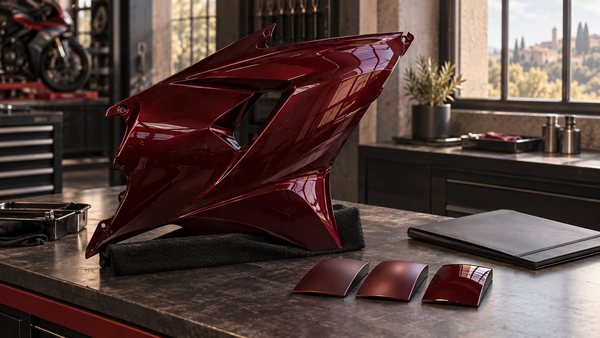
Images are AI-generated editorial illustrations, not photographs of a supplied kit or evidence of model-year fitment. Use real product information and your own motorcycle records for ordering decisions.
Key Takeaways
Treat CBR600RR and CBR650R as separate applications; verify each specific component rather than assuming a direct swap.
Always use the VIN to check your bike's exact model year, not the registration year.
US and European versions may differ; check year-specific regional parts documentation rather than relying on a generic feature description.
Make sure the seller's fitment range matches your specific year group before you order.
Make a list of all aftermarket parts, like exhausts or crash cages. Then ask if they change how the fairings fit.
Check all body panels as soon as they arrive, and take photos right away to record any damage.
Plan a controlled pre-fit according to the kit instructions and with professional help where needed. Do not ride with loosely fitted panels. Confirm the seller’s inspection and return conditions before installation.
Stay away from sellers who give unclear fitment claims like "fits all years." Pick sellers who check that the part works with your bike.
Honda CBR600RR vs CBR650R Fairings: Ordering Differences
Design and Styling Cues
The Honda CBR600RR and CBR650R share CBR styling cues, but their bodywork follows separate design paths. The 2025 Honda CBR600RR (599cc) is a supersport model. The 2025 Honda CBR650R (649cc) is a sport model with different bodywork proportions. Engine size alone does not prove that individual panels fit either bike.
CBR600RR bodywork listings often group multiple model years, but those seller ranges are not a universal Honda interchangeability chart. Verify the exact model year, original market and individual component reference. Changes in appearance do not by themselves prove that every mounting point changed, and a matching year range does not establish that every part is shared.
Material and Construction
Aftermarket motorcycle fairings differ in material and build quality. Some sellers make universal fit claims that do not match any specific year group. The safest way is to check the seller's fitment range against your exact year group.
Common ordering mistakes include buying by the CBR name alone, checking the model but not the year, and thinking "looks close" means "belongs in the same fairing group." Trusting pictures more than the listed fitment range leads to returns. Focusing on paint before confirming structure creates problems. Ordering without checking what comes in the kit leaves buyers with missing hardware.
A broad model or year label is not a part-specific fitment check. Confirm the exact motorcycle and proposed bodywork before ordering.
Fitment and Cost Expectations
For both models, use the exact motorcycle identity and the part-specific catalog reference rather than an unverified list of year groups. Ask the seller which years and markets the particular kit was designed for. Distinguish a complete matched bodywork set from a single replacement panel, since their compatibility questions are not identical.
Compare current quotes on the same material, finish, contents and application. A low or high price alone does not reveal panel thickness or kit quality. Ask which items and services are included and obtain the actual terms for the proposed order. Choose a documented application rather than the kit that looks closest in a photograph.
Why They Are Not Interchangeable
Two Separate Model Families
Honda identifies the CBR600RR and CBR650R separately. Treat a full kit advertised for one as a different application, not a direct-swap promise for the other. This does not establish whether an individual small component has a shared reference; check that question through the relevant catalog or supplier. The model name is the start of verification, not a complete interchangeability test.
The 2025 Honda CBR600RR (599cc) is a supersport bike. The 2025 Honda CBR650R (649cc) is a sport bike. Engine size alone does not tell you if a single panel fits your bike. Buyers who think these are one family often order the wrong parts. The safest method treats each model as its own platform with its own bodywork design.
The same CBR logo, graphics, or engine size does not prove the fairings will fit. A seller may list a kit under a broad CBR label. That label does not mean the panels match your specific bike. Always check the full model name before you order.
Model Year vs Registration Year
The model year and the registration year are not the same thing. A bike first registered in 2020 might be a 2019 model. That difference matters when you order fairings. Sellers often list fitment by model year. Your registration papers may show a different year.
Buyers should look at the VIN or the frame sticker for the exact model year. Do not rely on the registration date alone. A one-year gap can put your bike in a different fairing group. That mistake leads to panels that do not line up with your mounting points.
The same logic applies to the Honda CBR650R. A 2021 registration does not guarantee a 2021 model year. Check the model year from the bike itself. Then match that year to the seller's fitment range.
US and European Market Differences
US and European market specs can be different for the same model name. Do not merge regional versions or use current US numbers for all years. A part that fits a European bike may not fit a US bike of the same year.
Regional differences must be checked for a stated model year, not applied to every European or US CBR600RR. Compare the official model page and parts catalog for the motorcycle’s original market, then inspect its existing nose, windscreen, trim and supports. Visible styling features alone are not evidence that a replacement panel fits.
European-market bike: confirm the exact model year and regional component references.
US-market bike: verify its own year-specific bodywork rather than assuming a current overseas specification applies.
This difference shows why market matters. A US buyer who orders a European-style front fairing may get a part that does not match the original bodywork. Always check which market your bike was built for before you order.

CBR600RR Fairings Checks
Before you order bodywork, you need to confirm a few things. The full model name is important. The model year matters more than the year it was registered. The market region counts because US and European versions are not the same. Any changes already made to the bike can affect what fits. You also need exact reference numbers for the nose, side panels, tail, windscreen, and trim parts. This section goes through each check point.
Track Use vs Street Use
Road and track use can require different configurations. Ask which lights, trim, supports and other equipment the proposed bodywork is designed to retain, and check any event-specific requirements separately. Neither a racing appearance nor a street-kit label proves suitability. Keep finish preferences separate from functional and regulatory requirements.
Ask the supplier to state the intended application of the actual kit and list its contents. Do not assume track bodywork is lighter, has brake-cooling openings or uses a simpler mounting system. Likewise, a full road kit may not include every trim piece. Record the required retained parts and have the intended configuration assessed where necessary.
OEM vs Aftermarket Bodywork
For OEM replacement panels, use the appropriate catalog or dealer to confirm the complete reference, finish variant and any supersession conditions. The OEM label alone is not proof that a particular item matches a modified motorcycle or that a used part is sound. Compare availability and price using an actual quote rather than an assumed relationship to aftermarket alternatives.
Aftermarket suppliers may offer different finish and kit options, but verify the precise application rather than judging a listing by a broad year label alone. Compare the manufacturer’s component references with the seller’s description, photographs and written fitment confirmation. An OEM part number and a seller SKU serve different purposes and should not be treated as equivalent.
Mounting Points and Hardware
Fit depends on the intended panel assembly, its supports and the motorcycle’s current configuration. Check the specific application and any visible changes or damage. This guide does not document a history of frame attachment-point changes. If a mounting question cannot be resolved from reliable records, obtain an appropriate physical assessment.
Identification check |
Evidence to request |
|---|---|
Model and year |
Exact model designation and market-appropriate identification records. |
Original market |
Year-specific regional documentation and parts references. |
Individual component |
Nose, side, tail, windscreen and trim references checked separately. |
Existing modifications |
Photos and accessory identifiers supplied for written confirmation. |
Seller application |
Exact kit range and included parts, not a universal interchangeability promise. |
Confirm the model year and original market using the motorcycle’s identification records and a Honda dealer if necessary. Do not rely solely on registration date or apply a VIN decoding convention without checking that it is appropriate for the market. Obtain written confirmation of the exact product application before ordering.
Check the actual panel, surrounding pieces and supports together; a model name or a photograph alone is not a complete fitment confirmation.
Nose, Side, and Tail References
Check the nose, side and tail components individually. Their shape, openings, adjoining panels and mounting arrangements need to match the intended bodywork assembly. Avoid declaring cross-year compatibility or incompatibility from photographs alone; obtain the relevant component references and seller confirmation.
When you order, confirm each panel reference with the seller. Give the exact panel name. For example, ask about the "left side panel for a 2017 CBR600RR" instead of listing only CBR as the model name. Steps like these prevent wrong shipments.
Windscreen and Trim Pieces
Windscreen shape, fastener positions and surrounding trim must be checked against the exact nose panel and its application. Do not infer windscreen interchangeability from a broad generation label. Ask whether the kit is intended for the existing screen or a specified replacement, and verify required hardware separately.
Trim pieces like the front fender, inner panels, and radiator shrouds also vary by year. Order a full kit that lists all included pieces. Confirm with the seller that each trim piece matches your year group. Confirm these details before you pay.
This check process applies to any buyer of Honda CBR600RR and CBR fairings. Knowing these differences prevents costly mistakes. The next section covers similar checks for the CBR650R.

CBR650R Fairings Checks
The Honda CBR650R is made for people who ride to work during the week and have fun on weekends. This double duty shapes what you need from replacement bodywork. The 2025 Honda CBR650R (649cc) is a sport model, not a supersport. Its bodywork shows that purpose. Before you order, check the exact model year, market, and any accessories already on the bike.
Commuter Use vs Sport Use
Think about the motorcycle’s intended use and ask for suitable product information. Weather exposure, finish care, retained equipment and ease of maintenance may all matter. Do not assume a commuter or track label establishes durability, weather sealing or weight. Compare the actual construction and installation requirements of the proposed bodywork.
Describe the intended riding use to the supplier and request the exact supported configuration. Separate main panels from trim, hardware and required retained equipment. A generic full-kit or race-kit label does not prove which pieces are included or whether the purchase suits the current motorcycle.
Compatibility with Accessories
Identify factory equipment as well as aftermarket accessories. For example, Honda lists a 2025 US CBR650R E-Clutch variant; this is factory configuration, not simply an aftermarket add-on. Tell the supplier which version the motorcycle is and ask about the exact proposed bodywork, without inferring compatibility from an accessory maker’s separate product claim.
An accessory maker’s fitting claim applies to its stated accessory and motorcycle application, not automatically to an unrelated fairing kit. Provide the seller with the exact motorcycle variant and accessory identifiers, then ask for clearance confirmation for the proposed combination.
Ask whether the particular bodywork listing is intended for the motorcycle’s exact factory variant and current accessories. If the supplier cannot confirm this, keep the question unresolved. An accessory clearance statement is not, by itself, a cross-variant fairing interchangeability chart.
A no-modification claim for one crash-protection product does not establish that every replacement fairing will fit around it. Check the exact accessory version, installation instructions and bodywork configuration.
The lesson applies to any accessory. Crash cages, frame sliders, and luggage racks all interact with bodywork. Tell the seller about every accessory on your bike. Ask if their kit accounts for those parts. A kit that fits a stock bike may not fit yours.
Material Durability and Finish
Material names alone do not establish a finished panel’s weight, durability or crash behavior. ABS, fiberglass and carbon-fiber constructions vary by design, thickness, manufacturing process and quality. Ask for the actual product specification, finish information and intended application instead of assuming a universal ranking.
Ask about the actual coating system, finish specification and care requirements. A label such as single-stage or clear-coated is not sufficient to predict fading, scratch resistance or service life. Request suitable finish examples and clarify color-matching expectations before production.
Check how the seller packages panels for shipping. Thin material and poor packing lead to cracks in transit. Inspect every panel on arrival. Document any damage with photos immediately. The guide on photos to identify replacement motorcycle fairings explains how to capture useful images for claims.
Fitment checks for the Honda CBR650R follow the same logic as any bike. Confirm the model year against the seller's range. Verify that accessories do not interfere. Ask about material and finish. These steps protect your investment. The next section covers documenting a modified bike before you order.

Documenting a Modified Bike
When your bike has changes, normal fitment rules might not work. Aftermarket parts can change the frame, the subframe, or where parts attach. A tail swap changes the back bodywork area. An aftermarket exhaust changes space near the lower fairing. Good documentation before you order saves time and money. This section explains what to capture before you talk to a seller.
Photos and Measurements to Collect
Photos give the seller a clear view of your bike's current state. Take images from several angles before you remove any existing fairings. Include the full bike from both sides. Show the front view and the rear view. Take close-ups of every mounting point. If your bike has an aftermarket subframe, nonstandard rearsets, or clip-ons that changed the riding position, photograph those areas. The seller needs to see what space the fairing panels must fit around.
Keep clear photographs and notes of the existing configuration before any work. Leave removal to the person carrying out the installation when access requires dismantling. Photographs should document the owner’s actual motorcycle, not substitute stock or generated images for evidence of a mounting arrangement.
Ask the supplier which measurements are useful and how to identify the points consistently. Take only measurements that can be obtained safely without unnecessary dismantling; have difficult access checked by a technician. Record units and uncertainty with the photographs. Measurements support a focused enquiry but do not prove compatibility on their own.
Questions for the Seller
State the exact model, year, original market and factory variant, then list aftermarket changes separately. Include relevant tail conversions, exhausts or crash protection. Ask the supplier to address the proposed product and this particular configuration. Do not describe factory E-Clutch equipment as though it were necessarily a later owner modification.
Confirm the exact application of the kit, including model year, original market and relevant factory equipment. A broad range that contains the motorcycle’s year is only a starting point, not proof of fit. Identify any accessories separately and request a written inventory of the included trim, windscreen and hardware.
Red Flags That Signal a Wrong Fit
A vague fits-all-years claim needs clarification before purchase. Ask for the exact supported application and any exceptions, rather than relying on an unverified list of generational frame changes. The supplier should distinguish the complete kit from individual replacement pieces and explain what the listing actually covers.
Another warning sign is an unwillingness to answer modification questions. A seller who says "our kit fits all stock bikes" may not account for aftermarket parts. If they cannot confirm clearance for a tail swap or an exhaust system, shop elsewhere.
If the price differs substantially between offers, ask which components, finish work, shipping charges and services are included. Price alone does not prove thin material or missing pieces. Use the NiceFairings contact page for questions about an actual NiceFairings listing, with photographs and the motorcycle details needed for a focused response.
Fairings Comparison Table
How to Read the Table
The table below shows the main ordering differences between the two model families. It does not list technical specifications. It does not say the fairings can be swapped. Each row covers one thing you need to check.
The table has three columns. The first column names what to verify. The second column gives guidance for the 600RR model. The third column gives guidance for the 650R model.
Read each row from left to right. Start with the verification category. Then check the guidance for your model. The table helps you ask the right questions before you order bodywork.
Use the table as a reference when you talk to a seller. Each row stands for one step in the verification process. Do not skip any row. A missed step can lead to panels that do not fit. The table does not replace direct confirmation with the seller. It guides your questions so you get the right information.
What to Verify |
600RR Guidance |
650R Guidance |
|---|---|---|
Confirm full model name |
The 2025 CBR600RR (599cc) is a supersport. Earlier year groups have distinct bodywork shapes. |
The 2025 Honda CBR650R (649cc) is a sport bike. Its year groups differ from the 600RR model. |
Check model year vs registration year |
Use market-appropriate identification records or Honda dealer confirmation; registration date alone may not identify the model year. |
Same principle applies. A 2021 registration does not guarantee a 2021 model. |
Identify market region |
Verify the exact model year and original market; do not generalize regional bodywork features across all years. |
US and European specs can differ. Verify the original market for your bike. |
Note existing modifications |
Track use may need different fairings than street use. Ask about quick-release options. |
Identify the factory variant, including E-Clutch where applicable, and list aftermarket accessories separately. Ask the seller to verify the specific combination. |
Request panel and trim details |
Nose, side, tail, and windscreen vary by year group. Confirm each part reference. |
Trim pieces and inner panels vary by year. Verify kit completeness before ordering. |
Verify seller fitment range |
Ask for exact year group match. Avoid listings that claim to fit all years. |
Confirm the exact year, market and component references; do not rely on a generalized generation count. |
Matching the Table to Your Bike
Start with the first row. Confirm your full model name. Write down the exact model and year from your bike VIN. Do not trust your memory or your registration papers alone.
Go to the market region row next. Record the original market and the exact year, then compare the appropriate official documentation and component references. Imported or modified motorcycles may not match the current local showroom version. A winglet, decal or color scheme alone cannot resolve this question.
Then look at your current modifications. If your bike has aftermarket parts, make a list of them. Share that list with the seller. A kit that fits a stock motorcycle fairings set may not fit your bike.
The last rows help you confirm panel references and the seller's fitment range. Ask the seller for the exact year group range. Confirm each panel name. Check that trim pieces are included.
Work through the table in order. Each row builds on the one before it. Start with the model name. End with seller confirmation. This process lowers the chance of ordering the wrong bodywork.
After you match the table to your bike, contact the seller with what you found. The NiceFairings contact page lets you send your verification details. A good seller reviews your information before confirming compatibility.

Order Verification Checklist
Doing the right things before you order saves time and money. A careful process stops wrong panels from showing up at your door. This checklist covers what to do before you buy and after the box arrives.
Pre-Order Verification Steps
Going through these steps before ordering helps you feel sure about your purchase.
Confirm the full model designation, year and original market from reliable identification records. Do not assume trim names used for another Honda model also apply to this motorcycle. Ask a Honda dealer to resolve ambiguous identification before selecting a kit.
Compare reliable parts references, descriptions and images to identify the component you need. A visual resemblance is not proof of fit. Ask the relevant dealer about OEM catalog application and the aftermarket supplier about its own supported configuration.
Compare a complete kit with individual-panel replacement according to the damage, retained parts and finish-matching needs. A single-panel repair can make matching adjacent aged paint especially important; confirm this rather than assuming color matters less.
Agree color references, finish expectations and estimated lead-time milestones with the seller. A paint code is a starting reference, not a guarantee of a match to aged panels or screen colors. Separate estimates from any specifically agreed delivery commitment.
Ask how design approval works for the actual order and when changes can still be accepted. Review any promised preview carefully; it does not guarantee exact physical color reproduction. Keep the agreed version and change conditions with the order.
Check the seller's production batch schedule, shipping methods, customs policies, and packaging standards. These things affect how fast your order arrives and what shape it is in.
Arrange any pre-fit in accordance with the kit and motorcycle instructions, with professional help where needed. Check the seller’s actual return and inspection conditions before beginning. A trial fit does not automatically preserve return eligibility.
After-Order and Delivery Checks
Once your order ships, the prep work continues. Track the package so you know when it arrives. Customs delays happen with international shipments. Add that time to your schedule.
When the package arrives, inspect it right away. Do not sign for a damaged box without writing down the damage. Open the package slowly. Lay out every panel and check it against the packing list. Missing pieces are easier to report right away.
Take photos of each panel as you unpack it. Good lighting helps you spot surface flaws. The guide on photos to identify replacement motorcycle fairings explains which angles give useful reference images. Capture any cracks, scratches, or warping. Document every issue the same way you would for a claim.
If a pre-fit is appropriate, have it performed according to the specific instructions and keep the motorcycle out of use until safely assembled and checked. Stop if components require force, interfere with other equipment or expose damage. Contact the supplier and installer to resolve the issue. Follow the actual order terms; this guide does not promise returns after fitting or prescribe a universal procedure.
Follow the same process whether you own a honda cbr650r or a cbr600rr. A honda cbr650r buyer should check accessory clearance just as carefully. A cbr600rr owner should confirm the year group range. The right panels match your exact bike. The ones that look closest in a photo are not.
Treat the CBR600RR and CBR650R as separate bodywork applications. Verify the exact model, year, original market and proposed component references instead of assuming a direct swap from shared lettering or similar paint. Document existing modifications and obtain the relevant supplier or dealer’s clarification. Any claim about an individual shared part needs its own evidence.
The right fairings match your specific bike. They are not the ones that look closest in a photo. For official model identification, see the Honda US 2025 pages for the CBR600RR and the CBR650R. For fitment help, visit the NiceFairings contact page.
FAQ
Can I use Honda CBR600RR fairings on a Honda CBR650R?
Do not assume a direct swap. Verify the exact kit or component against the intended motorcycle, year, market and existing configuration. This guide does not establish a universal conversion or rule out every possible shared small part; a specific interchange claim needs specific evidence.
Does engine size prove that fairing panels are interchangeable?
No. Honda’s US 2025 pages list 599cc for the CBR600RR and 649cc for the CBR650R, but displacement alone is neither a unique motorcycle identifier nor evidence of panel compatibility. Use the full model, year, market and component references.
How do I find my bike's true model year?
Use appropriate identification records and a Honda dealer when the model year or original market is unclear. VIN conventions must be interpreted in the correct market context. Do not use first-registration date alone as the model year or assume a generic decoder resolves every motorcycle.
Do US and European bodywork specs differ for these models?
Specifications may differ by year and original market. Compare the relevant official documentation and component references for the actual motorcycle. Do not apply a current winglet or styling description to every US or European model year.
What should I check if my bike has aftermarket parts?
Record the factory variant separately from aftermarket changes. List relevant tail conversions, exhausts, crash protection and other accessories, and send actual photographs where useful. Ask the supplier to address compatibility of the specific proposed bodywork with that configuration.
How can I confirm a seller's fitment range is correct?
Ask for the exact year group range. Avoid listings that claim to fit all years. Compare OEM part numbers against the seller's photos. The guide on part numbers vs SKUs explains this process. Send photos and measurements through the contact page.
What photos should I take before ordering?
Capture both sides, front, and rear views. Photograph every mounting point. Include close-ups of aftermarket brackets or subframes. The guide on photos to identify replacement fairings shows which angles help sellers confirm compatibility.
What are red flags when buying fairings?
Unclear application details, missing contents information and unresolved questions should stop an order until clarified. Ask for the supported years and markets, exact components and relevant product evidence. Price alone does not establish material quality or completeness.